Forskning! Sedan 2010 har vi haft två D30-vagnar, vi vet inte så mycket om dem. Under februari köptes ett exemplar av SMJ-boken “SJ Personvagnar med Träkorg Modell 1909-1936”, och där är de! Tre ‘Grh’-vagnar från 1927 (nummer 31391-3) byggdes om 1941 som ‘D4 Modell 41’ (och numrerade 3511-3). 1948 blev de ‘D30’ och drogs tillbaka och skrotades under perioden 1969-73. Eftersom de byttes till postpackningsvagnar fick de periodiskt underhåll med samma intervall som gäller för passagerarvagnar. Vagntypen ‘D4’ var en efterföljare till den tidigare ‘D2’ men med större kapacitet. 1944 byggdes ytterligare 2 vagnar om, men av typen ‘G’ standardgodsvagnar (något lägre takhöjd och mycket längre hjulbas), och blev ‘D30 Modell 44’.
Tillverkarens Nyheter:
Vi har sett reklam för två paket med tre personvagnar från Heljan i “Snälltåget”-livery; ett paket med tre ‘Bc-t‘-vagnar (60801), och ett paket med tre ‘BC2‘-vagnar (60803). Varje packet kostar 2 395 SEK. Det finns tre reklambilder som följer med reklam, men samma tre för varje set, en med en äkta svensk ‘AB3K’! “Bc-t” är en f d DSB klass “B” sittvagn, ombyggd till liggvagn. ’BC2:an’ är dock en SJ-vagn från 1940-talet, ombyggd på 1970-talet, men inte visad på någon av Heljans bilder. Så vi är nyfikna på att veta exakt vad Heljan kommer att producera. De är alla för moderna för FLMJ, men om etiketten “BC2” är korrekt, kommer ett par (eller ett paket med tre) att hitta hit för att måla om till den ursprungliga SJ bruna färgen! Men, det blir komplicerat. Heljan hade en monter på Model Rail Scotland-eventet i slutet av februari, där de fick frågor om dessa vagnar och deras representant sa att de redan har varit och gått och sålt slut; vilket är konstigt med tanke på att butikerna precis har börjat annonsera om dem som “annonserade modeller”. (Vi frågade också om att deras IC3-tåg skulle återutges, vilket de sa hände för ett par år sedan och också är slutsåld, men det finns listat som en ny vara (ej driven) på deras hemsida när den här rapporten skrevs!) Nyfiken! Fortfarande med Heljan har vi sett reklam för deras ‘F5‘ (‘FV1‘ i modern terminologi) som en nyutgåva i ett urval av versioner. För närvarande finns det bara ritningar, inga förproduktionsmodeller; men det verkar ingen idé att fråga Heljan direkt om dem.
NMJ producerar några SJ-kylvagnar, typ ‘Hs‘ (pre-UIC) eller ‘Icmo‘ (UIC). Tyvärr finns de i deras ‘Superline’-sortiment och kommer därför att kosta €299 styck!
We have spent some more time on research! Ever since their purchase in 2010, the two D30 wagons have been something of a mystery. They are shorter than the DV30 (which were modified from standard ‘Gbs’ wagons); but now we have found some interesting information. Three ‘Grh’ wagons from 1927 (numbers 31391-3) were rebuilt 1941 as ‘D4 Modell 41’ (and numbered 3511-3). In 1948 they became ‘D30’, and were withdrawn and scrapped in the period 1969-73. (In 1929, 4 ‘Gs’ wagons were changed to mail packing wagons type ‘D2’, which gave them periodic maintenance at the same interval as applied to passenger carriages. For this purpose, the older style ‘Gs’ wagons with an 8-meter body and brake compartment were chosen.) The ‘D4’ wagon type was a successor to the ‘D2’ but with greater capacity. In 1944, a further 2 wagons were rebuilt, but of the type ‘G’ standard freight wagons (slightly lower height and much longer wheel-base), and became ‘D30 Modell 44’.
D30 3512, next to the locomotive, in a train at Lövhöjden, soon after delivery in 2010.
Manufacturer News
Heljan is understood to be producing two sets of three carriages in “Snälltåget” livery; one set with three ‘Bc-t’ carriages (60801), and one set with three ‘BC2’ carriages (60803). Both sets should retail for 2,395 SEK. Curiously, the first promotional photos comprise three images, one with the former DSB design carriages as models, one with drawings of the same, and one with a real Swedish ‘AB3K’! The ‘Bc-t’ are indeed former DSB class ‘B’ seating carriages, converted to couchette carriages. However, the ‘BC2’ are SJ carriages from the 1940s, rebuilt in the 1970s, and not shewn in any of Heljan’s images. Similar carriages to the former DSB ones, operated by Snälltåget, are the ‘Bmpz’ (ex-NS) and ‘Bvcmz’ (ex-DB); so we are curious to know exactly what Heljan will produce. They’re all too modern for the FLMJ, but if the label, ‘BC2’ is correct, then a couple (or set of three) will find their way here for repainting into the original SJ brown livery! However, to throw a spanner into the works, Heljan had an exhibit at the Model Rail Scotland event at the end of February, where they were asked about these carriages, and their representative said that they have already been and gone and sold out; which is strange considering that the shops have only just started advertising them as ‘announced models’. (We also enquired about their IC3 train being reissued, which they said happened a couple of years ago and is also sold out, but it is listed as a new item (unpowered) on their website at the time of writing this report!) Curious! Still with Heljan, we have seen suppliers advertising their ‘F5’ (‘FV1’ in modern terminology) as a reissue in an assortment of versions. Presently, only drawings exist, no preproduction model photos; but there seems no point in asking Heljan directly about them.
‘Probably’ a Bc-t at Centralstation (if not, then very similar), but note the livery; the text will be different on the other side!
A BC2 carriage in a Tågab train – not really looking very ‘inviting’!
Fv1 (F5-L) 25786 seen after one of the buffers had been repaired/replaced.
One of the three promotional pictures for the Snälltåget carriages apparently proposed from Heljan.
NMJ is producing some SJ refrigerator wagons, type ‘Hs‘ (pre-UIC) or ‘Icmo‘ (UIC). Unfortunately, they are in their ‘Superline’ range and will therefore cost €299 each!
Behind the Scenes
Mini-Series about the FLMJ, 3: Siljansbanan and the areas around it
The Siljansbanan gave the Railway a circuit around the home. It was a branch line and said to be non-electrified. However, it was used by all types of trains for running-in and testing purposes, and the non-electric rule was broken many, many times! (Because this line completed a circuit around the home, which had been named ‘Siljan’, Siljansbanan seemed an obvious name for it!) To give it some character (and purpose), a small station was provided, appropriately named Siljansnäs. Then, came the point for a track to an industrial area, which would be somewhere for people to practice shunting skills, and somewhere to be even more creative with the layout and scenery. It took a long time to develop, but as with many things, the final plan that was in use at the time of closure, was seen as ideal, and it is hoped to replicate it in the future. It provided for three industries and had a loop for running-round the loco. Later, a second point was added at the station, for a line leading to a harbour area, which was named Jonshamn (meaning “John’s Harbour”, named after a late friend who had lived on the same Park). It wasn’t in place for long enough to determine if it was ’right’, but it will be added, space permitting, to any new diorama; but if possible, as an extension from the industrial area (“Industriområdet” in Swedish). It’s two long tracks had a crossover and there were two small goods sheds. A better proposal would include an oil terminal and maybe a cement factory! But we’ll see how things develop! Operationally, if a goods train was not diesel-hauled, or it was bound for Gärde/Fjällnäs with a few drop off wagons, then a Z65 or Z70 shunter would bring the wagons from Lövhöjden to Gärde and then to Industriområdet or Jonshamn as required. There was also one shunter with conventional couplings for the benefit of so-fitted visiting wagons! Ideally, a V5 would also be available for this purpose, but the Märklin ones (converted to two-rail) were not up to the job in several respects, and gradually our V5 models were sold off. Jonshamn, having longer sidings, would also sometimes see a T43 or even a T44 diesel loco with longer train; and the T21 was no stranger here, either! Not overlooking Siljansnäs station; this had the generic Jeco model for the building, and a very similar structure has been found at Göringen in Dalarna: note that Siljansnäs is in Dalarna! In its final years it had only a single track through the station and the two points to the two goods lines. It had previously seen a passing loop, and at different stages had an island platform, or side platforms. If we are able to recreate this area, but with Jonshamn as an extension from Industriområdet, then there might be an access loop in the station area at Siljansnäs, but such plans are premature at this stage!
T43 212 with a long goods train at the harbour at Jonshamn: an area that was still under development when the Railway closed.
One of the industrial units at Industriområdet.
The ‘road’ side of Siljansnäs station, with bus and taxi-cabs awaiting their customers.
Next month, we’ll look at Gärde and the proposed Fjällnäs.
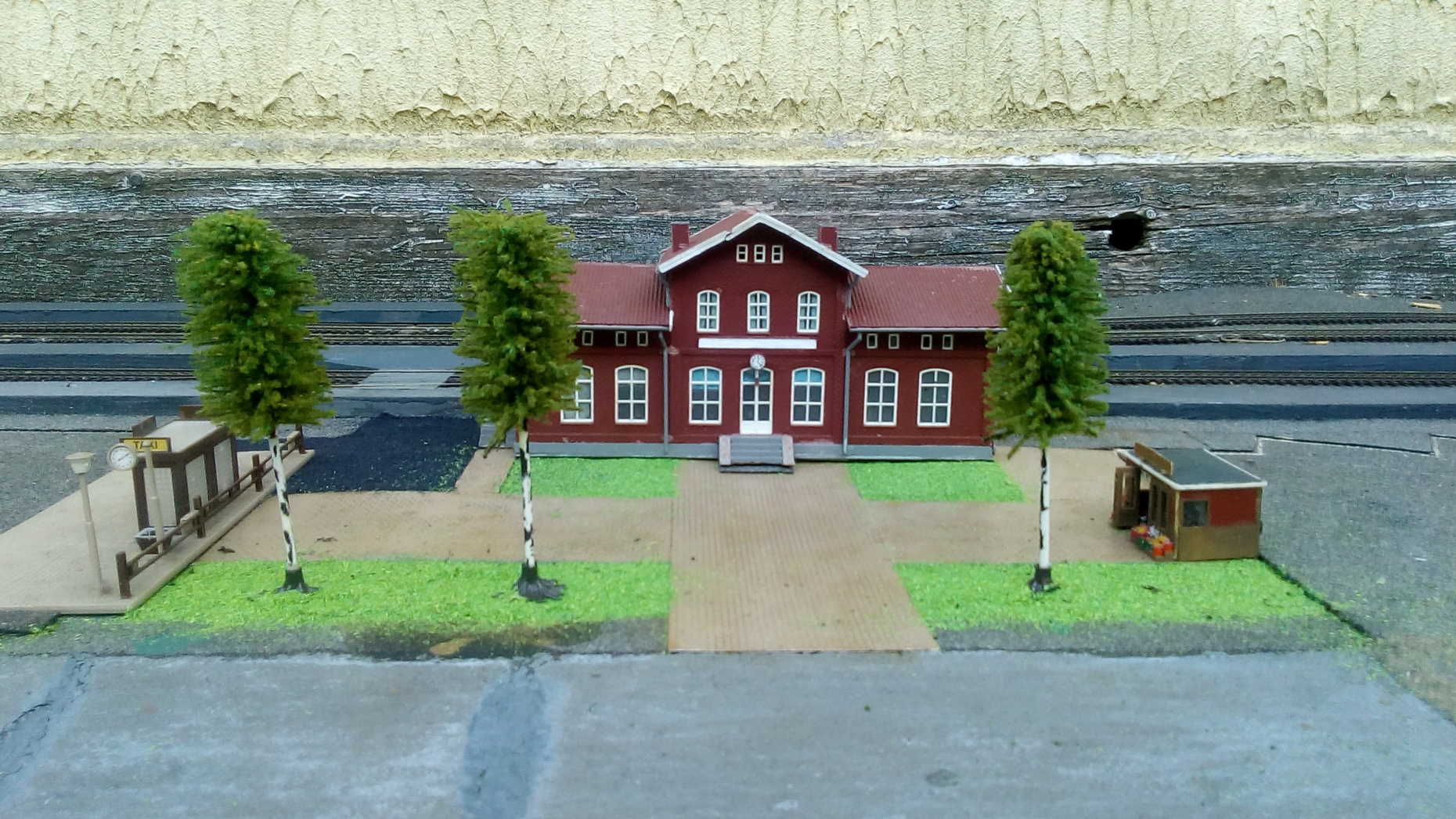
A lucky opportunity saw the purchase of a copy of the model that we have used at Lövhöjden station, Heljan’s model of Åmål station building. It is a good representation and very typically Swedish, but our model was very weather-beaten, and we had wanted to replace it for some time. Done!
The paved area, grass, trees, and more gave the entrance to Lövhöjden station building a nice atmosphere.
We have also used our spare time without a railway for research, and will clarify an irritation with certain wagons. We purchased a ‘Kbps’ last year, thinking it was the ‘missing one’, but in fact we had recorded one with a completely wrong number onto our database with the correct number as it should have been, with the intention that we would correct it later on. So, the duplicate will either be sold or renumbered completely. NMJ’s ‘Kbps’ wagons have either 335 or 370 as the fifth to seventh digits. 370 is completely wrong, it applies to the ‘Os’ wagon. Interestingly, the latest wagon has the usual incorrect UIC control check digit, but it would have been correct if NMJ had printed 335 instead of 370; so arguably it has the correct control digit, just a wrong wagon type number! Our duplicate wagon is article 602.107, but the one that we need is 602.106, which the advertising suggests also has the incorrect 370! It does seem a shame that after all the effort that NMJ went to, to produce these wagons, they failed at the last hurdle, in not getting the number right! (We have made a list of 24 of our wagons with incorrect control digits, and 15 of them — yes, more than half — are NMJ!)
The Kbis from NMJ comes in two slightly different versions, shewn here!
Manufacturer News
HNoll is increasingly frustrated with the Chinese production lines. It seems now that the A7/B7 carriages will not be produced before the Chinese New Year, and with the delivery schedules as they are, we may not see them this side of midsummer! As for the B4/BF4, photos of a prototype model have circulated on social media, but it would be foolish to make any estimates for a date to arrive into the shops! We certainly appreciate HNoll keeping us informed; we have quite a few on order, not just for the FLMJ, but for friends, also!
This is the time of year when there is a bit of a frenzy of announcements of newly proposed models. Here are the ones that we know about — obviously many of these new items are too modern for the FLMJ, but we thought maybe some of our readers would like to know about them!
An Rc4 in SJ blue with Green Cargo branding is proposed from Roco (a revised livery on a standard product).
A black liveried Rc6 is proposed from Märklin/Trix as a completely new model, digital, metal, and even gets heated mirrors!
The BR 185.2 is to come from two manufacturers, but different in detail. From Piko, it will be DB-AG red livery but branded for “Green Cargo”; and from Roco it will be in Green Cargo’s green livery (the 185.2 is the same as the ‘Re’, a TRAXX loco).
The Hector Rail G6 diesel loco (a very modern looking V5, in essence) is to be produced by Piko. As with many modern diesels, it is a standard European design, so it is easier (and cheaper) for the model manufacturer to produce than before.
A replacement motor for the NMJ Y1 and YF1 has been announced, using the Faulhaber 1624 with specially made flywheel, and a new engine mount from Winterzone. Construction description in Swedish is included. We are unsure of the producer of this ‘kit’ but hope to know more, soon.
Sadly, in order to give Märklin’s black Rc6 a train to pull, Märklin is also releasing a set of four black carriages of their standard 1960s designs, which is totally inauthentic as these carriages were withdrawn before the black livery was introduced!
The ‘DV30’ by Märklin is back in Epoch-IV condition. (If, unlike the previous one, it comes in a box that will accommodate a close-coupling head, then one could be procured for the FLMJ!)
The ‘Eaos’ wagon will also be produced by Märklin/Trix, in a set of three with a scrap load.
The ‘Sdggmrs’ articulated container wagon is to be released by Roco, labelled for DB-AG, but carrying two “Bode Spedition” containers.
A set comprising two ‘Zacns’ bogie tank wagons in “Pure Performance” (Green Cargo) livery is proposed from Roco.
Brawa does not produce Swedish models, but they are to produce the VTG Gigawood XXL, a non-Swedish timber wagon that is used by Hector Rail in Sweden, today. But it is not due until 2023.
Behind the Scenes
Mini-Series about the FLMJ, 2: Lövhöjden, Månstorp and Ålunden
Lövhöjden, representing the central area of Sweden, was naturally the centre point on the Railway. (At least it would have been, once the projection to Fjällnäs had been completed!) But it was designed to be a major station with several passing loops and three platforms, two of which were later split into halves by a crossover in the track. The control panel was designed so that the local controller could control the whole railway (well, maybe not the industrial sidings). Lövhöjden also had the most developed scenery, as much as we could manage given the weather damage (and cat damage)! Naturally, Lövhöjden became the most photographed location, and in the final days, the most was made of this. Even with forthcoming closure confirmed, development continued until the very last day.
A general view of Lövhöjden from 2011.
The main road through Lövhöjden, with grass embankments, pavements, trees; scenic details that the railway needed.
Månstorp, representing the southern area of Sweden, needed a more modern look, and the buildings could be more European in style. Unfortunately, it became very modern in respect of being truncated, losing passing loops and becoming just the essential layout for passing trains. This had become necessary due to the vulnerable location of the station; at the front of the garden, near the gate, where things could be ‘uplifted’ by unwholesome people! Nevertheless, we made the most of what little we could have here. The track sections were switched from Lövhöjden, and a CCTV overlooked the area. The crossover points here were the first to be remotely controlled. An almost amusing fact here is that the model cars on this area of the layout were of the ‘toy’ Eko brand; no great loss.
A nice model of Diö station building at Månstorp; but the road vehicles were vulnerable, so were of the lowest standard!
The modern black Rc-loco and train clash with the heritage railbus. This loco was probably the shortest-owned model on the FLMJ!
Ålunden was our shadow station. This was the encouraged location for placing models on the track and removing them. It gave the railway a sense of purpose; the trains arrived onto the FLMJ through a tunnel (hole in the wall) from anywhere on the SJ network. Ålunden therefore, determined the length of the trains, and the tracks would accommodate seven carriage trains (so they were seldom used to capacity). One track was set aside (by virtue of a point midway, and then a long curved section) for extra long goods trains. As a secondary line; longer passenger trains would be out of place.
Both Rc2 locos, an Ma and a Da, line up at Ålunden, ready for their next duties.
The shelf above the control panel stored empty stock boxes by day, and the model buildings by night!
Next month, we’ll look at the Siljansbanan and the areas that it served.
Ett lyckosamt tillfälle var att köpa ett exemplar av modellen som vi har använt på Lövhöjdens station, Heljans modell av Åmåls stationshus. Det är en bra representation och väldigt typiskt svenskt, men vår modell var väldigt väderbiten, och vi hade velat byta ut den ett tag. Gjort!
Vi har även använt vår fritid utan järnväg för forskning och ska reda ut ett problem med några vagnar. Vår nyaste “Kbps”-vagn är faktiskt en kopia av en som vi redan har! Numret är fel och vi har antecknat rätt nummer, med avsikt att ändra det som står på modellen. Så den här vagnen kommer antingen att säljas eller numreras om helt. NMJ:s “Kbps”-vagnar har antingen 335 eller 370 som femte till sjunde siffran. 370 är helt fel, det gäller ’Os’-vagnen. Faktum är att den senaste vagnen har den vanliga felaktiga kontrollsiffran för UIC-kontroll, men det hade varit korrekt om NMJ hade skrivit ut 335 istället för 370; så man kan hävda att den har rätt kontrollsiffra, bara fel vagnstypnummer! Vår dubblettvagn är artikel 602.107, men den vi behöver är 602.106, som reklam antyder också har den felaktiga 370! Det verkar synd att efter alla ansträngningar som NMJ gick till, för att producera dessa vagnar, misslyckades de vid det sista hindret, med att inte få rätt antal! (Vi har gjort en lista över 24 av våra vagnar med felaktiga kontrollsiffror, och 15 av dem – ja, mer än hälften – är gjorda av NMJ!)
Tillverkarens Nyheter
HNoll blir allt mer frustrerad över de kinesiska produktionslinjerna. Det verkar nu som att A7/B7-vagnarna inte kommer att tillverkas före midsommar! Vi uppskattar verkligen att HNoll håller oss informerade; vi har en hel del på beställning, inte bara för FLMJ, utan även för vänner!
Det här är tiden på året då många nya modeller tillkännages av tillverkarna; här är en sammanfattning, än så länge (de flesta är för moderna för FLMJ, men DU kanske skulle vilja veta ändå)…
¨ En Rc4 i SJ-blått med Green Cargo-märke föreslås från Roco (en reviderad färg på en standardprodukt).
¨ En Rc6 i svart föreslås från Märklin/Trix som en helt ny modell, digital, metall, och får äntligen uppvärmda speglar!
¨ En BR 185.2 ska komma från två tillverkare, men olika i detalj. Från Piko blir det DB-AG rött liv men märkt för “Green Cargo”; och från Roco kommer den att vara i Green Cargos gröna färg.
¨ Dieselloket Hector Rail G6 ska tillverkas av Piko. Som med många moderna dieslar är det en europeisk standarddesign, så det är lättare (och billigare) för modelltillverkaren att tillverka än tidigare.
¨ En ersättningsmotor för NMJ Y1 och YF1 har tillkännagivits, med Faulhaber 1624 med specialtillverkat svänghjul, och ett nytt motorfäste från Winterzone. Byggbeskrivning på svenska ingår. Vi är osäkra på tillverkaren av detta “kit” men hoppas att få veta mer snart.
¨ Tyvärr, för att ge Märklins svarta Rc6 ett tåg att dra, producera Märklin också en uppsättning av fyra svarta vagnar av deras standarddesign från 1960-talet, vilket är totalt oäkta eftersom dessa vagnar skrotades innan det svarta livret introducerades!
¨ ‘DV30’ av Märklin är tillbaka i Epoch-IV-skick.
¨ Även ‘Eaos’-vagnen kommer att tillverkas av Märklin/Trix, i ett set om tre, var och en lastad med skrot.
¨ ‘Sdggmrs’ ledade containervagn ska släppas av Roco, märkt för DB-AG, men med två “Bode Spedition”-containrar.
¨ Ett set bestående av två ‘Zacns’ boggivagnar i “Pure Performance” (Green Cargo)-liveri föreslås från Roco
¨ Brawa tillverkar inga svenska modeller, utan de ska tillverka VTG Gigawood XXL, en utländsk timmervagn som idag används av Hector Rail i Sverige. Men det kommer inte förrän 2023.
Vi hade turen att få två Roco ballastvagnar i en vanlig grå färg. De har samma specifikation som de gula, men inte lika starkt färgade! Tyvärr har en av dem ett nummer som duplicerar en av de dekalerade dubbletterna! Vi har dock kunnat beställa nya dekaler från en leverantör här i Sverige, så vi hoppas kunna leverera dem innan alltför lång tid. Samtidigt har leverantören gått med på att göra upp några dekaler för vår ‘frilansande’ Z69 så att den kan bära ett autentiskt nummer ganska snyggt. En framtida order kommer att vara att ersätta de målade numren som skulle ommärka de dubbla vagnarna (B7 5501, WL2 4477 och andra); och även senare överföringar för att omnumrera de många vagnarna som har felaktiga UIC-kontrollsiffror! Kolla på vår länksida för Byggsvenskt.nu om du också skulle vilja numrera om dina svenska modeller (och se allt annat som finns här — det är till exempel här vi har fått vårt X10-chassi ifrån)!
Tillverkarens Nyheter
SVLV (Skultorps Vagn & Lokverkstad) har tagit fram ett nytt motoriserat chassi till Perl/UGJ Y6 rälsbussarna. Motorn är av Faulhabertyp med svänghjul och kan anpassas till analog eller digital. Den kostar 1 990 — 2 380 kr beroende på version.
Minichamps-bilarna som annonserades för december 2021 visas nu december 2022. Det är ingen förändring av de andra datumen; Volvo 240-modeller väntas i januari och Saab 900-modeller i februari. Skärmbilderna (i de engelska nyheterna) togs den 29 december.
Andra nyheter
Entusiaster av den svenska järnvägen, i Storbritannien verkar få goda nyheter. I ett inlägg på sociala medier från Wansford MPD (vid Nene Valley Railway) bekräftar de att ett av de två kommande loken för översyn kommer att vara den svenska B-klassen nummer 101, som för närvarande står som en statisk utställning på Wansford station. (En tidigare nyhetsartikel från en annan källa sa att den svenska S-klassen nummer 1178 skulle återställas. Enligt vår egen undersökning är 1178 i mycket sämre skick och dess restaurering kommer sannolikt endast att vara kosmetisk. Men det behöver inte ta slut där, 101 har varit föremål för kosmetisk restaurering, och nu går det vidare därifrån…!) 101 började sitt liv som SWB A2 101. Den tillverkades av Nydqvist & Holm AB – Bofors-Nohab AB, Trollhättan, Sverige 1944; Tillverkningsnummer 2082. 1945 blev det SJ B 1697. Detta förklarar varför nummerskyltarna på hyttens sidor deklarerar att 101 är en klass A. Den målades alltid svart i svensk tjänst, men den brittiska allmänheten gillar lite mer färg, så flera av NVR:s kontinentala lok är oäkta målade; 101 är en ljusblå!
Vi har startat en miniserie om originalet FLMJ i England. Tyvärr är detta för mycket för oss att översätta här. All framtida järnvägsverksamhet kommer givetvis att vara tvåspråkig; kanske också en bok om järnvägen, om vi kan hitta ett lämpligt förlag som kan övervaka översättningarna.
We were fortunate to acquire two Roco ballast wagons in a plain grey livery. They are the same specification as the yellow ones, but not as brightly coloured! Unfortunately, one of them has a number duplicating one of the decaled duplicates! However, we have been able to order new decals from a supplier here in Sweden, so we hope to be able to supply them before too long. At the same time, the supplier has agreed to make up some decals for our ‘freelance’ Z69 so that it can carry an authentic number quite neatly. A future order will be to replace the painted numbers that were to relabel the duplicate carriages (B7 5501, WL2 4477, and others); and even later transfers to renumber the many wagons that have incorrect UIC control digits! Check on our links page for Byggsvenskt.nu if you would also like to renumber your Swedish models (and see all the other things that are available here — this is, for example, where we got our X10 chassis from)!
Grey ‘Qbd’ wagons, exactly like the bright yellow ones in all other respects.
Roco’s Z66 000; to become Z69 659.
Manufacturer News
SVLV (Skultorps Vagn & Lokverkstad) has produced a new motorised chassis for the Perl/UGJ Y6 railbuses. The motor is of the Faulhabertyp with flywheel and can be suited to Analogue or digital. It costs SEK 1 990 — 2 380 according to version. (Divide by 11 to get vague GBP amount!)
The Minichamps cars that were advertised for December 2021 are now shewing December 2022. There is no change to the other dates; Volvo 240 models are expected in January and Saab 900 models in February. The screenshots were taken December 29th.
The motorised chassis from SVLV for the Y6 series railbuses; models from Perl and UGJ.
Volvo 240GL Sedan and Estate models, expected from Minichamps 1.2022.
Saab 900 Cabriolet and Coupé models, expected from Minichamps 2.2022.
Other News
Enthusiasts of the Swedish railways, in the UK seem to be in for some good news. In a social media post from the Wansford MPD (at the Nene Valley Railway), they confirm that one of the next two locos in for overhaul will be the Swedish B class number 101, which presently stands as a static exhibit at Wansford station. (An earlier news article from another source said that the Swedish S class number 1178 was to be restored. From our own investigation, 1178 is in much poorer condition and its restoration is likely to be cosmetic only. But it doesn’t have to end there; 101 has been the subject of cosmetic restoration, and now it’s moving on from there…!) 101 started life as SWB A2 101. It was manufactured by Nydqvist & Holm AB – Bofors-Nohab AB, Trollhättan, Sweden in 1944; Manufacturing number 2082. In 1945 it became SJ B 1697. This explains why the number plates on the cab sides declare that 101 is a class A. It was always painted black in Swedish service, but the British public like a bit more colour, so several of the NVR’s continental locos are painted inauthentically; 101 is a light blue!
SWB A2 101, aka SJ B 1697; but conveniently referred to as SJ B 101; at the Nene Valley Railway [media photo].
Various pages on this website have been updated; can you find them all?
Behind the Scenes
Over the next twelve updates/months, we are going to run a small series of articles; too small to really take up space on the other pages of this website; about what the FLMJ was really about. We’ll look at a number of topics that made the FLMJ what it was, starting now, with a look at the absolute basic representation.
Mini-Series about the FLMJ, 1: The Diorama
Although the FLMJ replaced the KRBJ, the name is irrelevant with regards to the development of the garden railway. Over the entire 30 year history in the UK, improvements and refinements were continual until what we can now consider the final phase of the UK based set-up, with which we were very happy. We started with only a vague idea, which had many limitations. A simpler layout comprising a figure-of-eight inside a circuit was akin to a train set, which is not what we wanted. With the delivery of a new Park Home, we had to start all over again; and the plan for an end-to-end layout with a subtle branch line to make a circuit turned out to be the answer. It went through a few changes in terms of track layouts, but the final arrangement was absolutely ideal.
The route started from Ålunden, our fiddle yard (or ‘shadow station’ in Swedish terminology) in the shed. The main line then went around three sides of the home, before turning 180° the other way to go along the back perimeter to a final 90° turn to the terminus. The subtle branch line completed the circuit around the home. The home had been given the name, “Siljan”, so the line closing the circuit became the “Siljansbanan”.
The names were chosen to reflect the north (Fjällnäs), central (Lövhöjden) and south (Månstorp) areas of Sweden; with the great idea that the scenery would reflect those areas (all trains would work over the entire railway). However, the scenery had to be compromised in the outdoor environment; which was always a disappointment. Other names crept in. We needed a name for a halt between central and north, so Gärde was chosen. A town nearby would be called ‘Gärdestad’, which also happened to be the name of a favourite musician, who sadly passed away at the time that the name was chosen, so we have kept it ever since. Toraberg, also marking a bereavement, was the name of the house built by a friend in Sweden. But Kopparberg and Arjeplog were chosen in respect of a Harry Potter connection; deliberately subtle because not everyone would appreciate that character or creation. (In the ‘supporting book’, “Quidditch through the Ages”, reference is made to the Annual Broom Race of Sweden, which dates from the 10th Century, and goes from Kopparberg to Arjeplog. It is said that the race passes over a dragon enclosure, but we didn’t need to model that because non-magical people cannot see it!)
In the final years of the operational FLMJ, we had a track plan that worked well. There was consistency with the train services and formations; and timings. Authentically, most (passenger) trains operated to a two hourly timetable, and the goods trains worked around them. But the timetable was so well written that there were brief periods of absolute inactivity; at exactly the right times for Fika and Lunch breaks! Furthermore, it was possible to operate the basic timetable by one person, or by a group of people operating an ‘enhanced service’. The feel-good factor was very strong.
Next month we will consider the three primary locations, Lövhöjden, Månstorp and Ålunden.
En löpande kommentar av nya modeller är inte riktigt vad vi ville med den här webbplatsen, inte ens i den nuvarande situationen. Det får det att verka som om vi samlar tåg. Vi är inte samlare, vi är modellerare. Så vi kommer att undvika den typen av nyheter, förutom när det finns något extra speciellt att meddela.
Det finns dock några nyheter som passar här den här månaden. Först har vi från Byggsvenskt erhållit ett nytt chassi till en av våra X10-enheter, nummer 3149. Detta är ett tungt och kraftfullt drivsystem för modellen, och det kommer att vara perfekt kapabelt att arbeta med fyra vagnståg (så X10 3148 kommer att inte drivas alls). För det andra, och från samma leverantör, har vi fått de dekaler som krävs för Yd railbus och båda släpvagnarna, UF2 och UF6. Leverantören har också gått med på att göra speciellt några dekaler för UGJ F4F-bagagevagnen som har fel nummer. De enda nummer som verkar finnas tillgängliga som dekaler är för F4F som hade kontoret i ena änden av vagnen, inte de få där kontoret låg i mitten. Gissa vilken version vi har!
Vi har också skaffat några intressanta vägfordon. Två Volvo Amazoner och en PV544 (den sista med husvagn) är Wiking-modeller, inte Brekina eller Praliné/Busch. Så de duplicerar inte det vi redan har (i lager), men de ger oss något att använda för ett diorama om vi kan få ett byggt! Bussarna är egentligen för moderna för vår epok; men dessa är verkligen för en privat samling, en känsla av nostalgi kring de senaste 30 åren som turist till Stockholm; så även om de kan dyka upp på FLMJ då och då, är det mer sannolikt att de kommer att användas på ett separat statiskt diorama! “Checker-cab” respekterar att många svenskar importerar och restaurerar gamla amerikanska bilar, och det här är en klassiker!
Tillverkarens Nyheter:
HNoll meddelar att nästa passagerarvagnar (B4) sannolikt kommer att dyka upp i mars-maj, beroende på fraktalternativ. Vissa vagntyper är nu slutsålda hos leverantören och BC4, WL4, WL6 och R4/R12/S12 är ett avslutat kapitel, med förbehåll för eventuella återstående lager hos återförsäljare. En liten serie bruna R4 kommer dock att tillverkas efter behov, och RB11 i Blue-X/IC-11 kommer att kompletteras om det inte finns tillräckligt med vid releasen av A11 och B11.
PCX87 har annonserat fyra nya versioner (färgalternativ) av sin Saab 99, men av större spänning, en ny modell, Volvo 164, i 1968 års skick; igen, i fyra färger. För många år sedan gjorde Kniga Modelle ett byggsats av 1973 års version av denna bil (varav vi har satt ihop tre), så det ska bli trevligt att ha en (eller flera) färdiggjorda!
Det finns få nyheter om Minichamps föreslagna modeller. Under december väntas Volvo 480 coupé, 740 kombi och 850 sedan. Deras Volvo 240 (sedan och kombi) väntas i januari och båda Saab 900-versionerna i februari. Men Volvo 740 sedan har lagts tillbaka till september 2022.
Andra nyheter:
Modelljärnvägsmässa i Uppsala den 13/14 november besöktes på söndagen och ägde rum i bara en sal, trots att det stod ”Fyrishov Hall C & D” i reklam. Faktum är att de två ganska små salarna kan öppnas upp till en större hall. Där hade Upplands MJ sin moduluppbyggnad som innehöll en modell av Uppsala station innan den modifierades. Även om detta är ett pågående arbete, var det verkligen inspirerande, och det skulle vara intressant att se framstegen vid nästa års evenemang – de hoppas att det kan bli ett årligt evenemang. Eftersom de var en DCC-layout verkade de tillbringa mycket tid med att pilla med det, för att försöka få saker att fungera, men inte allmänt; det var mycket aktivitet och några trevliga tåg att beundra. Utöver detta fanns det några tågset för barn att leka med, och en hel del handlare – varav de flesta hade lagerlass med Märklin-produkter. Det var ganska uppfriskande att hitta ett stall med några andra märken! En vagn köptes, men inget annat!
Hjulmarknaden i Solna den 27 november var precis så stor och imponerande som den brukar vara. Avbröts förra året på grund av pandemin, det var bra för detta evenemang att vara tillbaka. Detta är inte en modelljärnvägsutställning, och även om det visades en liten layout i H0-skala och ett live-ångspår, var evenemanget verkligen en sammankomst av järnvägsmodelltillverkare och historiska järnvägsgrupper. För FLMJ är det här vi köpte chassit och dekalerna. Forskning och referensmaterial begränsades till två böcker och två DVD-skivor. Ett missöde var en handlare som hade några lokalt producerade modeller av postbilen ’Kalmar Tjorven’, men bad oss komma tillbaka för att se rätt person som kunde acceptera en icke-kontant betalning, och sedan lagom distraherad glömde vi! Resan till och från evenemanget skedde med Uppsala—Stockholm Pendel, men det var en besvikelse att både ut- och hemfärder skedde i moderna X40-tåg, inte de gynnade 1980-talsvagnarna toppade och svansade med Rc-lok! Den här resan blev nästan inte av eftersom SJs app inte fungerade som den ska och istället användes en alternativ onlineprocess som faktiskt gav billigare biljetter. Så vi klagar inte på att SJs app inte fungerar; dess misslyckande gjorde oss en tjänst!
A running commentary of new models is not really what we wanted with this website, even in the current situation. It makes it seem as if we’re collecting trains. We’re not collectors, we’re modellers. So, we are going to steer away from that sort of news, except when there is something extra special to announce. (Also, we try to avoid buying models in November! This is because their annual service is based on the month in which they were delivered, and November has traditionally been a ‘purchase’ month. Once we’re back into the regular schedules, we have a lot of work to do every November! Once the new FLMJ is functional, we will investigate a different schedule.) There are a few items of news that are suitable here, this month, however. First, we have obtained from Byggsvenskt, a new chassis for one of our X10 units, number 3149. This is a heavy and powerful drive system for the model, and it will be perfectly capable of working the four coach train (so X10 3148 will not be powered at all). We actually arranged for three drive-chassis units, the other two for friends of the former FLMJ who also have models of the X10 from UGJ. Secondly, and from the same supplier, we have obtained the decals required for the Yd railbus and both trailers, the UF2 and the UF6. The supplier has also agreed to make especially, some decals for the UGJ F4F baggage carriage which has the wrong number. The only numbers that seem to be available as decals are for the F4F which had the office at the end of the carriage, not the few where the office was in the centre. Guess which version ours is!
The new chassis for our X10(A) 3149; a bit more substantial than the current Tenshodo ‘spud’!
Decals for the Yd railbus and both trailers UF2/UF6.
We’ve also acquired some interesting road vehicles which are worth a mention. Two Volvo Amazons and a PV544 (the last with a caravan) are Wiking models, not Brekina or Praliné/Busch. So they do not duplicate what we already have (in storage), but they give us something to use for a diorama if we can get one built! The buses are really too modern for our epoch; but these are really for a private collection, a sense of nostalgia relating to the last 30 years as a tourist to Stockholm; so although they might appear on the FLMJ from time to time, they are more likely to be used on a separate static diorama! The Checker cab respects the fact that many Swedes import and restore old American cars, and this is a classic!
Two Volvo Amazons and a Volvo PV544 with a vintage caravan; all Wiking models.
Three new Stockholm buses for a private collection, but really a bit modern for the FLMJ!
As iconic in New York as the Austin FX was in London; something for the heritage scenery!
Manufacturer News
HNoll advises that the next passenger carriages (B4) are likely to appear in March-May, depending on shipping options. Some carriage types are completely finished with the supplier and the BC4, WL4, WL6 and R4/R12/S12 are a closed chapter, subject to any remaining stocks with retailers. However, a small series of brown R4s will be manufactured as demand allows, and the RB11 in Blue-X/IC-11 will be supplemented if there are not enough at the release of the A11 and B11.
PCX87 has announced four new versions (colour options) of their Saab 99, but of greater excitement, a new model, the Volvo 164, in 1968 condition; again, in four colours. Many years ago Kniga Modelle made a kit of the 1973 version of this car (of which we have assembled three), so it will be nice to have one (or more) ready made!
Promotional picture for one of the proposed Volvo 164 models from PCX87!
The Kniga Modelle Volvo 164, (two of our three built from kits,) representing a later version.
There is little news regarding Minichamps’ proposed models. Expected during December are the Volvo 480 coupé, 740 estate, and 850 sedan. Their Volvo 240 (sedan and estate) is expected in January and both of the Saab 900 versions in February. But, the Volvo 740 sedan has been put back to September 2022.
Other News
The Modelljärnvägsmässa in Uppsala on November 13th/14th was attended on the Sunday, and took place in just one hall, even though the advertising said, “Fyrishov Hall C & D”. The fact is that the two rather small halls can be opened up to make one larger hall. Upplands MJ had their modular layout there, which incorporated a model of Uppsala station before it was modified. Whilst this is a work in progress, it was certainly inspiring, and it would be interesting to see the progress at next year’s show – they are hoping that it can become an annual event. Being a DCC layout, they seemed to spend a lot of time fiddling with it, trying to get things to work, but not universally; there was plenty of activity and some nice train rakes to admire. In addition to this, there were some train sets for children to play with, and quite a lot of traders – most of whom had stock-loads of Märklin products. It was quite refreshing to find a stall with some other brands! One wagon was purchased, but nothing else!
A model depicting Uppsala – as it was – seen at the event at Uppsala.
Hjulmarknaden in Solna on November 27th was just as big and impressive as it usually is. Cancelled last year due to the pandemic, it was good for this event to be back. This is not a model railway exhibition, and although there was one small H0-scale layout on display and a live steam track, the event was really a gathering of railway model manufacturers, and heritage railway groups. For the FLMJ, this is where we purchased the chassis and decals. Research and reference material was limited to two books and two DVDs. One mishap was a trader who had some locally produced models of the ‘Kalmar Tjorven’ post car, but asked us to come back to see the right person who could accept a non-cash payment, and then suitably distracted, we forgot! Travel to and from the event was with the Uppsala—Stockholm Pendel, but it was disappointing that both outward and homeward journeys were in modern X40 units, not the favoured 1980s carriages topped and tailed with Rc-locomotives! This journey almost didn’t happen because SJ’s App didn’t function properly and an alternative online process was used instead, which actually produced cheaper tickets. So, we’re not complaining about SJ’s App not working; its failure did us a favour!
SJ’s X2000 is to run for many more years yet, with the first having just received a major overhaul and minor facelift; it still has an unimaginative livery, but some sort of effort has been made! It does now have a third level of comfort, the Second Class Calm, where you pay extra to have a so-called “quiet carriage”!
A dark grey cab identifies the refurbished X2000, the camouflage cab is a temporary cover, so we’re told!
Symbol for the Quiet Carriage on X2000 for which a supplement is payable!
Tre Rivarossi-vagnar anlände (som en förpackning) av typen ‘Gbs‘, förutom att två av dem är märkta och numrerade pre-UIC, som typ ‘Gre‘. Dessa är de före detta Lima-vagnarna, övertagna av Hornby, och sålda vidare under varumärket Rivarossi. Varför två olika epoker dyker upp i en uppsättning är något bara Hornby kan svara på. Ändå är de ett speciellt set, så vi ville inte missa möjligheten att skaffa dem, även om de är vittrade – något som vi brukar försöka undvika på FLMJ. Inte rullande materiel, men åtminstone modellmaterial. Två byggnader förvärvades via Tradera. Det ena är ett annat exemplar av det vanliga Pola svenska huset, men bilden på kartongen antydde att det var en annan version. Det är inte säljarens fel att det inte är det, snarare Polas fel! Men det här är ingen besvikelse, och monteringen ska ske snart, Den andra är lite mer generisk, men ganska typisk för ett hus i Sverige (och ett som vi inte redan har), så det blir lika intressant.
Tillverkarens Nyheter:
HNoll rapporterar om ytterligare produktionsproblem i Kina, och det är osannolikt att vi kommer att se några fler nya modeller före 2022. Tågkompaniet och Connex sovvagnar och liggvagnar har sålt väldigt bra, men ändå inte tillräckligt för att motivera att göra fler med olika nummer på! Brekina har tillverkat Daf 66 kombi i ett urval av färger. Det innebär att både Daf 66 och Volvo 66 finns som sedan och kombi. Wiking har tillverkat Volvo 850 kombi i metallisk kopparfärg. Vi undrade hur äkta den här färgen är på den här modellen, och den närmaste 1:1-versionen som vi kunde hitta på en ganska grundlig internetsökning, fanns på den här bilden (se nyheterna på engelska) från Polen! Denna modell är fortfarande Wikings modernaste Volvo. Winterzone (https://shop.winterzone.se/index.php?) släpper ständigt nya varor i sitt 3D-printade sortiment. Av särskilt intresse för järnvägsscenen är de lösa luftintagen och hyttväggarna att montera på NMJ:s Y1 och YF1. Se deras katalog på hemsidan. Andra föremål av intresse är en sandlåda, parkbänkar, trafikkoner och andra körfältsmarkörer, kabeltrummor, infartsbarriärer, pallar, olika typer av behållare och återvinningscontainrar, korvkiosk, plattformsställverk (nästa epok upp från TeknoBygg; se bild), diverse säten att sätta i modeller som saknar inredning, o.s.v.!
Andra nyheter:
MJ-Hobby hade ett speciellt evenemang i början av månaden, där, inne i butiken, all radiostyrd modellering flyttades bort för att ge plats åt en modulär modelljärnvägslayout och ett par andra utställningar; och lättare förtäring serverades från ett tält utanför butiken. Detta arrangerades istället för en full utställning eftersom det här är en hektisk tid på året för sådana evenemang och för mycket konkurrens! Butiken verkade mycket upptagen på dagen, men inga köp gjordes på uppdrag av FLMJ.
Three Rivarossi wagons arrived (as a boxed set) of type ‘Gbs’, except that two of them are labelled and numbered pre-UIC, as type ‘Gre’. These are the former Lima wagons, taken over by Hornby, and resold under the Rivarossi brand. Quite why two different epochs appear in one set is something only Hornby can answer. Nevertheless, they are a special set, so we didn’t want to miss the opportunity to obtain them, even though they are weathered – something that we usually try to avoid at the FLMJ. Not rolling stock, but modelling material at least. Two buildings were acquired via Tradera. One is another copy of the standard Pola Swedish house, but the picture on the box suggested that it was a different version. It is not the seller’s fault that it isn’t, rather Pola’s fault! But this is not a disappointment, and it’s assembly shall take place soon, The other is a little more generic, but quite typical for a house in Sweden (and one that we do not already have), so that will be just as interesting.
The former Lima Gbs was sold in a set by Rivarossi/Hornby.
Two kits from Tradera; to be built.
Manufacturer News
HNoll reports that production problems continue in China; now a lack of electricity means that future deliveries will be delayed. It is not possible to say with any certainty when any carriages can be delivered. HNoll says that we have to be realistic and count on delivery not before 2022. Revenues from these products will therefore be delayed, which affects the models planned for 2022. It is very sad that this is happening and nothing can be influenced. The only positive right now is that HNoll can spend even more time on details during the design stage for future models. Tågkompaniet and Connex sleeper and couchette carriages have sold so well that they have made a profit. The series has been produced in 120 copies of each model. However, there are still too few sold to justify a continuation with more running numbers, which will be a disappointment to people wanting to create scale length trains. No more will be manufactured in this series. However, the remaining carriages in the TKAB and Connex series will still be manufactured. Brekina has, not by surprise, issued the Daf 66 kombi in a selection of colours. This means that both Daf 66 and Volvo 66 are available as sedans and kombis. Wiking has released the Volvo 850 kombi in a metallic copper colour. We wondered how authentic this colour is on this model, and the nearest 1:1 version that we could find on a rather thorough internet search, was in this picture from Poland! This model remains Wiking’s most modern Volvo.
The ’66’ as a Daf kombi, from Brekina
Wiking Volvo 850 in Copper colour
A Polish registered Volvo 850 kombi in copper, but darker than the Wiking model.
Winterzone (https://shop.winterzone.se/index.php?) is constantly releasing new items in its 3D-printed range. Of particular interest for the railway scene, are the loose air intakes and cab walls to mount on NMJ’s Y1 and YF1. See their catalogue on the website. Other items of interest are a gritting sandbox, park benches, traffic cones and other lane markers, cable drums, entry barriers, pallets, assorted types of skips and recycling containers, sausage kiosk, platform switchgear (the next epoch up from the TeknoBygg one; see image), assorted seats to put in models that have no interior fittings, and so on!
The Winterzone air intake unit on the NMJ Y1.
Platform Switchgear from Winterzone
Other News
MJ-Hobby had a special event at the beginning of the month, where, inside the shop, all of the Radio Controlled modelling was moved away to make room for a modular model railway layout and a couple of other displays; and light refreshments were served from a tent outside the store. This was arranged instead of a full exhibition as this is a busy time of year for such events, and too much competition! The store seemed very busy on the day, but no purchases were made on behalf of the FLMJ.