Arbetet med konstruktionen av T45-modellen har återupptagits. Motorn och boggierna har anlänt och dessa har monterats och testats. Elektriskt finns det tillfälliga anslutningar ifall det skulle bli behov av att ta bort komponenter!
Det lilla diorama som vi tänker bygga snart kommer förmodligen att heta “Odensala Prästgård”, men det får vänta eftersom pengar har lagts på en välbehövlig bil i skala 1:1!
Tillverkarens Nyheter
I en färsk uppdatering från HNoll skriver de att en leverans förväntas med båt från Kina om 2-3 månader, men inte inklusive A11/B11-vagnarna (vi är inte säkra på vad som ingår). Men det kommer några fler restaurang-, ligg- och sovvagnar, några med nya nummer.
Andra intressanta nyheter
En rundtur på några platser av intresse för järnvägen har sammanfattats i våra engelska nyheter, men en större recension planeras för denna webbplats senare i år. Bilderna är från alla platser som vi besökt; Nynäshamns Järnvägsmuseum, LennaKatten, Modeljärnvägenshus, Föreningen Sörmlands VeteranJärnväg, Grängesbergbanornas Järnvägsmuseum, Hallsbergs Modelljärnvägsförening (och så Hallsbergs stationsmiljö för att ta många bilder på passerande tåg), Nora Bergslags Veteran-Jernväg, och “Miniature Kingdom” vid Kungsör.
Work has started on the second significant phase of the construction of the T45 diesel locomotive. This is the fitting of the motor, wheels, and complete drive-gear. The start of this work was reasonably straight forward. With the temporary ‘accommodation bogies’ removed, the new ones (from SV&LV – Skultorps Vagn & LokVerkstad) fitted perfectly into place; but it was a very fiddly job to fit the securing nut on each bogie, due to being difficult to access, and having very fine threads! The motor is a tight squeeze into the recess specially made for it, but there is no means of securing it. It might not need securing; testing at a later date will confirm one way or the other. Between the motor and each bogie there is a prop shaft (cardan shaft), and everything turns freely. Electrically, we decided that it would be wise to be able to remove components if the need arises, but lacking any plug couplers, the pairs of cables from the motor and each bogie were soldered to a contact strip that we glued onto the chassis (instead of soldering it all together directly). Then we reassembled the model and found that the chassis still bows slightly, so we will make up new securing points at each end, which we will use with two more M2 screws. Unfortunately, some of the more cosmetic components for the loco have been left behind in the storage facility, so these will be procured at a later date. With the absence of the full workshop facility, it should not be considered bad that the work described above took 4¾ hours. A week or so later (17th July), the loco was tested on a track with controller, with pleasing results. Clearly, it will need running in, but just to see it move a short distance under proper power was a great boost to the morale.
The T45 (without body) is seen with the motor and bogies fitted, along with cabling.
Odensala Prästgård is the name of our temporary diorama. There is the mainline between Märsta and Knivsta quite close to the temporary lodgings, and there used to be a station at Odensala, many years ago. So, the idea is to expand on the idea of a siding being retained, leading to a small area with just a few tracks for maintenance and other things; also giving us good photography opportunities! With the purchase of a new car (in 1:1 scale) draining funds, construction has been delayed slightly, but the T45 (see above) is keeping us busy!
Manufacturer News
In a recent update from HNoll, they write that a delivery is expected by boat from China in 2-3 months, but not including the A11/B11 carriages (we’re not sure what is included). But there will be a few more restaurant, couchette and sleeper carriages, some with new numbers.
Other News
As hinted last month, the summer tour of railway establishments actually started in June. Participants numbered from 1 to 8 depending on venue.
A typical Q12 tank-wagon at Nynäshamns Järnvägsmuseum.
We started at Nynäshamns Järnvägsmuseum, adjacent to Nynäs Gård station. This is a small museum and a bit too cramped, so photo opportunities were poor. But it has the usual hands-on policy, so we were able to look in every nook and cranny wherever our fancy took us. Naturally, this included the cab of E class 1189.
A few days later, we went to the Uppsala Lenna Järnväg (known also as the LennaKatten). Of the three trains in service, only one was steam-hauled, so that was our choice. A diesel hauled train was available, as was a diesel railbus train. After such a long time since last riding behind a steam loco, advantage was taken of the end platform on the leading carriage, and a delightful experience it was.
891mm gauge steam loco 5 “Thor” at Faringe on the LennaKatten.
One of the smaller dioramas at Söderby/Alunda. (Reflections due to layout screens!)
On the following day, we went to the permanent Model Railway Exhibition at Söderby/Alunda. This is a collection of model railways and train sets, mostly H0, but not entirely, and aimed more at the family audience than the true railway modeller. Interesting, but unlikely to revisit.
After a day’s rest, we went to Oxelösund, the “O” in TGOJ, to visit the FSVJ (Föreningen Sörmlands VeteranJärnväg) there. As with the museum at Nynäshamn, this is a static museum, and we were able to look over, among other things, a Ma-loco of the TGOJ variety, two of the four 1950s TGOJ carriages (the other two were present, but closed), and their former conference carriage (which started out as one of SJ’s first two restaurant carriages in 1929), where a Fika was enjoyed! Returning from Oxelösund, an unplanned detour was made to Läggesta for a ride on the ÖSlJ, with a steam loco, to Mariefred and back!
TGOJ S3 1001, built 1929 for SJ; a restaurant carriage, but used by TGOJ as a conference carriage.
600mm gauge ÖSlJ loco 5 “Hamra” at Läggesta. SJ main line on bridge in the background.
The TGOJ roundhouse at Grängesberg; barely visible is the Volvo inspection car (rightmost shed).
After another day’s rest we went on a tour that included three nights in B+B (at Örebro). The first of these four days was at Grängesberg, the “G” in TGOJ. Here, we saw some of the items modelled at the FLMJ; carriages type BCo7, Co8f, F5; and the Volvo rail-car. Whilst a few nicely restored items are kept under cover in the roundhouse, too many artefacts are rotting away outside in the elements, and we can understand why some items (the 1950s carriages, for example) have been removed from here.
The second day was at Hallsberg, “Hallsbergs Modelljärnvägsförening”; a significant model railway layout, open to the public, adjoining the Bergöövåningen exhibition. The main feature of the layout is the diorama of Hallsberg’s station, both the railway and the environment around it; and all of the local buildings have been faithfully recreated in miniature. Afterwards, back to the 1:1 scale Hallsberg station for a few hours taking photographs, mostly goods trains, headed by Rc-locomotives, including a former ÖBB version of the Rc2!
Hallsberg station in H0-scala, at Hallsberg!
Former ÖBB class 1043, identical to the SJ Rc2 (and built by ASEA), now in service in Sweden as class Rc2-ÖBB. Note different headlamp layout.
E2 1182 with an unusual grey boiler, at Nora.
The third day was at Nora and the overgrown line to Järle (where there was an exceptionally long turnover, despite there being nothing there). There is another line towards Pershyttan (which was not operating, it seemed). And that was about it. A good look around the yard was inspiring (to see some particular items) but also depressing (to see items in the process of being scrapped)! Travel was in a wooden planked carriage type Co4a-Å, coupled with two Norwegian carriages, both type B22 despite their many differences. Due to a special event taking place in Nora, the local fishing club decided it appropriate to charge for parking where it should have been free; but at 20kr, it wasn’t worth the fuss or argument!
The final day was at Miniature Kingdom at Kungsör. This is a Swedish equivalent of the Wunderland at Hamburg, but obviously smaller. But it is quite impressive. Like the FLMJ, it does not represent any particular area in exact detail; rather it shews a lot of Swedish landmarks, featuring elements from Stockholm, Norrland, Västerås, Örebro, and of course, Kungsör. The layout is still under development, but this does not detract from the enjoyment of the exhibit, it provides a good behind-the-scenes exhibit without actually going behind the scenes.
A short goods train on the layout at Miniature Kingdom, Kungsör.
A more thorough description of the staycation is being prepared for this website.
Behind the Scenes
Mini-Series about the FLMJ, 8: Epoch-IV
From inception, the FLMJ reflected the current Epoch. But gradually, the availability of models disappeared. A few modern goods wagons were being produced and locomotives were quite up to date. But with only 1980s carriages in use, and the models being very limited in range (and certainly no unit trains being available); the FLMJ was becoming less and less authentic. So, we stopped the clock and actually put it back to Epoch IV, which for us, represents the period through the 1970s and 1980s; but with a little late 60s and early 90s added. And this is in addition to “heritage” trains! Currently, this is a very comfortable decision to have made. We have a good selection of 1960s and 1980s carriages available now or proposed (though 1940s/1970s styles are lacking), and the Y1 and Y6 generation of railbuses are about right. We would be very happy for affordable models of the X9 to become available (at ‘average modeller’ prices), but otherwise all is well catered for. In this epoch, the carriages are brown (mostly), and locos are either brown or orange. Our most modern trains (just peeking into the 1990s) are the X2000 and Y2 (the latter still awaited, having parted with a terrible Heljan version); both in original liveries. It is also the period when the railway system and the trains were operated by railway companies, unlike most of the current operators who have interests elsewhere, and there was a greater sense of pride and identity. Indeed, the 150th anniversary of Stockholm’s Centralstation last year, was ignored completely because the organisations involved with the building today have no real interest in railways!
The modern black Rc-loco and train clash with the heritage railbus. This loco was probably the shortest-owned model on the FLMJ!
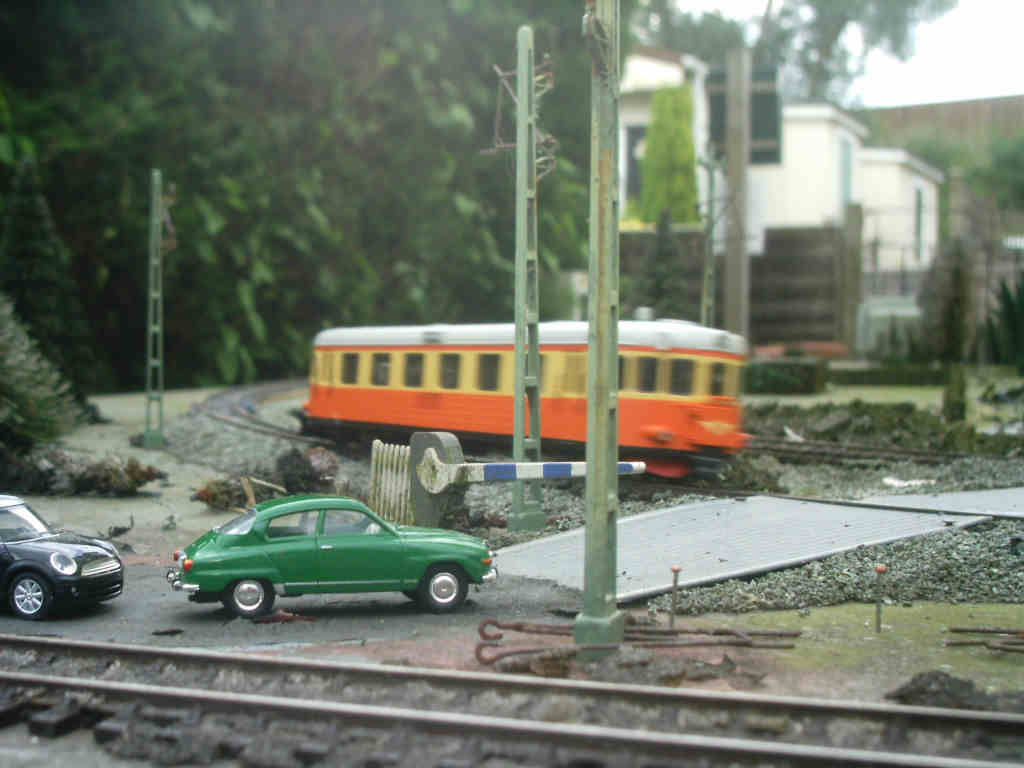
Y7 railbus passes over a level crossing just outside Lövhöjden.
In these images (above), a heritage Y7 railbus contrasts with a modern black Rc-loco; and whilst the green car in the other image is probably the same epoch, the front can be seen of a much more modern car!
Living in the current times, it can be difficult to not take an interest in some modern artefacts. Thankfully, this does not extend to the trains, but a few of the model buildings could perhaps be a bit too modern, as indeed are some of the cars and other road vehicles. To offer justification for this, it was decided that the FLMJ is a ‘heritage railway set in the current day’, so some of the modern items could creep in. And the local ‘kommun’ is said to be offering incentives to residents and businesses to respect the “heritage epoch”!
Next month, we’ll consider the scenery, or at least the scenic aspect of the railway.
Efter många diskussioner om ämnet med lokala vänner, är vi på väg att påbörja bygget av ett litet diorama som kommer att innehålla möjligheten att köra tåg. Det blir mindre än Köpingsvik, men inte den föreslagna Byxelkrok-dioraman, eftersom vi vill ha kontaktledning. Med två veckors semester borde vi kunna börja…
Tillverkarens Nyheter
Trots problemen i Kina har Dekas kunnat leverera ’Kö’/’Ugkkpp’-vagnarna. Den övergripande kvaliteten är upp till den standard som man tidigare haft med Dekas-modeller, och dessa var väl värda att vänta på. Tyvärr finns det två misstag, gemensamma för de danska tillverkarna: NEM-kopplingsfickorna är inte korrekt inställda så det finns risk för buffertlåsning; och alla fyra med UIC-nummer (som har kommit hit) har felaktiga ‘kontrollsiffror’!
Noch är ett namn som sällan förekommer här, men en av deras nyheter för i år är en nyhetskiosk, som förmodligen av en slump ser väldigt lik kioskerna utanför Skansen; artikel 14320.
Andra intressanta nyheter
Den svenska midsommaren är ett tillfälle att inventera övergången så här långt, och med ett par veckor semester från jobbet planeras en del intensiv forskning ungefär när denna uppdatering går live! Så vi kommer att ha mer om detta nästa gång.
After many discussions on the subject with local friends, we are about to embark on the construction of a small diorama that will include the possibility to run trains. It will be smaller than Köpingsvik, but not the proposed Byxelkrok layout, because we want overhead cabling. With two weeks vacation, we should be able to make a start…
Manufacturer News
Despite the problems in China, Dekas has been able to deliver the ‘Kö’/‘Ugkkpp’ wagons. Overall quality is up the standards previously enjoyed with Dekas models, and these were well worth waiting for. Sadly, there are two mistakes, common to the Danish manufacturers: the NEM coupling pockets are not correctly set so there is a risk of buffer-locking; and all four with UIC numbers (which have arrived here,) have incorrect ‘control’ digits!
The Dekas Ugkkpp; a very fine model.
Notice the compressed buffer with these close-coupled ‘Ugkkpp’ wagons; brings a risk of buffer-locking!
All four (UIC) ‘Ugkkpp’ wagons.
Noch is a name that doesn’t often appear here, but one of their new items for this year is a news kiosk, which, probably by coincidence, looks very similar to the kiosks outside Skansen; article 14320.
Very similar to the kiosks at Skansen, this is the (new for 2022) news kiosk from Noch.
Other News
The Swedish midsummer is celebrated, it seems, with more vigour than Christmas! This seemed an opportunity to take stock of the transition so far, and with a couple of weeks booked off work, some intensive research is planned for about the time that this update goes live! So, we’ll have more on this, next time.
E 1189 on shed; we have a model of this loco!
The first of our outings has already occurred, and it was an opportunity to see (and climb aboard) E 1189, of which we have the Jeco model!
Behind the Scenes
Mini-Series about the FLMJ, 7: Signalling
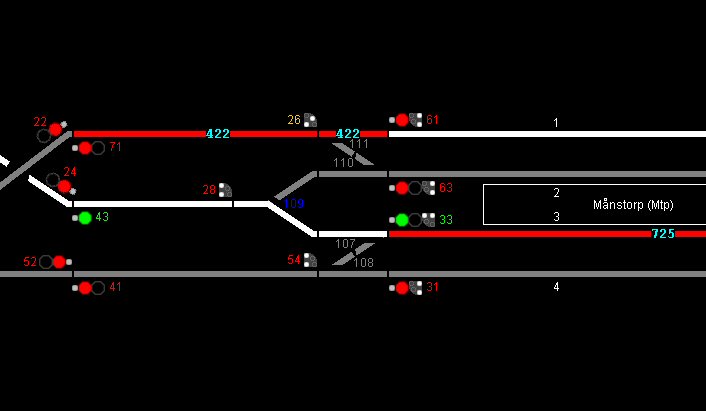
Last month, in our review of control systems we mentioned Signalling. As an Epoch-IV secondary line, we were blessed with a simple, yet effective signalling project. There was a time when the route from Ålunden to Lövhöjden was double track, and the whole railway was to be the subject of a CTC (Centralised Traffic Control) from a computer program. This had been developed by one of the team members, and it contributed nicely to him getting a university Degree. But, that is too modern and too ’busy’ for anything that we desire now.
A screenshot of the trial version of the CTC for the FLMJ.
First, here is a very simplified description of the development of Swedish signalling layouts.
The ’T’ semaphore signal would stand in the middle of the station and had an arm pointing both ways perpendicular to the track; the driver of an approaching train paid attention to the one pointing to the left. There was a board outside the station which the train must not pass if the arm is horizontal (at ’danger’). Often, the arm would be operated by a crank-handle at the base of the post. The station master would give a hand signal regarding permission to proceed from the station.
Then, the signals were moved to where the boards had stood, thus proper ’home’ signals. They were soon joined by ’starter’ signals for departures; but the station master would still give a hand signal within the station area to confirm that the starter signal had been cleared, and to which train (if there were several) the signal applied.
Now, all signals are given by fixed signals; except where radio block or other dubious systems have replaced them. And of course, they are colour light signals, now!
A so-called ‘T’-semaphore signal, seen here, at Jädraås
A single armed semaphore signal, somewhere along the Inlandsbanan.
A five-aspect signal at Solna, with a shunt signal below.
A so-called Dwarf signal at Gällivare.
For the FLMJ, given that it is a secondary route reflecting the Epoch-IV period (more about that next month), we are going for the ’home’ and ’starter’ signals (or ”Infartssignaler” and ”utfartssignaler” in Swedish) option. Maybe a small station on a branch line can have an historical ‘T’ semaphore (as we have one in stock and would like to use it)! But otherwise, colour light signalling would be appropriate. (Well, we always fancied the idea of semaphore at Fjällnäs; but we’ll see!)
Operationally, there are a few considerations that would help make this sort of system function well on a model railway. Very basic interlocking would be good for the starter signals at each end of each section. Using DC analogue for the trains, polarity in the track contributes to part of this interlocking. Home signals can give a few different proceed aspects according to line status ahead (so-called “Speed based signalling”), and this can be influenced by the setting of points, and to a lesser extent the setting of the track isolation switches.
A goods train arrives at Steninge, ‘Home signal’ out of view, but all were interlocked!
However, it would be pointless describing a proposed signalling system for any new railway, because the technicality of it is very involved, and it would be a waste of time to go into that sort of detail before we know what we have available. But the point is that it will be thorough, authentic and simple; and of course, interlocked!
Next month, we’ll look at “Epoch-IV” and what it means for the FLMJ.
Vårt lok T45 har tagits ur lager, redo för vidare arbete. I skrivande stund har en förfrågan gjorts för att skaffa de nödvändiga delarna för att göra den till en fungerande modell, men denna förfrågan inkluderar en begäran om NEM standardhjul istället för RP25; förhoppningsvis får vi en uppdatering om det nästa månad . (Det fanns en antydan om att skaffa ett drivkit (chassi) privat, men allt verkar ha blivit tyst på det.)
Den ‘saknade’ NMJ ‘Kbps’-vagnen anlände i maj och det var glädjande att notera att numret har korrigerats (typ 335 istället för 370), och därmed är kontrollsiffran (‘4’) korrekt!
Tillverkarens Nyheter:
I de senaste nyheterna från HNoll verkar leveransen av nästa vagnar ha lagts tillbaka till efter sommaren! Förseningen har haft en förutsägbar effekt på finansieringen med betydligt högre kostnader för räntor som leder till högre produktionskostnader på framtida modeller än förväntat. Verksamheten bygger på lån. Man hade hoppats att HNoll nu skulle vara i en situation där framtida modeller till stor del kunde utvecklas med eget kapital. De är långt därifrån på grund av förseningarna.
Märklin/Trix har tillsammans gett ut respektive versioner av det danska Litra E-loket (3-räls från Märklin, 2-räls från Trix), för att hjälpa till att fira ett stort danskt järnvägsjubileum! Medan alla de svenska “F”-ångloken blev klass “E” i Danmark (efter att ha sålts till DSB), byggdes många fler på licens, och modellen representerar ett av de senare loken. Det betyder att det finns detaljskillnader som utesluter tillverkningen av ett passande svenskt F-lok. Återförsäljare hoppas på att en lämpligt omarbetad version kommer att bli tillgänglig senare (med samma chassi skulle båda tillverkarna vinna på extraförsäljning av svenska och danska versioner av det svenskbyggda loket), men som alltid är ingenting säkert! Ändå har det skett en ökning av antalet versioner av sämre kvalitet av dessa modeller från Heljan som dykt upp på andrahandsmarknaden, nyligen!
Andra intressanta nyheter:
Spårvägsmuseet öppnade igen på sin nya plats den 21 maj och med fritt inträde den helgen var det mycket hektiskt. Vi var glada över att se att trots att det är en mindre plats har ingen av charmen gått förlorad, och utställningsföremålens layout är inspirerande. Det är fortfarande fokuserat på transporten av huvudstaden. Det är lätt att ta sig till Spårvägsmuseet med blå buss nummer 6 (går mellan Karolinska sjukhuset och Ropsten), och röd buss nummer 75 (går mellan Centralstationen och Ropsten), båda går till Drevergatan. Själva museet finns på Gasverkstorget 1, 115 42 Stockholm. Även båt nummer 80 anlöper bryggan vid Ropsten, varifrån det är 10 minuters promenad till museet. Vi har återställt länken till deras webbplats på vår sida med relaterade länkar.
Our T45 loco has been brought out of storage, ready for further work. At the time of writing, an enquiry has been made to obtain the necessary parts to make it into a working model, but this enquiry includes a request for NEM standard wheels instead of RP25, Hopefully, we’ll have an update on that next month. (There was a hint of obtaining a drive kit (chassis) privately, but all seems to have gone quiet on that.)
The ‘missing’ NMJ ‘Kbps’ wagon arrived in May, and it was pleasing to note that the number has been corrected (type 335 instead of 370), and thus the control digit (‘4’) is correct!
T45 328 on so called ‘Accommodation bogies’, awaiting the next development in its construction.
Kbps 21 74 335 4 099-4 is a correct number and will need no adjustments.
Manufacturer News
In the latest news from HNoll, delivery of the next carriages seems to have been put back to after the summer! The delay has had a predictable effect on the funding with significantly higher costs for interest rates leading to higher production costs on future models than expected. The business is based on loans. It had been hoped that by now, HNoll would now be in a situation where future models could largely be developed with equity. They are far from there, because of the delays.
Märklin/Trix have jointly issued respective versions of the Danish Litra E locomotive (3-rail from Märklin, 2-rail from Trix), to help celebrate a big Danish railway anniversary! Whilst all of the Swedish ‘F’ steam locos became class ‘E’ in Denmark (after being sold to the DSB), many more were built under licence, and the model represents one of the latter locos. This means that there are subtle but significant detail differences, precluding the production of a suitable Swedish ‘F’ loco. Retailers are hopeful that a suitably retooled version will become available later (using the same chassis, both manufacturers would gain with extra sales of Swedish and Danish versions of the Swedish-built loco), but as always, nothing is certain! Nevertheless, there has been an increase in the number of the poorer quality versions of these models from Heljan appearing on the second-hand market, recently!
The Trix DSB E loco – maybe a Swedish F could follow…?
Other News
Spårvägsmuseet reopened at its new location on May 21st, and with free entry on that weekend, it was understandably busy. We were delighted to see that despite being a smaller site, none of the charm has been lost, and the layout of the exhibits is inspiring. It remains focused on the transport of the capital city, (unlike the LTM in London which focuses more on the economic and social history of that city, competing with the London Museum). Spårvägsmuseet is easily reached by blue bus number 6 (running between Karolinska Hospital and Ropsten), and red bus number 75 (running between Centralstation and Ropsten), both calling at Drevergatan. The museum itself is at Gasverkstorget 1, 115 42 Stockholm. Even boat number 80 calls at the pier at Ropsten, from where there is a 10-minutes walk to the museum. We have reinstated the link to their website on our Related Links page.
Inside the new Spårvägsmuseet. Naturally, very transport themed, unlike its London counterpart!
In the image above, the mini-train is being driven by the ‘pedestrian’ at the very back, using a radio controller. This ensures more seats for passengers, and the driver has a good all-round vision of the passengers (safety), the train, and its environment, especially important given that it is not fenced off. The museum is on four levels all accessible by lift.
Behind the Scenes
Mini-Series about the FLMJ, 6: How it worked The FLMJ was always a 12v dc analogue railway. DCC (Digital Command Control) has been looked at and played with on other people’s layouts, but on balance we have reached the decision that it is not right for the FLMJ. The conventional analogue system on two rails provided a simple means of controlling the trains. By remembering that the Positive rail (+ve) is always the one on the right (despite Peco’s misguided advice to the contrary), the scope of the system is as good as the modeller is creative. With the FLMJ, all track sections were divided electrically (rather like signalling block sections on a larger-scale railway), and a toggle switch (with a centre-off position) was provided for each section. Moving the switch down connected that track to the local controller; moving it up connected it to a remote controller. If we had a location where coupling up (of double-locos) was required, then a simple on-off subsection would be provided; this was the case at Ålunden and intended for Fjällnäs. Eventually, we were able to control the entire railway from the Lövhöjden control panel, with the Ålunden track sections selected to the remote controller. (By that time, Månstorp had lost its local controls!) It had an added bonus of being able to be operated by one person alone, or by a group of people. As an original intention, this will be used on any new layout.
Between the controlled locations, there were specially controlled sections that could be controlled from either end; whichever end took control first, blocked out the controller from the other end. However, the other end could interrupt the continuity of the connection and take over! This was useful when running a train without wanting to stop it; the controllers would be synchronised (speed and direction) and then switched over to enable the smooth running of the train. Coloured indicators confirmed the status of these sections.
Different locations had different switch layouts, so that we could see which were the most user-friendly! At Ålunden, they were mounted in a row, and labelled to match the labels on the track diagram. At Lövhöjden, they were mounted onto the track diagram. One of the shunting areas had the switches in groups according to usage; and the locoshed area had two way centre-off sub-sections so that one line or the other could be connected, but not both! The new layout will have the switches arranged according to whatever feels right for the track plan; initially. But we wish to start with a new system that is interlocked with the signalling, so that by switching on a section with momentary contact, the controller follows the train according to the signalling and point settings. It will be an experiment, and until it is in a semi-advanced stage, we cannot sensibly say more about it, here, now.
Controls at Ålunden, a row of switches with labels. Those under the Roco boxes are for points and signals!
Controls at Lövhöjden; switches on the diagram. The red and green indicators are for the shared block sections.
Next month, having mentioned the signalling, we’ll take a look at that.
Desperat efter lukten av ett ånglok ordnades en tur till lokstallets öppet dag på Krylbo den 30 april och B klass 1324 kunde lukta från parkeringen! Uppdrag slutfört! Men det här var också en bra chans att ta en titt runt så mycket av stallet som var öppet, köpa ett par saker från handlare, inklusive ‘SLM’ från 1973, och vara i en ordentlig järnvägsmiljö igen!
Tillverkarens Nyheter:
Vi har nyheter från Dekas. En avstängning har införts i DongGuan i södra Kina för att begränsa spridningen av Covid-infektion. Det är här deras fabrik ligger. Tyvärr innebär det att fabriken har stängts på obestämd tid. Det gäller inte bara Dekas egna produkter utan även deras OEM-kunder (McK, HNoll, ExactTrain, ASM och Lemke/HobbyTrain). Den här nyheten förstärker uppdateringarna från HNoll.
I ljusare hänseende förstås PCX87 förbereda en modell i H0-skala av Volvo 343 från 1976. Detta är en ofta förbisedd bil eftersom den alltid låg i skuggan av 244/245-bilarna från den epoken, och vi är glad att PCX87 ska fylla den luckan. Modellen kommer att finnas tillgänglig på följande sätt: 870300 gul, 870301 grön, 870302 silver, 870303 röd (och en begränsad upplaga “ljusblå metallic”-version exklusiv för Model Car World i Tyskland).
Andra intressanta nyheter:
Spårvägsmuseet öppnar på sin nya plats, Gasverkstorget 1, (kort bussresa från Ropsten,) den 21 maj. Den gamla platsen i Sofia stängde för några år sedan och återöppningen är en mycket efterlängtad händelse.
Den här webbplatsen … vi har laddat upp ytterligare 12 bilder till kategorin, “Rebuilt FLMJ (2016+)” på vår fotosida, av vilka bara en redan finns på andra ställen på sidan!
A set of six Märklin ‘Mas’ iron ore wagons has arrived (albeit fitted with DC insulated wheelsets). They have six-digit numbers instead of the five-digit numbers as carried on the Roco versions. This means that they are models of the newly built wagons from the 1950s, not the rebuilt 1908 ones from then. More about these farther down…
Desperate for the whaff of a steam locomotive, a trip was arranged to the Locoshed open day at Krylbo on 30 April, and B class 1324 could be smelt from the car park! Mission accomplished! But, this was also a good chance to have a look around as much of the shed as was open, buy a couple of items from traders, including the ‘SLM’ from 1973, and be in a proper railway environment again!
B class 1324 at Krylbo
Manufacturer News
We have some news from Dekas. A shutdown has been introduced in DongGuan in southern China, to limit the spread of Covid infection. This is where their factory is located. Unfortunately, this means that the factory has been closed indefinitely. This applies not only to Dekas’ own products, but also to their OEM customers (McK, HNoll, ExactTrain, ASM and Lemke/HobbyTrain). This news reinforces the updates from HNoll.
On a brighter note, PCX87 is understood to be preparing a model in H0-scale of the Volvo 343 from 1976. This is an often overlooked car because it was always in the shadow of the 244/245 cars from that epoch, and we are delighted that PCX87 is to fill that gap. The model will be available thus: 870300 yellow, 870301 green, 870302 silver, 870303 red (and a limited edition ‘light blue metallic’ version exclusive to Model Car World in Germany).
Preproduction sample photo of the proposed Volvo 343 from PCX87.
Other News
Spårvägsmuseet opens at its new location, Gasverkstorget 1, (short bus ride from Ropsten,) on 21st May. The old site at Sofia closed a few years ago, and its reopening is a much anticipated event. (With the model railway exhibition on this day at Mölndal being cancelled, our weekend has been saved!)
This website … we have uploaded an extra 12 pictures into the category, “Rebuilt FLMJ (2016+)” on our photos page, only one of which already appears elsewhere on the site!
A brief history of the Iron Ore wagons
We hinted last month at a review of the Iron Ore wagons. It has not been possible to fully identify every type that has run, but we have been able to create a summary (here) which will become a much fuller article on this website, soon. With the models, we refer to ‘ready to run’ (r-t-r).
The story starts in 1886, with 375 type ‘Maä’ wagons built in England. When the firm went bankrupt in 1894, the Swedes built 295 more of the same wagon, but labelled it ‘Mam’. Both versions later became type ‘M1’. Many were later transferred to the TGOJ for their Iron Ore railway between Grängesberg and Oxelösund. A new version was designed in Sweden with 75 prototypes in 1900. These were followed by 454 slightly modified versions in 1902, 255 further modified versions in 1903, and then 2730 of the penultimate design in 1908. These were all labelled ‘M2’, and would later become ‘Mas’, then ‘Ud’, and finally ‘Foo’/‘Foo-x’. In 1950, another new version appeared (and many older 1908 wagons were rebuilt to a similar body design). These 1740 wagons were labelled ‘Mas’ from new, then ‘Ud’, and finally ‘Foo’/‘Foo-x’. Some of these wagons are referred to as the 1952 version; put simply, the 1950 version was built in Sweden, the 1952 version in Belgium and Germany.
Two versions of the ‘Mas’ wagon: NMJ’s 1920s version left, and Roco’s rebuilt 1950s version right.
In 1956, a few design experiments led to the construction of 11 prototype ‘Mar’ wagons, but the results were not encouraging, and the project was abandoned as a favourable 4-axle bogie design was identified!
In 1965, 199 4-axle bogie wagons type ‘Mb65’ were introduced, but still, they were not satisfactory. They remained in service, not entirely on Ore duties, and were substantially modified. Thus, relabelled to ‘Uad65’ or more correctly, ‘Uads’, they became eventually ‘Faoos’/‘Faoos-x’ and ‘Faoos-t’/‘Faoos-tx’. Quite urgently, a modified ‘Uads’ was required, and the 1968 wagon was the answer, built in 732 samples. These became ‘Uad’ and later ‘Faoo’. Then, in 1970, 808 wagons of a modified version for the carriage of Iron Ore ‘pellets’ were introduced. These were ‘Uadp’, and later ‘Faoo-x’. The desire for heavier trains carrying more cargo led to the ‘Uno’ wagon from South Africa. Only 68 wagons of this type were delivered in 2000, as they could not cope with the arctic winter conditions, so the balance of the order was cancelled. To cope with this failure, and the need to move more cargo, 110 wagons based on the ‘Uad’/‘Uadp’ design were built from 2005. They were quite visibly different, and labelled ‘Uadk’. Eventually, a Swedish designed and built wagon appeared. This wagon was built in two styles, and operates in 1000+ pairs as a master and slave. Individually, they are both type ‘Fanoo’, but the pair is ‘Fammoorr’! Interestingly, as single wagons, the ‘Fanoo’ is used a little farther south, in Norway between the Kvannevann mine and pit, and the port in Mo I Rana. Finally, the ‘Fammrr’ is a pair of wagons operated (150 pairs) by another company (not LKAB) between a transhipment site at Pitkärärvi to Narvik. The mine is actually at Pajala, and especially modified lorries ply the route between the mine and the transhipment site! This wagon does not have bottom discharge, and is known as a ‘Helix Dumper’, with the body rotating 148 degrees on its chassis!
TMZ 1410 with Iron Ore train on the Western Model Railway Society’s Grunfurter Strasse layout.
The ‘M2’/‘Mas’ in original condition has been modelled by NMJ and sold in packs of four, with mostly different running numbers.
The ‘Mas’ in rebuilt condition (after the arrival of the new 1950s version) has been modelled by Roco and sold in packs of four, with different running numbers.
(NMJ and Roco collaborated on this project to produce the models with the same chassis.)
The ‘Mas’ as the 1950 new production has been modelled by Märklin (with a 2-rail compatible version marketed by Trix,) and sold in packs of six, with different running numbers.
The new and the rebuilt 1950s wagons can be distinguished by 6-digit running numbers on the new and 5 on the rebuilt!
The ‘Uad’/‘Uadp’ has been modelled by Roco and sold in packs of four, with mostly different running numbers. Some packs have four ‘Uad’, some have four ‘Uadp’, some have a mixture.
There is also a solitary ‘Uad’ wagon with a grossly overscale working tail lamp!
The ‘Fammoorr’ has been modelled by Roco and sold in packs of two pairs (four ‘Fanoo’ wagons).
We are still researching these wagons and are curious to know more about the following:
Roco’s ‘Uad’ has a reinforced top, but photos and images shew versions with slightly rounded tops also. Reference to Mb79 106759 as a photo on the internet should illustrate what we mean. How many of these were there and where do they fit in? Did they have UIC numbers, eventually? They are also seen in LEG’s program about the Dm3.
More information on the ‘Uads’ which seems to be very different to the Mb79 mentioned above.
Two versions of the Uadp are known; one with a flat top (as depicted on the Roco model), and one with a bowed top (as depicted on one of UGJ’s kits); and both seen in the aforementioned LEG program! Were they modified at random, or were a number built in this way?
We also need some photos that we may use to accompany the article!
Behind the Scenes
Mini-Series about the FLMJ, 5: Train Formations
The FLMJ had an intensive passenger train schedule, but the goods trains were more for show whilst we were still developing the railway with facilities for them. There would be goods facilities at Gärde, Fjällnäs, Industriområdet and Jonshamn; the latter two reached only by diesel-hauled trains, often by shunters picking wagons out from an electric-hauled train at Lövhöjden, as described in an earlier review! In fact, the loco-shed at Lövhöjden was ‘home’ to shunting diesel locos of classes Z65 and Z70! See one of the photos in the meta-slider on our homepage! We were starting to get a good schedule going when closure brought everything to an abrupt halt. But we had enough of a start to be able to pick up on it whenever we get going again.
Rc6 1328 brings a goods train into Lövhöjden.
Passenger trains were easier to develop given that many of our members had travelled as passengers on the Swedish railways! With this experience, we created a schedule for InterCity, InterRegio, Local, and Night (sleeper) trains. All trains (except ‘night’) operated on a two-hourly interval, and considering that the InterCity trains would have come from a long distance, they were changed for each service each day! The local trains would come onto the layout from the shadow station, and stay there until the evening; shuttling between the various locations that they served. Naturally, we were limited to the models that were available (which largely influenced our eventual Epoch decision—but that’s for another time), and any new set up will see a few changes.
Our InterCity trains comprised four carriages, one of which would have first class seating. But there were no catering carriages, because none were available as models. Since then, both 1960s and 1980s rakes have had new models procured, and the trains can be five carriages long (RB1 catering carriage in the 1960s rakes, and R4R in the 1980s rake). Even our 1940s set now has the B3S for catering! With new 1980s models arriving from HNoll, we are looking at acquiring a second 1980s rake, and making them both seven carriages long! The X2000 also falls into the InterCity category of course, and that is a fixed ‘unit’ formation.
InterRegio trains comprised three carriages, one of which had composite seating (areas for first and second class). There was no need for catering carriages, and there seems no need to change these rakes. Our two main rakes comprise 1960s carriages (types ‘AB3’+‘B1’+‘B5’), but there are others, including the TGOJ 1940s rake and a 1960s rake in 1990s livery!
Lövhöjden with an InterRegio train in the foreground, and an InterCity train with an extra Conference carriage in the background.
Local trains would normally consist of Y6 generation railbuses; but in any new set-up, we have the Y1/YF1, and soon the Dekas Y2 unit should arrive. These are all diesel units of course, but we have a new chassis to put under our X10 electric unit, so soon that will be just as reliable and useable. There were and remain also, some loco hauled local trains, one with the AB4 and BF2 carriages, and one with a set of B6 carriages, for example; but not forgetting the heritage 2-axle models!
Night/Sleeper trains will have changed dramatically since the old FLMJ closed. Then, we had a primary set comprising our two Lima sleeper carriages, Lima restaurant carriage, an often-changed seating carriage, and a Lima baggage carriage. The UGJ couchette carriages were usually run with our international carriages from Russia and Norway, but this ‘second’ set’ had no fixed formation. With the arrival of HNoll’s 1980s carriages, this has changed. A Roco B7 has replaced the often-changing seating carriage, and the baggage carriage has been replaced by three HNoll BC4 couchette carriages. The second set comprises the three UGJ BC1 couchette carriages, a HNoll R4R catering carriage, Roco B7, and two HNoll sleepers, types WL4 and WL6. (We purchased only one of each sleeper carriage because they were never brown, and we don’t want too many things in the 1990s livery!) The R4R could be changed to an R4 if HNoll does develop this. The Norwegian and Russian carriages (and a German seating carriage) are now reserved for special duties.
Special mention should be made of our 1930s rake of carriages, which don’t ‘fit’ into any of the above categories; but they have a special niche in Heritage trains. The rake is four carriages long, plus a 2-axle goods carriage. There is a small area for first class seating in one of the carriages, and there is a catering carriage.
Everything had its place in the timetable. This made the operation of the railway easier, and more organised. The timetable allowed time for getting models out of their boxes and putting them away (as Ålunden had only four tracks); and deliberate brief periods of absolute inactivity were timed perfectly for Fika and Lunch breaks!
Next month we’ll look at how it all worked; without getting too technical!
Det finns inga nyheter från oss denna månad. Vi har forskat lite kring de malmvagnar som används i norr, men vi har just nu fler frågor än svar, så en sammanfattning här får vänta!
Tillverkarens Nyheter:
PCX87-modellen av Volvo 164 har kommit till butikerna nu, en mycket fin modell av den tidigaste versionen från slutet av 1960-talet. Som vanligt finns den i fyra färger, och vi räknar med att detta blir ytterligare en begränsad upplaga. I vår engelska utgåva beskriver vi en reparation som var nödvändig på en av modellerna som inte hade monterats ordentligt.
Andra intressanta nyheter:
Det finns några goda nyheter från Nene Valley Railway i England. De har sagt att UBF6Z släpvagnen 1987 var kopplad till Y7 vid Overton och efter en lyckad parning sprang de två upp till Wansford och kördes från släpvagnen. Några småjobb behövs för att bli klara och parningen av två vagnar bör börja användas strax efter påsk!
No news from us directly this month. We have been conducting some research into the Iron Ore wagons that are used up in the north, but we currently have more questions than answers, so a summary here will have to wait!
Manufacturer News
The PCX87 model of the Volvo 164 has arrived into shops now, a very nice model of the earliest version from the late 1960s. As usual, it is available in four colours, and we expect this to be another limited edition.
Observation regarding the PCX87 Volvo 164!
Once the Volvo flagship, we justified ordering one of each of the four colours offered with this model. However, our maroon one was faulty.
This newly delivered PCX87 Volvo 164 had a ‘dropped’ glazing unit!
The chassis and seats for the PCX87 Volvo 164; note the large tabs/studs at front and rear.
Note the slots for the grille and bumper; the tabs will hold the model together!
A beautiful model of a beautiful car!
Look at the first photo, and especially at the windscreen; it seems to have slipped. We decided to investigate this here (our other three were fine). Should you have a need to take apart one of these models, observe these notes. As with many model cars in this scale, you start by gently prising out the bumpers. Then you should be able to prise the body off the chassis. Not quite; with this one, you also need to prise out the chrome grille, which is not a flat moulding, it sits in a recess and need to be pushed from inside. Of course this is not easy with the chassis in place, but certain very fine modelling tools will be useful. There are pins on the chassis which are a snug fit into sockets on the body, so the whole assembly needs to be gently prised apart. Once apart, the window unit (one piece moulding for all windows) was pushed up into place and we found that it was a snap fit, suggesting that it had not been properly assembled, not that it had come loose in transit. Before, reassembling, we filed down the tab on the back of the grille so that the chassis is less dependent on it, but the grille seems to be a good enough fit to not need a drop of glue. Bumpers are of course a snug fit, and it is important to note which way up the rear one goes – it’s quite obvious at the front. Finally, at all stages, remember to take great care handling the model, the door-mirrors are very vulnerable!
Other News
A Social Media post from the Nene Valley Railway on Sunday 20th March, read, “Swedish railcar ran well in service today. Friday saw the trailer car connected at Overton and after a successful pairing the two ran up to Wansford being driven from the trailer car. A few little jobs to finish and the two car pairing should enter service just after Easter!” This is certainly good news and will be a pleasant train to see and travel in.
If you are looking for a good time to visit Sweden, consider this event… Since the Swedish Transport Administration is installing the new ERTMS signalling system on the Iron Ore Railway, up in the north, they wanted to run actual ore trains with the Railway Museum’s locomotives one last time. (Heritage locos are not fitted with the new signalling interfaces!) They also want to celebrate the 120-year anniversary of the northern section of the ore line, and to coincide with the Kiruna Festival.
Kiruna Festival, Thursday 30 June – Saturday 2 July
Scheduled events in Kiruna:
Exhibit of historic and modern locomotives at Kiruna Station on Thursday and Friday afternoons. Steam locomotive R 976 from 1909, electric locomotive Dm3 1246-1247-1248 “Oskar” from 1970 and Rc1 1007 from 1967. Exact times for the locomotive exhibits to be announced this spring.
Short daytime tours by steam train for the public in Kiruna on all three days. Tentative pick-up and drop-off at Kiruna Station, free of charge, no pre-booking – just show up and come on board.
A lunch train on all three days, round trip from Kiruna to Abisko pulled by electric locomotive Da 888 from 1955, which used to serve the Iron Ore Line. This needs to be pre-booked.
Historic ore trains, night towards Sunday 3 July
During the lightest hours of the midnight sun, two historic ore trains will run along the Kiruna–Vassijaure route. They are running these trains at night because trackwork is taking place in the morning on the northern part of the Iron Ore Line, and because traffic is minimal this late at night.
Ore train with steam locomotive R 976. This steam locomotive was built to pull the ore trains on the most demanding section, from Abisko Östra to Riksgränsen at the Norwegian border, so these locomotives became the most robust ever built for Swedish train service. The planned wagon weight is 1,400 tonnes – exactly what the R locomotives are built to pull.
Ore train with electric locomotive Dm3 1246-1248-1248. This is the classic electric locomotive type that operated on the Iron Ore Line up to 2013, and in its time was one of Europe’s strongest electric locomotives with close to 10,000 horsepower. The Dm3 is built to pull a wagon weight of 5,200 tonnes. Loaded ore wagons from LKAB will be pulled behind it.
After both ore trains arrive in Vassijaure, all loaded wagons will be switched to one train and pulled by LKAB to Narvik (R 976 and Dm3) will carry ore that will actually be transported to Narvik.
Experiencing the magic of these trains doesn’t cost you a thing – all you need to do is get yourself out into nature in the middle of the night. Please keep in mind that because these are museum locomotives, they might not perform as intended. But the Railway Museum will do everything in its power to make it work out.
Here are some photo tips:
On the afternoon of Monday 27 June, Rc1 1007 will pull a train along the same route with all their passenger carriages and staff. The train will arrive in Kiruna on Tuesday afternoon.
Late Saturday night on 2 July, Rc1 1007 will pull a freight train from Kiruna to Abisko Östra.
During the week of 23 May, Dm3 will slowly pull a decoupled (cold) R 976 at 40 km/hr from Gävle to Kiruna. The trip will take about 2-3 days.
On Monday evening, 4 July, the Rc1 will pull a train from Abisko Östra down to Gävle with all passenger carriages and staff who will arrive in Gävle on Tuesday evening.
On Tuesday, 5 July, Dm3 will bring a decoupled, cold R 976 to Gävle. This train will also operate at 40 km/hr and reach Gävle in 2-3 days.
Note that these trains are for display only and will not carry passengers.
More details at: https://www.jarnvagsmuseet.se/en/trains-trips/current-programme
Behind the Scenes
Mini-Series about the FLMJ, 4: Gärde and Fjällnäs
On its way northwards from Lövhöjden, the Railway would pass Gärde. This mid-way halt would be served only by local trains. However, when the railway did reach this station, InterRegio trains often made the extended journey, and on the rare occasion, an InterCity train would also venture this far! The track layout was essentially simple, and the ‘headshunt’ was clearly the start of the line farther north to Fjällnäs. Sadly, the baseboard materials were faulty and needed replacing; but the station never did get rebuilt.
Dm 836+837, the Roco model, is seen at Gärde with an iron ore train of ‘Uad’ wagons
Gärde nearly got more tracks than just those described above. It was considered for the terminus of a narrow gauge tourist railway using H0e 9mm track (600mm in scale terms). However, we decided that this gauge would be too difficult to manage in the outdoor environment, so the plans were abandoned and the entire collection sold off. If a new “FLMJ” is built in Sweden, and there is room for a narrow gauge section, then H0n3 10,5mm track will be selected (representing the 891mm gauge, or ‘three Swedish feet’)!
An ‘Exhibition Circuit’ for narrow gauge trains during SJ-150 in 2006!
Fjällnäs, sadly, only ever existed on paper (or hard-drive)! The name had been used on the final layout before the Park Home was exchanged, but the intended terminus was beyond our reach. Had the circumstances that led to the Railway’s closure not occurred, then it is fair to suggest that the terminus would have been reached now. There was a “2020 Vision” for the Railway, and everything was on time according to the schedule. As a terminus, the ore trains would require the loco running round to take the train to and from Arjeplog, where there was said to be the ore mine! (The wagons would be loaded here, and emptied at Ålunden!) Arjeplog would quite possibly be located in the second shed.
A visiting ‘Ra’ locomotive calls at Fjällnäs station during a rainy open event.