Dekas has announced the production (for 2025) of the SJ ‘Lnps’ wagon, a 2-axle timber-carrying chassis wagon with U-shaped stakes. This is a long overdue model, and it will fill a gap in the ‘essential models’ for Swedish railways (timber and ore are two of Sweden’s largest exports)! Modellproduktion already produces a kit of the very similar ‘Lps’ and there is no reason why the two types cannot run in the same train. (From our copy of “SJF 636.1”, there were 24 ‘Lps’ and several hundred of the ‘Lnps’. Visual differences are slight and the ‘n’ signifies that it has a maximum load limit over 30t. At least two types of ‘Lnps’ have existed, maybe more, but the version 871 is fewer in number, slightly lighter and shorter with a shorter wheelbase than version 891; the Dekas model will be the 891.)
A typical Lnps wagon with its dedicated load!
More news from Dekas is that their Swedish ‘Ge’ wagon is likely to appear around August, but being the holiday season, we expect that estimate to be flexible. Still no news on the ‘Y2’, however.
Other News
In our January update, published February, we reported on the loss of the Warley National Model Railway Exhibition; and then in the following update, about another organisation that will provide a very similar event at the same location on the same general weekend. Now, we have a further update! The Warley Model Railway Club is teaming up with the Statfold Narrow Gauge Museum Trust Ltd to hold a brand new railway modelling showcase event at the Trust’s Statfold Country Park venue near Tamworth, Staffordshire. Branded as “Warley at Statfold” the event is planned for the weekend of the 12 & 13 October 2024 and entry tickets will include the model railway exhibition, full access to the Museums locomotive and stock collection, unlimited train rides on both of the narrow-gauge railways and the chance for visiting families to enjoy numerous children’s themed attractions also on the site. See https://thewarleyshow.co.uk/ for more information. Should we become aware that a Swedish layout will be on display at the event, or that the Scandinavian Railways Society will be present, we’ll add the details to our Events page.
Behind the Scenes
Mini-Series about the new railway; 4: Stuverydsbäckens Järnväg
There had been a plan for the FLMJ to add a narrow-gauge section, the so called “Södra Folketsparks Järnväg”. The actual route was never confirmed (though, Gärde to Folketspark/Siljansnäs was a popular idea), and it was eventually realised that this smaller gauge in the garden would be just asking for trouble. So, the entire collection (all H0e (9mm gauge) and not at all Swedish) was sold off.
Indoors now, we can reconsider. There is a fourth room in the basement, but one with limited clearances due to the staircase from the house above. A narrow-gauge railway with its minimal clearance requirements, and ability to negotiate smaller radii curves, is being considered for this room, but to also go through the walls at each end to ‘meet’ the stations at Rickbacken and Töjnan!
Being a significant addition to the whole diorama, it really ought to be H0n3 (10½mm gauge) to represent Sweden’s popular 891mm gauge (not exactly, but close enough). The trains, needing to be of mostly Swedish origin, would need to be kit-built, and ought to include a type YP railbus, among other things. It’s a tough project, and won’t be given much thought until the RTJ is fully operational, first; but it’s one that we have high hopes for! The name comes from a nearby nature reserve.
Det har inte varit någon aktivitet på våra modeller under november.
Förståeligt nog kommer det inga RTJ-nyheter på några månader ännu. Källaren där RTJ kommer att byggas ansågs vid besiktning vara fuktig. Innan vi påbörjade någon grävning runt huset utanför (för att förbättra isoleringen) bestämde vi oss för att undersöka möjligheten att bristen på uppvärmning i kombination med en öppen golvbrunn kunde ha bidragit till detta. Vi har kunnat använda en kraftfull avfuktare, och redan resultatet är mest uppmuntrande: den har använts i två rum och väggarna där är nu torra. Uppvärmning kommer att tillhandahållas härnäst (en luftpump måste vänta tills det finns mer “investeringsresurs” (pengar) tillgängliga), och vi är försiktigt säkra på att starta järnvägen under våren, nästa år.
Tillverkarens Nyheter
Dekas ska producera fler versioner av sin framgångsrika svenska Hbis-vagn och några nya Ge/Gs-vagnar, några av de senare i ASG-färg.
Roco har annonserat en annan version av deras Dm3 lok; artikelnummer 7500006 är i tidigare skick (nummerserier 834-845, 942-957, 968-986, inte 1201-1250), men fotot är ett montage och de faktiska löpande numren är inte kända. Det finns även AC- och DCC-versioner med olika artikelnummer.
Andra intressanta nyheter
Den årliga Hjulmarknaden ägde rum på Solna i slutet av november, en vecka tidigare än den vanliga ”lördagen samma helg som första söndagen i advent”. På grund av förvirringen om datumet (som också hade citerats fel ett tag) ställdes långdistansbesökare (våra vänner och andra från Storbritannien, till exempel) upp och deltog inte.
Ändå kunde vi köpa en modellbil. En ganska speciell sådan, och modellen byggdes från grunden (så den är lite sällsynt och var inte billig, men inte för dyr heller). Det är en Kalmar Tjorven 441-C; ett fordon som används av Posten. De hade ett Daf-44-chassi och tillverkades i början av 1970-talet, men togs ur drift under 1976.
SJ har stängt alla biljettkontor och tagit bort alla biljettautomater. Detta betyder inte att resan är gratis; passagerare måste köpa online via hemsidan eller deras app. Vissa användares erfarenhet är att varken webbplatsen eller appen är särskilt effektiva; och det har i vissa fall visat sig omöjligt att köpa biljetter. “Chatbot” och kundtjänst är lika ohjälpsamma. Vi känner till minst två andra biljettleverantörer, och om våra undersökningar är framgångsrika kommer vi att länka till dem.
There has been no activity on our models during November.
Understandably, there will be no RTJ news for a few months, yet. The basement where the RTJ will be built was considered, at inspection, to be damp. Before commencing any digging around the house outside (in order to improve the insulation), we decided to investigate the possibility that the lack of heating, coupled with an open floor drain, could have contributed to this. We have been able to use a powerful dehumidifier, and already the results are most encouraging: it has been used in two rooms and the walls there are now dry. Heating will be provided next (an air pump will have to wait until there is more ‘investment resource’ (money) available), and we are cautiously confident of starting the Railway during the Spring, next year.
Manufacturer News
Dekas is to produce more versions of their successful Swedish ‘Hbis‘ wagon, and some new ‘Ge‘/’Gs‘ wagons, some of the latter in ASG livery.
Roco has announced a different version of their Dm3 loco; article number 7500006 is in the earlier condition (number series 834-845, 942-957, 968-986, not 1201-1250), but the photo is a montage and the actual running numbers are not known. There are also AC and DCC versions with different article numbers.
Other News
The annual Hjulmarknaden (“wheel fayre”) took place at Solna at the end of November, one week earlier than the usual “Saturday of the same weekend as the first Sunday in Advent” (first Sunday is four weeks before Christmas (not essentially the first in December), thus 27th November to 3rd December). Due to the confusion about the date (which had also been misquoted for a while), longer distance visitors (our friends and others from the UK, for example) were put off and didn’t attend.
Nevertheless, we were able to buy a model car. A rather special one, and the model was built from scratch (so it’s a bit rare, and wasn’t cheap, but not over-priced, either). It’s a Kalmar Tjorven 441-C; a vehicle used by the Swedish Post Service, with right-side drive so that the driver can put the mail into the roadside mailboxes without having to leave the vehicle. They had a Daf-44 chassis, and were produced in the early 1970s, but were taken out of service during 1976.
Scratch-built model of the Kalmar Tjorven postal vehicle.A Kalmar Tjorven in 00-scale, and Finnish postal livery; seen near Lövhöjden.
SJ has closed all ticket offices and removed all ticket machines. This doesn’t mean that travel is free; passengers must buy online via the website or their app. Experience by some users is that neither the website nor the app are particularly efficient or effective; and it has in some instances proven impossible to buy tickets. The ‘chatbot’ and customer service are equally unhelpful. We know of at least two ‘third party’ ticket providers, and if our investigations are successful, then we’ll link to them.
Behind the Scenes
Mini-Series around the FLMJ; L: That ‘other’ online channel
During the many years in the UK, the FLMJ had a ‘slight’ presence on YouTube; but this was more personal for the Director General who also posted videos from other railway activities, mainly do with railways in 7¼” gauge! In nearly all cases, the uploaded videos were ‘point and shoot’ with no editing. There was a pause function on one of the smartphones, but it was not reliable. Using time off (from having a layout to work on), some video editing resources have been looked at and played with. We think it would be nice if we can present a 5-10 minutes quarterly update video on progress with the new railway, but we have many obstacles to overcome. If we are able to do this, then we will advise, here!
Seemingly consigned to history is the involvement with 7¼” gauge railways. They are very rare here in Sweden, and none have authentic operation or signalling, something that Adrian had been accustomed to in the UK. But our ‘channel’ can still include other videos of more relevant interest!
Starting Next Month: We are going to say more about the new railway during next year’s “Behind the Scenes” in our monthly updates.
Mitt i månaden reparerade vi den trasiga bufferten på en av FV1/F5-L-modellerna. När vi jämförde detta med de andra två som vi har här, fann vi att en av de andra också hade en skadad buffert. Denna skada orsakades av originalförpackningen, så både buffert och förpackning har modifierats. Vi avslutade med att modifiera den hemmagjorda innerbrickan för den lika hemgjorda kartongen till FV1:an som köptes begagnad utan originalkartong. Detta kommer att skydda den från ytterligare skador.
När månaden gick mot sitt slut byttes växlingsloket Z66 000 till Z69 659 med de nya dekalerna.
Vi tog emot ersättningsbuffertarna till N-loket i oktober, men det har ännu inte avsatts tid för montering. Vi tittar på en helg i december…!
Tillverkarens Nyheter:
Årets största nyhet måste vara tillkännagivandet av ett nytt lok, detta från Jeco; T23 diesel. Det kommer att finnas sex olika nummer, och det kommer att finnas tillgängligt i analogt och digitalt, och två livery-versioner. Under 1950-talet köpte SJ 25 smalspåriga ’Tp’-lok för att ersätta ångloken på 891 mm spårvidden. Men när de smalspåriga linjerna lades ner en efter en stod det snart klart för SJ att de hade fler lok än de behövde, och de lyckades inte sälja dem; så beslutades det att bygga om femton av dem till standardspårlokomotiv. Ombyggnaderna skedde i samarbete mellan SJ’s verkstad i Örebro och AB Svenska Järnvägsverkstäderna i Falun. Ett nytt ramverk måste konstrueras och lokkarosserna breddas. Axelbeskrivning ändrad till D (0-8-0 i brittisk nomenklatur) istället för 1’C1′ (2-6-2), men fortfarande med kopplingsstångsdrift. Loken fick en färg liknande T21 i rödbrunt med gula dekorativa ränder. De användes i godståg och växling i bland annat Halmstad och Jönköping, men tjänstetiden var kort. Mot slutet av 1970-talet togs loken ur drift och avsattes som beredskapslok. Ett lok (115) såldes som industrilok till Gullfiber och hamnade i början av 1990-talet hos fraktföretaget Österlentåg. Efter att företaget gått i konkurs såldes loket till ett skrotföretag. 2002 beslutade Banverket att göra sig av med de T23-lok som stod i beredskap och de såldes till olika museiföreningar och skrothandlare. Flera T23-lok är därför bevarade; representeras av fem av de sex som ska produceras som modeller.
Jeco har också förnyat sin avsikt att producera fler lokomotiv i Rc-serien, inklusive Rc1 och Rc4 i orange färg, och flera mer moderna färger på Rc2 och Rc3.
Dekas utökar sitt sortiment av spannmålsvagnar med tre märkta ’Udg’, lämpliga för den tidigare delen av Epoch-IV; och ett par som S-RT (Epok-VI). S-RT Ugkkpp är en modell av SJ sandtåg täckt trattvagn, använd från 2015 och för närvarande. Dessa förväntas alla i januari 2023.
Brekina har gjort en modell av Büssing Senator 12D-bussen i ”Stockholms Spårvägar” (SS)-livery. Beskriven som 1962 års modell är den egentligen i ombyggt skick med dörrar till höger för högertrafik (från september 1967). Minst en av dessa finns bevarad i Stockholmsområdet. Ett prov har kommit hit; mycket snyggt gjort, men tråkigt nog utan några dekaler för ruttnummer eller destination!
När vi gjorde en sammanfattning av tillverkarnas uppdateringar (vilket vi inte gör så ofta som vi borde) hittade vi en död länk, och vid ytterligare undersökning fann vi att Brimalm Engineering AB försattes i konkurs 2017. Brimalm var mest känt för handbyggda modeller i etsad mässing, riktade till höginkomsttagare och samlare, och tillverkade i mycket begränsade upplagor. Det anses dock allmänt att Brimalm inte gjorde något för modelljärnvägar som en “helhet”; modellerna var prissatta i en annan liga än seriösa järnvägsmodellerares intressen. De ansågs ofta vara i en liknande klass med “Fabergé-ägg”, mer om investeringar än äkta järnvägsmodellering, och absolut inget för att locka barn och ungdomar till hobbyn. Naturligtvis har företag av den här karaktären en hög risk att kollapsa vid minsta vackling i den globala ekonomin, och så verkar det ha varit fallet.
Andra intressanta nyheter:
I vår genomgång av semestern kring Sveriges Järnvägsplatser i år hänvisades till sjukhusvagnar, om vilka ingen information gick att hitta. SJK:s senaste upplaga av Tåg innehåller en artikel om sjukhus- (och ambulans-) vagnar, men dessa två nämns tydligen inte (en vid Oxelösund och en på Grängesberg). Det hänvisades dock till två Bo14b-vagnar, 1899 och 1901, som hade byggts om till So10, och beskrivningarna passade (och ytterligare forskning visar att dessa ursprungligen var Co6-vagnar med träkaross). Men deras bortgång citeras (i Tåg) som den ena på Nässjö Järnvägsmuseum och delar av den andra på Gävle Järnvägsmuseum. När vi grävde djupare upptäckte vi att 1899 är inköpt från Gävle för några år sedan och finns på FSVJ i Oxelösund. Man tror att hänvisningen till ‘1899’ på ‘delarna’ förmodligen relaterar till något annat, eller något som hade passat tillfälligt! 1901 sades senast vara i järnvägsavdelningens bruk, och det ena fotot som vi har av vagnen vid Grängesberg visar visserligen en liten del av ett vagnnummer under den grå färgen; vilket med stor sannolikhet är 1901. Webbplatsen för Nässjös Järnvägsmuseum säger ingenting om den rullande materielen där, och vi har inte varit där (sedan 1998), så vi är försiktigt övertygade om att vi har identifierat båda vagnarna.
Vi tittade nyligen ordentligt på vår hemsida för att se om något behövde uppdateras. Åh ja; och några stavfel måste också korrigeras. Vi kommer att spendera tiden mellan nu och slutet av året för att finslipa och polera, men det verkar inte vara någon mening med att katalogisera dem här. Eventuella stora förändringar kommer naturligtvis att få ett omnämnande.
With a work-free weekend mid-month, there was a plan to paint over the Z66 000 number on the little shunting loco so that we could apply the Z69 659 decals; but the decals were in a safe place and couldn’t be found! So, instead, we repaired the broken buffer on one of the FV1/F5-L models. Comparing this with the other two that we have here, we found that one of the others also had a damaged buffer and we could see that the cause was the nature of the inner packaging that is supposed to support the model and protect it from damage! This was also repaired. Using available time, we finished by modifying the homemade inner ‘tray’ for the equally homemade box for the FV1 that was bought second-hand without an original box. This will protect it from further damage.
Two F5-L/FV1 models (nicely made by Heljan) on the workbench.An FV1 having its buffer straightened – by unconventional means, but effective!One of the F5-L/FV1 models in its new home-made box!Z69 659 now has a number to show it as such. For the Swedish scene, it is actually freelance!
As the month drew to a close, and having located the decals, Z69 659 was accordingly branded, and is now fit for full service.
We took delivery of the replacement buffers for the N-loco in October, but time has not yet been allocated for fitting them. We are looking at a weekend in December…!
Manufacturer News
Without a doubt, the biggest news of the year has to be the announcement of a new loco, this from Jeco; the T23 diesel. There will be six different numbers, and it will be available in analogue and digital, and two livery versions. During the 1950s, SJ bought 25 narrow-gauge ‘Tp’ locomotives to replace the steam locomotives on the 891mm gauge lines. However, as the narrow-gauge lines were shut down one by one, it soon became clear to SJ that they had more locomotives than they needed, and they were unsuccessful in selling them; so, it was decided to rebuild fifteen of them into standard gauge locomotives. The rebuilds took place in collaboration between SJ’s workshop in Örebro and AB Svenska Järnvägsverkstäderna in Falun. A new framework had to be constructed and the locomotive bodies widened. Axle-description changed to D (0-8-0 in British nomenclature) instead of 1’C1’ (2-6-2), but still with coupling rod drive. The locomotives were given a livery similar to T21 in red-brown with yellow decorative stripes. They were used in freight trains and shunting in, among other places, Halmstad and Jönköping, but the period of service was short. Towards the end of the 1970s, the locomotives were taken out of service and set aside as standby locomotives. One locomotive (115) was sold as an industrial locomotive to Gullfiber and ended up in the early 1990s with the freight company Österlentåg. After the company went bankrupt, the locomotive was sold to a scrap company. In 2002, Banverket decided to dispose of the T23 locomotives that were on standby and they were sold to various museum associations and scrap dealers. Several T23 locomotives are therefore preserved; represented by five of the six to be produced as models.
SJ T23 113 in a photo from the internet; model awaited from Jeco!
Jeco has also renewed their intention to produce more Rc-series locomotives, including Rc1 and Rc4 in orange livery, and several more modern liveries on Rc2 and Rc3.
Dekas is extending their range of grain wagons with three marked ‘Udg’, suitable for the earlier part of Epoch-IV; and a couple as S-RT (Epoch-VI). The S-RT Ugkkpp is a model of SJ sand-train covered hopper wagon, used from 2015, and currently. These are all expected January 2023.
Brekina has released a Büssing Senator 12D bus in “Stockholms Spårvägar” (SS) livery. Described as a 1962 model, it is actually in rebuilt condition with doors on the right for right-hand traffic (from September 1967). At least one of these has been preserved in the Stockholm area. A sample has arrived here; very nicely made, but disappointingly without any decals for route number or destination!
The Brekina model of the Büssing Senator 12D bus in Swedish SS livery.
Whilst doing a round-up of manufacturers’ updates (which we don’t do as often as we ought), we found a dead link, and upon further investigation, found that Brimalm Engineering AB was declared bankrupt in 2017. Brimalm was best known for hand-built models in etched brass, aimed at the high-earners and collectors, and made in very limited editions. It is generally considered, however, that Brimalm did nothing for model railways as a ‘whole’; the models were priced in a different league to the interests of serious railway modellers. They were often considered to be in a similar class with “Fabergé eggs”, more about investment than true railway modelling, and certainly nothing to attract children and youth into the hobby. Naturally, businesses of this nature have a high risk of collapse in the slightest wobble in the global economy, and this seems to have been the case.
Other News
In our review of the holiday around Swedish Railway places this year, reference was made to hospital carriages, of which no information could be found. SJK’s latest edition of Tåg carries an article about hospital (and ambulance) carriages, but seemingly no mention of these two (one at Oxelösund, and one at Grängesberg). Reference was made however to two Bo14b carriages, 1899 and 1901, which had been converted to So10, and the descriptions fit (and further research shews that these were originally wooden bodied Co6 carriages). But their demise is quoted (in Tåg) as one at Nässjö Railway Museum and parts of the other at Gävle Railway Museum. Digging deeper, we found that 1899 was purchased from Gävle a few years ago and is at the FSVJ at Oxelösund. It is believed that the reference to ‘1899’ on the ‘parts’ probably relates to something else, or something that had been a temporary fit! 1901 was last said to be in railway ‘department’ use, and the one photo that we have of the carriage at Grängesberg does show a tiny part of a wagon number under the grey paint; making this very likely to be 1901. The website for Nässjö’s Railway Museum says nothing about the rolling stock there, and we’ve not visited (since 1998), so we are cautiously confident that we have identified both carriages.
We recently had a good look around our website to see if anything needed updating. Oh yes; and a few typos need correcting also. We will be spending the time between now and the end of the year to tweak and polish, but there seems little point in cataloguing them here. Any big changes will, of course, get a mention.
Behind the Scenes
Mini-Series about the FLMJ, 11: The Team behind the Railway
Whilst the FLMJ was managed by one person, it ought to be remembered that it was owned by Adnalms Järnvägar, and the operation and maintenance of the Railway was carried out by a team of dedicated volunteers. These friends of the Railway were known as a club, Adnalms Järnvägsklubb (AJK); and when the belligerent site owner decided to ban clubs from the (residential) estate, we changed our status to ’Friends of the Railway’ thus Adnalms Järnvägsförening (AJF)! (The site owners really were control freaks who imposed many pointless and unnecessary rules and prohibitions; they even tried to prevent the development of the railway!) The railway’s investment was assumed to come from one source, the Manager (or Director General to use the official title), but this was not the case. There were several outside sources who were suitably inspired by the railway to want to contribute to its success and development. But the Railway’s influence resulted in a number of volunteers building their own Swedish or multinational railway layouts, and to them we are sorry for the FLMJ’s closure.
Adnalms Järnvägsförening (the ’Friends’ of the Railway) continues to this day, albeit as a remote club sharing news, ideas, and inspiration, largely via this website. The Friends will continue to receive our support and encouragement especially with the development of their own Swedish railway modelling. Adnalms Järnvägsklubb (the Club) will be re-established once a start has been made on the new railway. We have no delusions about how big such a club could become, especially considering that ‘DCC’, in which we have no interest, has quite a large following here; and the railway will be designed in the same way as before, so that it can be operated by just the one person alone if necessary, or by a team.
Because of the nature of sharing this hobby, our updates tend to use ‘we’ instead of ‘I’; and it is fair to record that almost everything that is done – even the outings – has more than just the one person taking part. The summer tour of railway museums was mostly in the accompaniment of one or more friends; the work on developing a temporary layout here in Odensala is being made possible by housemates’ assistance; and so on.
Next month, in our final instalment*, we’ll look at the possibilities for the way forward. *Well, we actually have something ‘different’ but related, planned, for 2023!
Ingen järnvägsmodelleringsaktivitet har inträffat under augusti! Nu när hösten är här borde det börja igen, och i september är det ett evenemang som vi hoppas kunna gå på.
Vi har lagt till en mer djupgående recension (på engelska) av rundturen på järnvägsplatser här i Sverige. Du hittar den under “General Articles” från hemsidan.
Tillverkarens Nyheter
Danska tillverkaren Dekas har informerat om sina svenska modeller, att IBAB TMX 1014 (DK-8750121~4) har kommit och att de flesta återförsäljarnas förbeställningar har skickats. Omkörningen av TMX från Vida och Tågkraft (blå och orange) bör komma i mitten av september.
Fleischmann och Roco har infört ett nytt artikelnumreringssystem, men i de exempel som de ger i sina nyheter om det stämmer inte helt överens med beskrivningarna, och det verkar som att det nu inte kommer att göras någon skillnad mellan Fleischmann- och Roco-produkter.
PCX87:s Volvo 343 finns nu i butikerna, liksom den andra omgången av 240 sedaner och herrgårdar.
Andra intressanta nyheter
Det sista C6-tåget gick på Blå linjen söndagen den 7 augusti. Vi är lite förvirrade över vad händelsen betydde. Tåget togs för tillfället in från en annan linje; C14 (av samma “första generation”) kommer att vara i trafik på den linjen i möjligen två år till; så evenemanget var inte ett riktigt slut på en era, som reklamtexterna antydde! (Vi förstår att den blå linjen hade en liten tilldelning av C6 från 1975 till 2003/4, som löpte tillsammans med C7, C8, C9 och C15. Men C6 användes mer på den röda linjen.) Trots det var det en trevlig dag ute , för att åka på den gamla bullriga och ojämna materielen och träffa en gammal vän från Storbritannien!
No railway modelling activity has occurred this last month! Summer shut-down is typical for Sweden, so it was not possible to buy materials, either. Now that the Autumn is setting in, things should pick up a bit, and in September there is one event that we hope to get to.
As hinted previously, we have now added a more in-depth review of the tour of railway installations here in Sweden. You can find it under ‘General Articles’ from the home page. (In the article, mention is made of problems with a new Doro phone. This has now been replaced following its inability to display incoming SMS; a problem other Doro owners have reported. So, for the first time, we provide consumer advice not related to railways: don’t buy a Doro!)
Manufacturer News
Danish manufacturer Dekas has advised of their Swedish outline models, that IBAB TMX 1014 (DK-8750121~4) has arrived and that most of the dealers pre-orders have been dispatched. The rerun of the TMX from Vida and Tågkraft (blue and orange) should arrive mid-September. (Our photo below shews the Heljan version of this loco!)
TMX 1014 back in regular service (following the removal of Kadee couplings).
Fleischmann and Roco have introduced a new article numbering system, but in the examples that they give in their news item about it, do not fully tally with the descriptions, and it seems that there will now be no distinction between Fleischmann and Roco products.
PCX87’s Volvo 343 is now in the shops, as is the second batch of 240 sedans and estates.
Other News
The last C6 train ran on the Blue line on Sunday 7th August. We are a little confused about what the event signified. The train was brought in for the occasion from another line; the C14 (of the same “first generation”) will be in service on that line for possibly two more years; so the event wasn’t a true end of an era, as the promotional texts implied! (We understand that the blue line had a small allocation of C6 from 1975 to 2003/4, running alongside C7, C8, C9 and C15. But the C6 was used more on the red line.) Nevertheless, it was an enjoyable day out, to ride on the old noisy and bumpy rolling stock, and to meet an old friend from the UK!
C2 car 2686 at Hjulsta before it’s ‘final’ run on the blue line.
Behind the Scenes
Before we get underway with our Mini-Series about the FLMJ; following our review of the Railway’s Epoch, better clarification and understanding was requested, so here is a brief summary.
For authentic representation of a period of railway history on model railway layouts in Europe, a division into different eras/epochs was established. Often this information on the epoch is given in the catalogues and/or on the product packaging. It is NEM recognised. The published periods are quite controversial, as they tend to have no direct reference between the epoch designation and a specific year or a specific decade. The time epochs could just as easily be given in the time segments of the decades or with specific year numbers, as is usual in North America. As a rule of thumb, then: ~Epoch-I until around 1925. ~Epoch-II from around 1920 to around 1950. ~Epoch-III from around 1945 to around 1970. ~Epoch-IV from around 1965 to around 1990. ~Epoch-V from around 1985 to around 2010. ~Epoch-VI from around 2005. Sweden’s new ‘blue’ themed liveries were introduced in 1989 and are said to be the start of Sweden’s Epoch-V. Previously, a major reclassification of rolling stock occurred around 1970, so that could be the Swedish start of Epoch-IV, not 1965 as suggested above. (But this is complicated by the 1967 arrival of the revolutionising Rc-loco!) So, the Epochs are vague within countries, not just between them.
The United Kingdom uses it’s own system and is already into Epoch-9!
Mini-Series about the FLMJ, 9: The Scenic aspect
Scenery was a sore point on the FLMJ. Very little was weather-proof, and nothing was cat-proof! In 1996, in the final days of the KRBJ, the whole infrastructure suffered extensive vandalism. Subsequently, only the track and platforms became permanent features. Everything else was taken in at the end of the day. This meant that it took a couple of hours to set up each time we wanted to operate the railway, and the same again to put away. This was in addition to cleaning the track in the mornings, and drying things off in the evenings if we had endured typical British weather! For some weekend ‘open’ events, not everything did get put away on the Saturday evening, just hidden from incidental view; but a good night’s sleep was not then possible!
All locations had a number of model buildings (which were mounted over locating blocks to ensure that they were correctly positioned) and most of the roads were painted down. Lövhöjden and the nearby Kopparberg received a bit more attention. Gradients and contours appeared in the scenery, along with corrective measures to keep the buildings upright in strong winds! Greenery was added, and the area around the loco-shed especially, became very photogenic. But the final and delightful addition was the lighting, around the loco-shed area and in the church much farther away.
Sa 938 with its regular local train, at Månstorp.The white blocks guide the buildings into place. Only the point motor covers in the background remained out all the time.The maisonettes were positioned on an incline, so they needed special bases made up, to keep them level.A small cottage with internal lighting; charming, and we hope to develop this project.
The church in question was a model of the church from Seglora, now preserved at Skansen. Other authentic buildings were the Diö and Åmål station buildings at Månstorp and Lövhöjden respectively; but many other authentic representations existed all over the layout. Special mention should be made of the block of flats kit produced by Auhagen, of which we had two; of German origin, but so authentic for 1940s/1950s Sweden and still current today.
Most of the model cars were faithful to the epoch (see last month’s update), but we decided that rather than reject interesting models, we would treat the whole diorama as a heritage setting, and allow modern vehicles to creep in. Sometimes, these represent cars that friends have. But currently, thinking of Swedish brands, the most modern Saab is a 900 from the mid-80s and the most modern Volvo is the 850 from the early 90s. But whatever our new diorama is, it will have to accept a Swedish Koenigsegg from 2015! One of our members also has a private collection of SL buses, which are quite modern; but too nice to not have on the layout! Doh!
Åmål station building as a model (by Heljan) at Lövhöjden. Ground scenery was short-lived.Seglora church as a model (by Heljan), near Lövhöjden with scenery under development!
Before moving to the address where the FLMJ existed, the Director General had managed the Herpham & District Railway, a combined H0e/00-9 model railway; which was more of a scenic diorama with the small railway running through it. It was inspirational, charming, and a delightful setting that people enjoyed. With the new FLMJ being planned for an indoor location, the scenic possibilities are inspiring.
Next month, back to the railway itself, we’ll look at the track and infrastructure!
Efter många diskussioner om ämnet med lokala vänner, är vi på väg att påbörja bygget av ett litet diorama som kommer att innehålla möjligheten att köra tåg. Det blir mindre än Köpingsvik, men inte den föreslagna Byxelkrok-dioraman, eftersom vi vill ha kontaktledning. Med två veckors semester borde vi kunna börja…
Tillverkarens Nyheter
Trots problemen i Kina har Dekas kunnat leverera ’Kö’/’Ugkkpp’-vagnarna. Den övergripande kvaliteten är upp till den standard som man tidigare haft med Dekas-modeller, och dessa var väl värda att vänta på. Tyvärr finns det två misstag, gemensamma för de danska tillverkarna: NEM-kopplingsfickorna är inte korrekt inställda så det finns risk för buffertlåsning; och alla fyra med UIC-nummer (som har kommit hit) har felaktiga ‘kontrollsiffror’!
Noch är ett namn som sällan förekommer här, men en av deras nyheter för i år är en nyhetskiosk, som förmodligen av en slump ser väldigt lik kioskerna utanför Skansen; artikel 14320.
Andra intressanta nyheter
Den svenska midsommaren är ett tillfälle att inventera övergången så här långt, och med ett par veckor semester från jobbet planeras en del intensiv forskning ungefär när denna uppdatering går live! Så vi kommer att ha mer om detta nästa gång.
After many discussions on the subject with local friends, we are about to embark on the construction of a small diorama that will include the possibility to run trains. It will be smaller than Köpingsvik, but not the proposed Byxelkrok layout, because we want overhead cabling. With two weeks vacation, we should be able to make a start…
Manufacturer News
Despite the problems in China, Dekas has been able to deliver the ‘Kö’/‘Ugkkpp’ wagons. Overall quality is up the standards previously enjoyed with Dekas models, and these were well worth waiting for. Sadly, there are two mistakes, common to the Danish manufacturers: the NEM coupling pockets are not correctly set so there is a risk of buffer-locking; and all four with UIC numbers (which have arrived here,) have incorrect ‘control’ digits!
The Dekas Ugkkpp; a very fine model.
Notice the compressed buffer with these close-coupled ‘Ugkkpp’ wagons; brings a risk of buffer-locking!
All four (UIC) ‘Ugkkpp’ wagons.
Noch is a name that doesn’t often appear here, but one of their new items for this year is a news kiosk, which, probably by coincidence, looks very similar to the kiosks outside Skansen; article 14320.
Very similar to the kiosks at Skansen, this is the (new for 2022) news kiosk from Noch.
Other News
The Swedish midsummer is celebrated, it seems, with more vigour than Christmas! This seemed an opportunity to take stock of the transition so far, and with a couple of weeks booked off work, some intensive research is planned for about the time that this update goes live! So, we’ll have more on this, next time.
E 1189 on shed; we have a model of this loco!
The first of our outings has already occurred, and it was an opportunity to see (and climb aboard) E 1189, of which we have the Jeco model!
Behind the Scenes
Mini-Series about the FLMJ, 7: Signalling
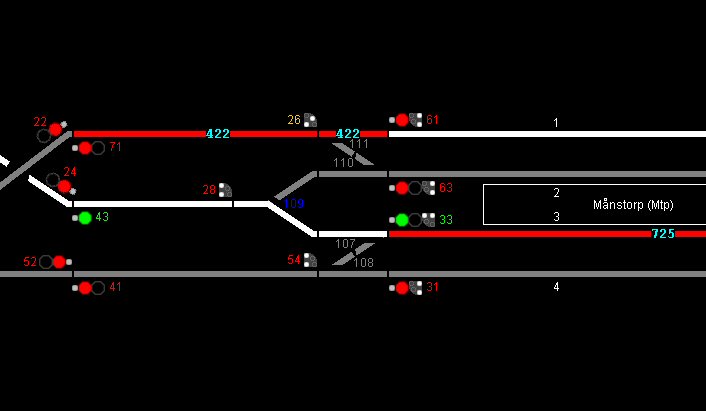
Last month, in our review of control systems we mentioned Signalling. As an Epoch-IV secondary line, we were blessed with a simple, yet effective signalling project. There was a time when the route from Ålunden to Lövhöjden was double track, and the whole railway was to be the subject of a CTC (Centralised Traffic Control) from a computer program. This had been developed by one of the team members, and it contributed nicely to him getting a university Degree. But, that is too modern and too ’busy’ for anything that we desire now.
A screenshot of the trial version of the CTC for the FLMJ.
First, here is a very simplified description of the development of Swedish signalling layouts.
The ’T’ semaphore signal would stand in the middle of the station and had an arm pointing both ways perpendicular to the track; the driver of an approaching train paid attention to the one pointing to the left. There was a board outside the station which the train must not pass if the arm is horizontal (at ’danger’). Often, the arm would be operated by a crank-handle at the base of the post. The station master would give a hand signal regarding permission to proceed from the station.
Then, the signals were moved to where the boards had stood, thus proper ’home’ signals. They were soon joined by ’starter’ signals for departures; but the station master would still give a hand signal within the station area to confirm that the starter signal had been cleared, and to which train (if there were several) the signal applied.
Now, all signals are given by fixed signals; except where radio block or other dubious systems have replaced them. And of course, they are colour light signals, now!
A so-called ‘T’-semaphore signal, seen here, at Jädraås
A single armed semaphore signal, somewhere along the Inlandsbanan.
A five-aspect signal at Solna, with a shunt signal below.
A so-called Dwarf signal at Gällivare.
For the FLMJ, given that it is a secondary route reflecting the Epoch-IV period (more about that next month), we are going for the ’home’ and ’starter’ signals (or ”Infartssignaler” and ”utfartssignaler” in Swedish) option. Maybe a small station on a branch line can have an historical ‘T’ semaphore (as we have one in stock and would like to use it)! But otherwise, colour light signalling would be appropriate. (Well, we always fancied the idea of semaphore at Fjällnäs; but we’ll see!)
Operationally, there are a few considerations that would help make this sort of system function well on a model railway. Very basic interlocking would be good for the starter signals at each end of each section. Using DC analogue for the trains, polarity in the track contributes to part of this interlocking. Home signals can give a few different proceed aspects according to line status ahead (so-called “Speed based signalling”), and this can be influenced by the setting of points, and to a lesser extent the setting of the track isolation switches.
A goods train arrives at Steninge, ‘Home signal’ out of view, but all were interlocked!
However, it would be pointless describing a proposed signalling system for any new railway, because the technicality of it is very involved, and it would be a waste of time to go into that sort of detail before we know what we have available. But the point is that it will be thorough, authentic and simple; and of course, interlocked!
Next month, we’ll look at “Epoch-IV” and what it means for the FLMJ.
Desperat efter lukten av ett ånglok ordnades en tur till lokstallets öppet dag på Krylbo den 30 april och B klass 1324 kunde lukta från parkeringen! Uppdrag slutfört! Men det här var också en bra chans att ta en titt runt så mycket av stallet som var öppet, köpa ett par saker från handlare, inklusive ‘SLM’ från 1973, och vara i en ordentlig järnvägsmiljö igen!
Tillverkarens Nyheter:
Vi har nyheter från Dekas. En avstängning har införts i DongGuan i södra Kina för att begränsa spridningen av Covid-infektion. Det är här deras fabrik ligger. Tyvärr innebär det att fabriken har stängts på obestämd tid. Det gäller inte bara Dekas egna produkter utan även deras OEM-kunder (McK, HNoll, ExactTrain, ASM och Lemke/HobbyTrain). Den här nyheten förstärker uppdateringarna från HNoll.
I ljusare hänseende förstås PCX87 förbereda en modell i H0-skala av Volvo 343 från 1976. Detta är en ofta förbisedd bil eftersom den alltid låg i skuggan av 244/245-bilarna från den epoken, och vi är glad att PCX87 ska fylla den luckan. Modellen kommer att finnas tillgänglig på följande sätt: 870300 gul, 870301 grön, 870302 silver, 870303 röd (och en begränsad upplaga “ljusblå metallic”-version exklusiv för Model Car World i Tyskland).
Andra intressanta nyheter:
Spårvägsmuseet öppnar på sin nya plats, Gasverkstorget 1, (kort bussresa från Ropsten,) den 21 maj. Den gamla platsen i Sofia stängde för några år sedan och återöppningen är en mycket efterlängtad händelse.
Den här webbplatsen … vi har laddat upp ytterligare 12 bilder till kategorin, “Rebuilt FLMJ (2016+)” på vår fotosida, av vilka bara en redan finns på andra ställen på sidan!