Swedish railway news
Further to the announcement of new sleeper carriages and locomotives to pull them, SJ is ordering new daytime stock to augment the existing X2000 trains. These will have a higher speed capability (250 km/h) than the existing track allows for (200 km/h) and the first of them is expected to arrive next year.
Work has started on replacing the catenary poles along the railway from Borlänge to Mora, through the heart of Dalarna. These unusual poles were noticed during the first holiday in 1990; they’re wooden, like telephone cable poles, but carrying 16kV cables! The new ones will be steel, thus a sad sense of nostalgia.
Swedish model news
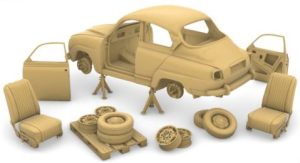
A 3D printed model by SSR Models (www.model-craft.se/brand/ssr-models) of a Saab 96 V4 under renovation is available as a ready-to-paint kit. Amongst many other kits, they also produce a model of a man about to respray the car! Interesting and unusual models for any diorama.
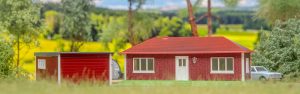
Wiking, known for entry-level model cars has announced a model of a Swedish house (article 112001) and separately a garage (article 114005). We are not convinced of the authenticity of these models; the Falu-red with white corners is correct, but the profile is questionable! It is labelled “Bullerbü,” which is the German translation of Bullerbyn, and therefore possibly connected with “The Children of Noisy Village” stories by Astrid Lindgren, made into two films in the mid-1980s. But none of the houses there look like this model. Caveat Emptor.
Our railway news
We have on long-term loan, a model of Jeco’s Rc4. It has an irritating problem. The directional lamps are not as directional as they ought to be – there is a flicker or faint glow at the ‘wrong’ end. Usually this is a result of optical bleed-over and is cured by the application of silver, then matt black paint between the fibre optics (or black insulating tape). But on this model, the LEDs are directly at the lamp apertures. The problem is a feedback issue, which will take longer to fix, and has only been an issue since manufacturers stopped making models for analogue railways. (A digital model is fitted with a so-called ‘blanking chip’ so that it can run on Analogue, but if not done properly, it comes with this feedback problem.) Roco also produces the Rc4 (and in the same orange livery), and they produce a ‘more analogue’ version, which does not have this problem.
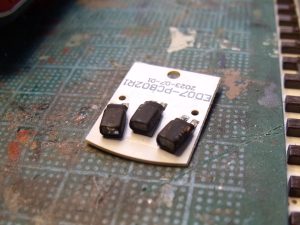
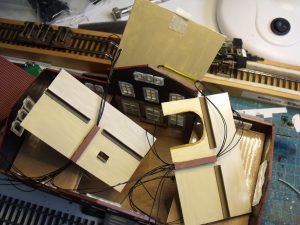
The construction of the model for Rickbacken station has ground to a halt, after it was found that the 12V bulbs that we had been sold were in fact 1,5V and all now need replacing! The picture gives an indication of how much work is involved with replacing all of them.
Other railway news
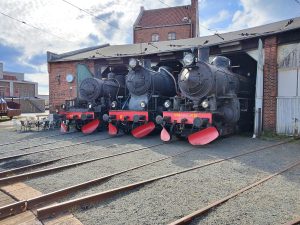
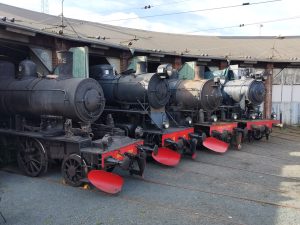
During a recent ‘work party’ at Nässjö railway museum, advantage was taken of the very rare opportunity to line up all four steam locomotives there; E2 1092, A5 1545 (but preserved in original condition as KJ 17), B 1038 and L5 1778 (but awaiting restoration as NOJ 33). NOJ 33 was not actually in the shed, and not part of the line-up until someone realised that this opportunity might never happen again, so after 40± minutes of shunting wagons and locos about, the loco was reached and added to the line-up!
Also, from Nässjö railway museum, is the opportunity to help with the construction of ‘modules’ for their H0-scale model railway. These modules are built according to a standard, especially in relation to how the tracks line up at the end of the baseboard module. Then, any two can be coupled together – anywhere – from any builder – at any event! Literally, it’s not quite like that, after all some modules have single track sections, some have double, but in essence that is how it works. Coupling them together in this way is really only suitable (easily) for digital control, so our interest is somewhat limited; but it does provide suitable practice for future baseboard building sessions once the RTJ can get started, so the experience is valuable.
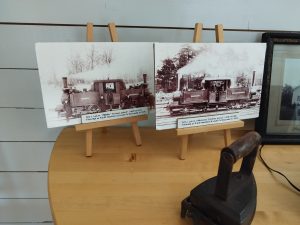
During a recent visit to Bruzaholm’s Bruksmuseum, we found these pictures of two of the British built Fairlie locomotives that were bought for the construction and subsequent use along the line through the village. The Fairlie patent was good for heavily curved lines, which is in fact how the Nässjö Oskarshamn Railway has always been known as Bockabanan (the curved railway). This has also caused some confusion with poor translations relating our earlier research in that the word Bock also means goat – and we wondered what was the significance of naming the line after these animals – it wasn’t!
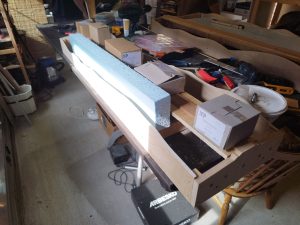
Inspiration with open-framed boards for when we build the RTJ!