Tag Archives: T45 328

Nyheter för första kvartalet 2026

Här är en liten formatändring som ligger i linje med syftet med denna webbplats. Nyheter från svenska järnvägar och modeller av svenska tåg och tillbehör finns väl dokumenterade (på svenska) på andra webbplatser, så vi kommer inte att säga mycket mer än bara en kort sammanfattning. När det kommer nyheter från vår egen modellering kommer det att finnas mer av det här. Det kommer att finnas fler nyheter om svenska järnvägar och modellering i våra engelskspråkiga uppdateringar.

Nyheter om svenska järnvägar

Tyvärr måste vi börja med ett litet råd, en ”varning”. När man bokar resor med Snälltåget är seniorbiljetten för 60+ faktiskt ett tillägg, inte en rabatt! Tur- och returbiljetten för en nyligen resa med 60+-alternativet var 863 kr, men när vi senare kontrollerade standardpriset för vuxna för samma två tåg blev totalpriset 831 kr, cirka 32 kr billigare! Det finns inget ”Kontakta oss”-alternativ på deras webbplats, och inspektören ombord var helt okunnig! Caveat Emptor.

Nyheter om svenska modelljärnvägar

Jecos ombyggda Ra-lok kommer också att finnas tillgängligt med Marshall-belysning (men fortfarande med den ursprungliga dörrlayouten). Flera olika löpnummer kommer att erbjudas, men som tidigare, inte de två första, eftersom de har små skillnader i detaljer (till exempel strömavtagarens placering).

NMJs Of-lok finns nu i butik. Det är lämpligt för tidiga malmtåg längs Malmbanan (innan Dm-lokets ankomst) och senare för godståg lite längre söderut.

Roco har tillkännagivit fem nya lok, inklusive Da 917. Det orange Rc4 1173 verkar ha den ursprungliga takprofilen men senare metallfönsterramar, vilket skiljer det från Jeco-modellen. Amtrak Rc4 1166 ska vara i nuvarande skick (med modifierad takprofil och “Nordic Refinance”-märkning). Och helt aktuellt kommer det att finnas två lok; TRAXX F140 AC2-loket med varumärket “Nordic Refinance” och Re 620 052, som överfördes från Schweiz till Sverige 2025 efter att ha tagits över av Nordic Refinance. Det kommer fler, men den här har en elegant “alpin”-lackering!

En återförsäljare ryktar om att NMJ förväntas producera modeller av tre vagnar från 1940-talet: R3, WL2 och BF2; de två första tillverkades tidigare av Lima. Men vi kan inte hitta dessa på NMJs egen webbplats!

Roco ger också ut nya vagnar; den 2-axliga stridsvagnen i “Koppartrans”-lackering i ett paket om två, “Teu”-vagnen (före UIC) i ett paket om två, men även dubbelvagnen “Himrrs” i “Nordwaggon”-lackering.

De efterlängtade Minichamps-modellerna av Saab 900 3-dörrars coupé och 2-dörrars cabriolet finns nu tillgängliga. Till skillnad från PCX87-versionerna är dessa av årsmodellerna från 1995 och därför modeller från GM-produkter!

PCX87 annonserar den föreslagna produktionen av en modell av Volvo 360 sedan från 1985, som initialt kommer att finnas tillgänglig i fyra olika färger. Vissa återförsäljare annonserar den som 340, men 340 var en halvkombi (3-dörrars eller 5-dörrars), 360 var bara en 4-dörrars sedan, som på bilderna från PCX87.

Våra järnvägsnyheter

Det finns en förändring i planeringen av det nya dioramat. Zätaspåret skulle ha varit en H0n2-linje (7 mm spårvidd), representerande 600 mm spårvidd, som gick från Kållstorp (på H0n3-linjen) till en skuggstation som skulle identifieras som Hemsjön. Vi har beslutat att den europeiska H0f-identiteten (även känd som H0i) (6½ mm spårvidd) skulle vara mer lämplig för denna linje än H0n2 (som är amerikansk), till stor del för att det finns fler modeller tillgängliga, redo att köras, och de har ett mer europeiskt utseende.

Vi har också beslutat att RTJ, som är av sydligare natur, inte kommer att vara ett lämpligt hem för Malmbanans modeller, så vi har beslutat att erbjuda dessa till försäljning. Sexton av de tjugo ‘Uad’-vagnarna har sålts, liksom alla de tjugotvå ‘Mas’-vagnarna. Förutom de fyra återstående “Uad”-vagnarna finns i skrivande stund ett Dm-lok och ett Dm3-lok kvar till salu. (Dm-loket finns i England, resten finns här i Sverige.)

Med ankomsten av H&M:s “Loco Tester” från lagret kunde vi köra in några lok. Den nybyggda byggsatsen av N-loket var den första, väldigt stel till en början, men kom så småningom igång – och sedan bröt den excentriska vevaxeln av på ena sidan! Detta är en fastlödd del och som tur var har vi kunnat löda fast den igen. U-loket var nästa, en gammal Tenshodo-modell, också lite stel, men mycket bättre (tills den spårade ur den “rullande vägen”). Jeco T23:an gick sönder igen, så vi bytte ut “chipet” mot en BP21 och vi kunde sedan köra in den helt, om än utan belysning (så vi har skjutit upp monteringen av den nya belysningskabeln)! Även T21 64 och T45 328 behövde köras in; T45:an eftersom det här var första chansen sedan byggsatsen, och T21:an eftersom det var första chansen med den nya motorn. T45:an, som har ett chassi från SV&LV, går utmärkt; men tyvärr behöver T21:an fortfarande mer arbete.

Och slutligen…

En av våra vänner tog fotot som sågs i våra engelskspråkiga nyheter, på Nässjö station under sommaren (där arbetare ses sätta upp nät under stationens tak för att hålla fåglarna borta), och frågade: “Hur många säkerhetsbrister kan man se på ett foto?”

Svaren inkluderade:

  1. Arbeta nära perrongkanten medan tåg kör i närheten;
  2. Blockera lokförarens sikt mot signalen (ganska skymd på det här fotot – men en finns där);
  3. Arbeta på höjd nära 16 kV elektrifiering utan skydd;
  4. Inga skyddshjälmar;
  5. Person i hissen som står på skyddsräcket, inte på golvet, och utan säkerhetssele;
  6. Banksman som uppenbarligen inte är uppmärksam och låter människor passera nära arbetet och perrongkanten;
  7. Ingen säkerhetszon runt tornet (barriärer, skyltar etc.).

Det kan finnas fler (och vi startar ingen tävling om detta), men lite extra träning kanske inte är en dålig idé för de inblandade!

News for first quarter, 2026

Swedish railway news

Unfortunately, we need to start with a bit of advice, a ‘caution.’ When booking travel with Snälltåget, the 60+ senior ticket is actually a surcharge, not a discount! The return fare for a recent trip with the 60+ option was 863 kr, but when, out of curiosity, we checked the standard adult fare for the same two trains, the total was 831 kr, some 32 kr cheaper! There is no ‘Contact Us’ option on their website, and the onboard inspector was completely clueless! Caveat Emptor.

Swedish model news

Jeco has announced that their retooled Ra-loco will also be available with Marshall lighting (but still with the original door layout). Several different running numbers are to be offered, but as before, not the first two, because they have slight differences in detail (pantograph positions, for example).

NMJ’s Of-loco is now in the shops. That arrived rather quickly! It is suitable for early ore trains along the Malmbanan (before the arrival of the Dm-loco) and latterly for general goods trains a little farther south.

Roco has announced five new locomotives, including Da 917. The orange Rc4 1173 seems to have the original roof profile but later metal window frames, this latter point distinguishing it from the Jeco model. The Amtrak Rc4 1166 is to be in the current condition (with modified roof profile and ‘Nordic Refinance’ branding). And right up to date, there will be two locomotives; the TRAXX F140 AC2 loco with ‘Nordic Refinance’ branding, and the Re 620 052, which was transferred from Switzerland to Sweden in 2025, having been taken over by Nordic Refinance. There will be more, but this one is in a fancy ‘Alpine’ scenic livery!

Rumoured by one retailer, NMJ is expected to produce models of three 1940s carriages: the R3, WL2 and BF2; the first two of which were previously made by Lima. But we cannot find these on NMJ’s own website!

Roco is also reissuing some wagons; the 2-axle tank wagon in “Koppartrans” livery in a pack of two, the ‘Teu’ wagon (pre-UIC) in a pack of two, but also the ‘Himrrs’ double-wagon in “Nordwaggon” livery.

The awaited Minichamps models of the Saab 900 3-door coupé and 2-door cabriolet are now available. Unlike the PCX87 versions, these are of the 1995 year-models, and are therefore models of GM products!

PCX87 is advertising the proposed production of a model of the Volvo 360 saloon from 1985, which will initially be available in four different colours. Some outlets are advertising it as the 340, but the 340 was a hatchback (3-door or 5-door), the 360 was only a 4-door saloon, as in the pictures from PCX87.

Our railway news

There is one change in the planning stage; that of one of the proposed narrow-gauge additions to the main diorama. The Zätaspåret was to have been an H0n2 (7mm gauge) line, representing the 600mm gauge, running from Kållstorp (on the H0n3 line), to a shadow station to be identified as Hemsjön. We have decided that the European H0f identity (aka H0i) (6½mm gauge) would be more suitable for this line than H0n2 (which is American), largely because there are more models available, ready-to-run, and with many significantly from Busch, they’re more European in appearance.

We’ve also decided that the RTJ, being of a more southerly nature, will not be a suitable home for the iron ore railway (Malmbanan) models, so we’ve decided to offer these for sale. Sixteen of the twenty ‘Uad’ wagons have been sold, as well as all of the twenty-two ‘Mas’ wagons. In addition to the four remaining ‘Uad’ wagons, one Dm-loco and one Dm3-loco remain for sale at the time of writing. (The Dm is in England, the rest are here in Sweden.)

With the arrival of the H&M ‘Loco Tester’ from storage, we were able to run-in some locomotives. The newly built kit of the N-loco was the first, very stiff to start with, but eventually got going – and then the eccentric crank broke off on one side! This is a soldered part and thankfully we have been able to solder it back on. We do have some spare parts if this becomes a regular problem (both sides have failed in turn, now)! The U-loco was next, an old Tenshodo model, also a bit stiff, but much better (until it derailed off the ‘rolling road’), though there is one wheel-set that is not perfectly aligned and the loco wobbles – but that is not too difficult to sort out. The Jeco T23 failed again, so we replaced the ‘chip’ with a BP21 and we were then able to run it in fully, albeit without lighting (so we’ve postponed fitting the replacement lighting cable)! Also, T21 64 and T45 328 needed running in; the T45 because this was the first chance since building the kit, and the T21 because it was the first chance with the new motor. The T45, which has a chassis from SV&LV, runs beautifully; but sadly, the T21 still needs more work.

And finally…

One of our Friends took this photo at Nässjö station during the summer (where workmen are seen putting up netting under the station canopy to keep the birds out), and asked, “How many safety failures can you see in one photo?”

The answers included:

  1. Working close to the platform edge whilst trains are running close by;
  2. Blocking the train driver’s view of the aspect given by the signal (quite obscured in this photo – but one is there);
  3. Working at height near 16kV overhead electrification without any protection;
  4. No hard hats;
  5. Person in the lift standing on the guard rail, not the floor, and without safety harness;
  6. Banksman clearly not paying attention, allowing people to pass close to the work and to the platform edge;
  7. No exclusion zone around the tower (barriers, signs, etc).

There may be more (and we’re not launching a competition about this), but some extra training might not be a bad idea for the people involved!

Nyheter från januari 2023

Våra Nyheter

En del arbete utfördes på T21 87 under januari. “Bågen” i A-ändens buffertbalk gjordes större så att kopplingarna nu kan användas, och ersättningsbuffertar har monterats. Beskrivningen av det sistnämnda jobbet ges i den engelskspråkiga uppdateringen.
En del arbete utfördes också på T45 328. Under januari monterade vi boggisidorna och bolster på modellen, vilket förbättrade dess utseende. Sedan monterade vi plogarna framför boggierna och sedan stegen och ledstängerna. Vi skulle också vilja få in mer vikt under kroppen eftersom loket verkar för lätt
Som förväntat tog vi emot våra HNoll-vagnar av typen A7R och B7R. Dessa modeller är mycket överlägsna i kvalitet jämfört med Roco A7/B7, och de kommer i skyddslådor, vilket Roco-modellerna inte gör! De är ungefär bara 200kr dyrare än Roco, vilket tyder på att Roco är överprissatta!

Tillverkarens Nyheter

Trix ska producera en likström version av nya Märklin Rc5. Det kommer att vara i 1990-talets orange färg (med logotypen “flygande falukorv”); och märkt som Rc5 1364, säljs som artikelnummer 25281. Tidiga bilder tyder dock på att chassit är för mörkt och att taket har helt fel färg!
HNolls nästa vagnar kommer troligen att vara B4 och olika derivat (BF4 & BF7), och dessa förväntas anlända i slutet av året, eller i början av 2024. Vi är intresserade av att skaffa två till de vanliga InterCity-tågen; och kanske en tredjedel för ett av sovtågen! (Vagnarna fick först identiteten B4 av SJ, men denna ändrades senare till den mer korrekta BF4 där F står för lastutrymme.)
Märklin annonserar ut ett paket med tre vagnar typ Tbis571, artikel 47303. Dessa SJ-vagnar är tvåaxlade skjuttaks-/skjutväggsbilar och är i rödbrun grundfärg med grå skjutdörrar och skjuttakar. Utförandet har konvexa skjutdörrar och är utan bromsmansplattformar. Modellerna ser ut som de gjorde runt 1985. På modellerna glider faktiskt taken upp, men inte dörrarna. Vi känner inte till en Trix likström version, men DC-hjulset per bil är artikel E700580.

Andra intressanta nyheter

Om du letar efter en ursäkt för att fira något i år, överväg följande. 2023 är det 100-årsjubileum av elektrifieringen av Malmbanan; 70-årsjubileum av introduktionen av loktyperna Dm och Ma, och YCo6 rälsbus; och 30-årsjubileum av bildandet av Scandinavian railways Society (i Storbritannien), vars 100:e upplaga av deras tidskrift utkommer under året.

News from January 2023

Our News

Work progressed on the recently acquired T21 87 diesel during January. One small challenge was the ‘arch’ in the A-end buffer beam which prevented couplings from being used. This has now been widened (one of the compromises one has to sometimes make with working models), but it is still an arch; just wider. The bigger challenge was the buffers. Heljan provides unpainted brass buffers with the model, which protrude too much and are not sprung. Not being sprung is not a problem, as long as the user does not intend to use the factory fitted chain-link coupling! But protruding too much prevents the use of close couplings. The buffers were hollow and had been mounted (with glue) over studs, so we followed a simple procedure, yet precise, to replace them.

  1. Thankfully Heljan used weak glue and with pliers we were able to pull the buffers off.
  2. Using a fine drill, we drilled through the studs’ centrelines and through the buffer beams.
  3. Going through the buffer beams meant that we had reference points, so we could next remove the studs.
  4. We then widened the drilled holes to fit the new Bachmann buffers; loose fitted them and then took them out, so that we could refit the buffer beams to the loco without the buffers; thus revealing the need to drill a little way into the chassis also.
  5. Being on the edge of a sub-frame (not the actual chassis itself), we instead used a file to make clearances for the backs of the buffers.
  6. Then the buffers were lightly glued into place, and the beams back onto the loco. Job Done!

The Bachmann product, incidentally, is article number 36-032, a pack of eight round sprung buffers, intended for the British 00-gauge market, but perfectly fitting – mentioned just in case any of our readers are looking for ways of rebuilding their Heljan T21 locos!

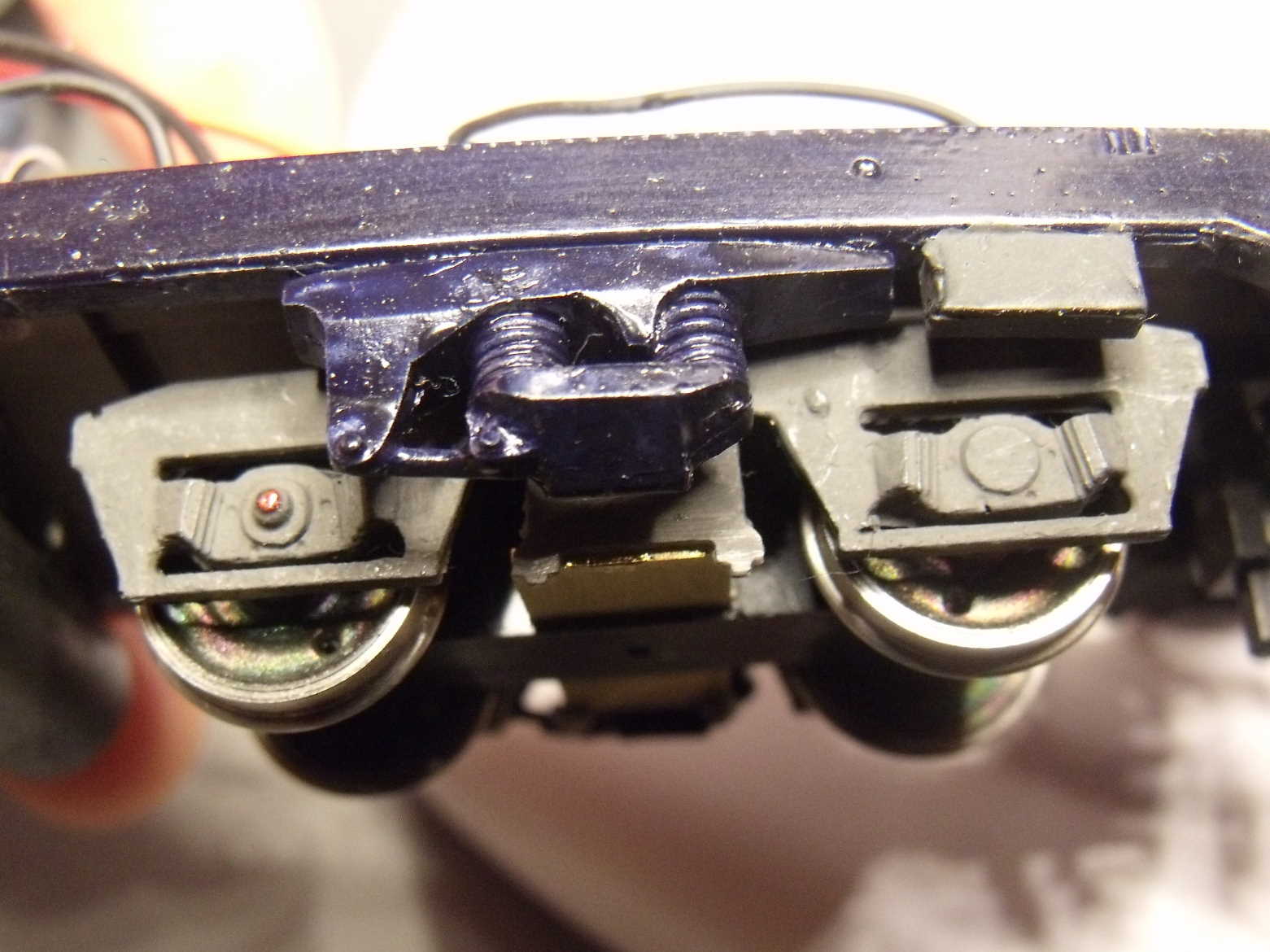
We also worked on our T45 328. During January, we fitted the bogie sides and bolsters to the model, greatly improving its appearance. We were able to discard some plexiglass pieces because they had been supplied with the model for use with the then-recommended drive-chassis from a provider in Helsingborg; but we used the more modern chassis from SV&LV, where the bogies were suitably designed for these pieces to be redundant. We had two of each type of bolster, and as with the Rc-locos, it is quite random which way round they are fitted. The one good picture that we have of the real T45 328 shews both bolsters ‘pointing’ inwards on the one side visible in the photo, so that is how we have mounted ours. Then we noticed that these are actually mentioned in the instructions and two were wrong, so they were exchanged (the bolsters should point outwards on the other side)! The next challenge with this model was fitting the etched brass components, ploughs onto the bogies, steps, and then the handrails. In all cases, we had to improvise because there was no clearly marked fitting place for any! The ploughs needed to be quite forward from the bogies, so these are mounted onto the couplings (with spacers). The handrails seemed totally wrong when all available photos were studied, so with 0,5mm brass rod we manufactured our own! Although far from perfect, we are pleased with the results, and in the process, we mounted the extra low level steps. Job Done! However, we would also like to fit more weight under the body because the loco seems too light…! More about the T45 below!

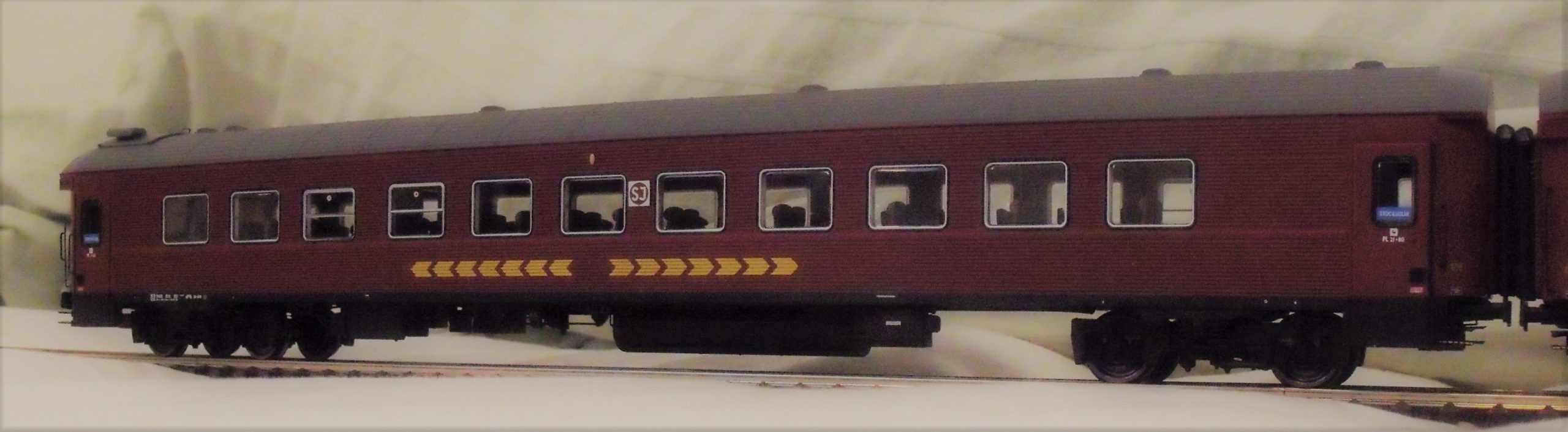
As expected our HNoll delivery arrived early January, comprising two A7R and two B7R carriages. These models are far superior in quality to the Roco versions, although the differences are subtle at a quick glance. The fact that the Roco models are only ±£20 cheaper, and come in unprotective brittle plastic tubs (instead of protective boxes), suggests that they are somewhat overpriced!

Finally, recent correspondence suggested that the Uad/Uadp iron ore wagons had their first two digits changed at some point from 20 to 41. We tried this change with the three that have incorrect ‘control digits’ (given that none of them shew the first four digits on the wagons), and thus the ‘control digit’ was accepted as correct. Job Done!

Manufacturer News

Trix is to release a 2-rail version of the new Märklin Rc5. In the orange livery, but 1990 condition (with the “flying falukorv (sausage)” logo), it will be Rc5 1364 and sold as article number 25281. However, early photos suggest that the chassis is too dark and the roof is completely the wrong colour!

HNoll’s next carriages will probably be the B4 and various derivatives (BF4 & BF7), and these are expected at the end of the year, or early 2024. We are interested in acquiring two, for the regular InterCity trains; and maybe a third for one of the sleeper trains! (The carriages were first given the identity B4 by SJ, but this was later changed to the more correct BF4 where F stands for cargo space.)

Märklin is advertising a pack of three wagons type Tbis571, article 47303. These SJ wagons are two-axle sliding roof / sliding wall vans, and are in a reddish-brown basic paint scheme with grey sliding doors and sliding rooves. The version has convex sliding doors and are without brakeman’s platforms. The models look as they did around 1985. On the models the rooves do actually slide open, but not the doors. We are unaware of a Trix 2-rail version, but DC wheelsets per car is article E700580.

Other News

More about the loco type T45.
ASEA (Allmänna Svenska Elektriska Aktiebolaget), which for a long time was Sweden’s largest manufacturer of electric locomotives, also tried its hand at building diesel locomotives in the early 1970s. The idea was to challenge Nohab in Trollhättan, which until then had dominated the Swedish diesel locomotive market.
A bogie locomotive was constructed where, among other things, the bogies and parts of the electrical equipment were the same as in the Rc locomotives, thus offering a standardisation of spare sparts. Otherwise, the locomotive was a collaboration: the diesel engine was of the SEMT-Pielstick system and was manufactured by Hedemora Verkstäder, while Norwegian Thune was responsible for the mechanical parts and the locomotive bodies. In terms of appearance, the locomotives were quite similar to the T43 and T44 locomotives, and they became the T45. Up to three locomotives could be multiple-worked.
In 1969, SJ signed a contract with ASEA to rent the five locomotives that were manufactured. They were delivered in 1971-1972 in an orange/white livery similar to the Rc locos, but with ASEA branding, and no SJ logo. The locomotives were placed in Borlänge and pulled both freight trains and passenger trains on the then still unelectrified line to Mora.
In 1976, SJ returned the T45 locomotives to ASEA. Operational reliability had not been so good, mainly due to problems with the diesel engines and SJ did not really want another diesel locomotive type. ASEA tried to sell them abroad but there was no interest. Only one locomotive (324) was sold to the mining company A/S Sydvaranger in Kirkenes in Norway. The remaining locomotives became shunting locomotives in various Swedish industries, including at the ironworks in Avesta and Hofors. The investment was therefore not a success and ASEA did not build any more diesel locomotives.
Today, there are no T45s left in traffic and all locomotives except one have been scrapped. T45 327 is preserved at the Gefle-Dala Railway Museum Association in Falun [www.mfgdj.nu].

About 328:
Manufactured by ASEA, Västerås, Sweden in 1972. Manufacturing number 1702.
Leased 1972-76 by SJ from ASEA. Based at Borlänge 1972-75.
328 was sold in 1978 as a shunting locomotive to SKF Steel in Hofors, where it was given the ownership number 8631. In Hofors, the locomotive was useful on the industrial track from the mill to the station, which runs at a very steep incline (approx. 15‰). The locomotive was supplied (by SKF) with handrails around the platforms, automatic couplings, lighting and TV cameras over the ends. In 1992, SJ took over the shunting at the mill and the locomotive ended up with SJ in Gävle. When SJ took over the locomotive, it received a small refurbishment and was test driven for some speculators. However, the locomotive had some remaining faults, and was worn, and in addition, an odd locomotive construction does not warrant any sale. The locomotive was then disposed of to the Railway Museum in Gävle, but in autumn 1994 it was sold to SP Tågservice in Östersund. In Östersund, the locomotive was revised and in May 1995 it was put back into operation, now leased to Banverket for macadam (ballast) train service. During that summer, the locomotive suffered a serious failure of the diesel engine due to overloading; the diesel engine was removed from the locomotive and sent back to Hedemora. However, it was judged to be so costly to repair the locomotive that it was instead scrapped. The bogies were sent to SSAB in Domnarvet, which used them under its locomotive, 327. (327 had been sold in 1995 to SSAB in Donmarvet, where it was overhauled for approximately SEK 1 million and received, among other things, the bogies from 328.)
(Information from mostly jarnvag.net and svenska-lok.se)

If you’re looking for an excuse to celebrate something this year, consider the following. 2023 is the 100th anniversary of the electrification of the Malmbanan; 70th anniversary of the introduction of loco types Dm and Ma, and the YCo6 railbus; and 30th anniversary of the formation of the Scandinavian Railways Society, whose 100th edition of their journal will be published during the year.

Behind the Scenes

Mini-Series around the FLMJ; B: The Journal, FLMJ-Nytt

KRBJ-Nytt, which eventually became FLMJ-Nytt, was a general news journal. It enabled us in our pre-IT days to keep everybody up to date with the Railway’s development and other activities, and also carried special features such as book and video reviews, and anything else that we thought our readers might appreciate (and this even included one year with a cartoon strip)! The frequency changed over its course, finally settling on five editions annually (produced week numbers 5, 15, 25, 35, 45, so there was virtually no risk of losing copies in the Christmas post)! As the Publisher program was automatically updated, so did our curiosity and development, and the last few editions were very neatly presented. In addition to UK proliferation, copies were sent to readers around the world, including USA, UAE, Australia and the Nordic countries. Today, members of the Scandinavian Railways Society benefit from their journal, “Skandiapilen”, which is now edited by Adrian, and has a much more dynamic presence than anything produced before, both for the SRS and for us. It represents an idea of what FLMJ-Nytt could have looked like if it continued in print, today!

Naturally, our readers had an interest in the KRBJ/FLMJ, so everything was related to that interest. With the closure of the FLMJ in 2018, it seemed pointless continuing whilst there was no actual railway to report from, and most (if not all) of our readers are online. Therefore, the decision has been taken to not restart it once a new railway does get going; but we’re not completely forgetting our publishing heritage, as we’ll discuss later in the year!

Next month: the ‘internal’ newsletter for the committed ‘members and friends’ of the Railway!

Nyheter från september 2022

Våra nyheter:

Med inköp av lämpligt material fortsatte arbetet med T45-loket. Ett plastblock sattes in i varje ände under karossen, i chassinivå, och efter att ha limmats, borrats och gängat kan vi nu fästa karossen i chassit i ändarna. Detta korrigerar de visuella effekterna av det lätt böjda chassit. Loket är nu nästan klart för inkörning. Boggisidorna och bolstren (kosmetiska föremål på modell) verkar ha lagts på ett säkert ställe, så de kommer att monteras senare; men för närvarande finns det inget ytterligare arbete att göra med denna modell. Detta betyder dock inte att det är komplett. När vi köpte modellen för många år sedan köpte vi inte saker som ledstänger, torkare och liknande; så vi hoppas kunna införskaffa dessa under de kommande månaderna (gärna som tilläggssats, men skrapbyggda om de inte finns), troligen från ‘Hjulmarknaden’.

Tillverkarens Nyheter:

HNoll har drabbats av ytterligare problem, några med mycket bredare knock-on-effekter. 3D CAD-designern på Dekas, som ritar HNolls modeller, har sagt upp sig, och kommer inte att ersättas. De modeller som har ritats kommer att tillverkas, men det som finns på ritbordet kommer behöva kompletteras av någon annan. Detta innebär att leveransen av vagnar kommer att försenas ytterligare på obestämd tid. Dessutom går priserna upp; material, arbetskraft, frakt och ökade levnadskostnader i Sverige. Priserna på HNolls modeller kommer att justeras. De passagerarvagnar som är på väg (för närvarande hålls i kinesisk tull) kommer att kunna hålla sitt rekommenderade pris på 995:-. Men, B4/BF4/BF7 vagnarna kommer att justeras till 1195:-, och det finns ingen känd leveranstid!

Förra månaden tillkännagav vi tillgängligheten av PCX87 Volvo 343, men vår levererades inte förrän i september, så vi hade ingen bild. På vår engelska nyheter, här vi en bild med två av modellerna: för att annonsera om 343:an som en billigare modell än 240:an som fanns tillgänglig samtidigt, tillverkade Volvo dem i primärfärger.

Andra intressanta nyheter:

Modellutställningen på Kårsta, som nämnts på vår hemsida, fanns inte! Deras annons gav ingen specifik adress för evenemanget, så vi gick till den enda adressen som anges på deras hemsida, Kårsta stationsväg 16, 186 60 Kårsta; som verkar vara en bostadsfastighet, inte platsen för ett evenemang med minst 16 handlare! Vi var inte de enda som åkte dit. En annan person ringde några telefonsamtal (inga till arrangören eftersom inget nummer anges) och fick reda på ett rykte om en händelse nära Vallentuna, inte så långt borta; men utan adress övergav vi (och de andra personerna) uppdraget och gick hem! (När vi insåg att detta var en parodi hade tåget som tog oss till Kårsta avgått, och det var en timme till nästa, så den allmänna stämningen var inte bra!)

Till en finare sak; vi har upptäckt vad som verkar vara en ny webbplats i Sverige, som vi har länkat till från denna webbplats. Den visar den svenska järnvägskartan och platsen för nästan alla tåg i trafik, färgkodade efter hur bra de presterar i förhållande till tidtabellen. Detta är användbart för passagerare som kanske undrar var deras försenade tåg är, och intressant för entusiaster av alla möjliga hobbyrelaterade skäl. (Vi kan nu se när ett godståg är på väg att köra förbi vårt fönster och står därför redo med en kamera!) Den ovanliga URL:en är 1409.se.

News from September 2022

Our News:

With the purchase of suitable materials, work continued on the T45 locomotive. A plastic block was inserted at each end under the body, at chassis level, and suitably glued, drilled and tapped, we are now able to secure the body to the chassis at the ends. This eliminates the visual effects of the slightly bowed chassis. The locomotive is now almost ready for running in. The bogie sides and bolsters (cosmetic items on a model) seem to have been put in a safe place, so they will be fitted later; but for now there is no further work to be done to this model. This does not mean it is complete, however. Not purchased all those years ago when we bought the model were things like handrails, wipers and suchlike; so we hope to acquire these in the coming months (preferably as an add-on kit, but scratch-built if not available), probably from ‘Hjulmarknaden’.

Manufacturer News:

HNoll has been hit by further problems, some with much wider knock-on effects. The 3D CAD designer at Dekas, who draws HNoll’s models, has resigned, and will not be replaced. The models that have been drawn will be manufactured, but what is on the drawing board will need to be completed, probably by another party. This means that the delivery of carriages will be further delayed indefinitely. Furthermore, prices are going up; materials, labour, freight and increased living costs in Sweden. The prices of HNoll’s models will be adjusted. The passenger carriages that are on their way (currently held in Chinese customs) will be able to keep their recommended price of 995:-. But, the B4/BF4/BF7 carriages will be adjusted to 1195:-, and there is no known delivery time!

Last month, we announced the availability of the PCX87 Volvo 343, but ours didn’t get delivered until September, so we had no picture. Here is one of two of the models: to advertise the 343 as a cheaper model than the 240 which was available at the same time, Volvo produced them in primary colours.

Other News:

The model exhibition at Kårsta, as mentioned on our website, didn’t exist! (We won’t be promoting Staffshobbyhörna again!) Their advert didn’t give a specific address for the event, so we went to the only address given on their website, Kårsta stationsväg 16, 186 60 Kårsta; which seems to be a residential property, not the venue of an event with at least 16 traders! We were not the only ones to go there. One other punter made a few phone calls (none to the organiser because no number was given) and found out about a rumour of an event near Vallentuna, not so far away; but with no address, we (and the other punters) abandoned the mission and went home! (By the time we realised that this was a spoof, the train that brought us to Kårsta had departed, and it was an hour to the next one, so the general mood was not good!)

On to a nicer item; we have discovered what seems to be a new website in Sweden, which we have linked to from this website. It shews the Swedish railway map and the location of nearly all trains in traffic, colour coded according to how well they are performing in relation to the timetable. This is useful for passengers who might be wondering where their delayed train is, and interesting for enthusiasts for all sorts of hobby related reasons. (We can now see when a goods train is about to run past our window and therefore be ready with a camera!) The unusual URL is 1409.se.

Behind the Scenes:

Mini-Series about the FLMJ, 10: Track and Infrastructure

From inception, the FLMJ used Peco Code-100 track. Code-100 refers to an imperial measurement of rail height, 100 thousandths of an inch (one-tenth is easier to read)! This is a little overscale, and Peco has subsequently created Code-75 track, which is actually a bit too small for European standard. Roco, among others, created Code-83 (which Peco also does, now), and with which the KRBJ experimented in 1992. (The KRBJ’s experiment failed because the points had inbuilt contacts that were not weather-proof!) We also had a particular liking for Code-100 because its bulkiness resisted the problems of the uneven nature of the garden-located railway, it resisted moving with the deteriorating baseboards and resisted vandalism from the local cats!

But, the way forward is different. We have no desire to build the railway outdoors again (and here in Sweden, H0 scale would not be compatible with the weather). So, we are confident about moving down to Code-83. This gives us the opportunity to investigate other brands alongside Peco, and sadly, it seems that the best producer of Code-83 was Shinohara, who closed down in 2018. We also investigated Tillig for their dual-gauge elements, but they only feature H0e (9mm) and H0m (12mm), not H0n3 (10,5mm), which would be best for representing the very Swedish gauge of 891mm. So, that brings us to Roco. Their finer-scale turnouts (points) are at 10° instead of Peco’s 12°, but curiously, not their diamond crossings which are at 15°. This was the biggest cause of hesitation with Roco, but there is an interesting consideration that the final form of the FLMJ in the UK had no diamond crossings; so we could still move forward with this brand. There is also an absence of three-way points in Roco’s range, but this does not create any major problems for us. As with Peco, everything is produced with timber profile sleepers (actually made of plastic, of course), but the long flexible panels are also available with concrete. (Tillig, whose range is very limited, also offer imitation steel sleepers!) We have four short panels for display purposes, and a point will be purchased before too long to experiment with. Peco has had to be ‘dropped’, due to the higher costs caused by Brexit from the EU (but more due to the subsequent departure from the EEA as well); and supply problems due to their difficulties in finding a way to produce materials during the Covid pandemic, which other manufacturers seemed able to do.

The FLMJ, for a few years, was fitted with a not-quite-complete catenary system. We had purchased the somewhat cumbersome Jeco variety instead of finescale Entec, due to considerations of cost (so much needed) and the ability to stand up to the cats! The system was not completed due to issues with stability and rust; but, even without the contact wire, images of the railway at this time are impressive and inspiring. Some of the catenary bridges across the station layouts had been made to our specification, in terms of track spacing; it is doubtful that we’ll be able to use them again, but this is also something that cannot be predicted. Towards the end of the double-track main line era, we received some ready-made Entec masts. These were much stronger than we had thought they might be, and so there is a fair possibility that any new layout will have a mixture of the two marques.

Next month, we’ll pay tribute to the team who made the FLMJ what it was!

Nyheter från juli 2022

Våra nyheter

Arbetet med konstruktionen av T45-modellen har återupptagits. Motorn och boggierna har anlänt och dessa har monterats och testats. Elektriskt finns det tillfälliga anslutningar ifall det skulle bli behov av att ta bort komponenter!

Det lilla diorama som vi tänker bygga snart kommer förmodligen att heta “Odensala Prästgård”, men det får vänta eftersom pengar har lagts på en välbehövlig bil i skala 1:1!

Tillverkarens Nyheter

I en färsk uppdatering från HNoll skriver de att en leverans förväntas med båt från Kina om 2-3 månader, men inte inklusive A11/B11-vagnarna (vi är inte säkra på vad som ingår). Men det kommer några fler restaurang-, ligg- och sovvagnar, några med nya nummer.

Andra intressanta nyheter

En rundtur på några platser av intresse för järnvägen har sammanfattats i våra engelska nyheter, men en större recension planeras för denna webbplats senare i år. Bilderna är från alla platser som vi besökt; Nynäshamns Järnvägsmuseum, LennaKatten, Modeljärnvägenshus, Föreningen Sörmlands VeteranJärnväg, Grängesbergbanornas Järnvägsmuseum, Hallsbergs Modelljärnvägsförening (och så Hallsbergs stationsmiljö för att ta många bilder på passerande tåg), Nora Bergslags Veteran-Jernväg, och “Miniature Kingdom” vid Kungsör.

News from July 2022

Our News

Work has started on the second significant phase of the construction of the T45 diesel locomotive.  This is the fitting of the motor, wheels, and complete drive-gear.  The start of this work was reasonably straight forward.  With the temporary ‘accommodation bogies’ removed, the new ones (from SV&LV – Skultorps Vagn & LokVerkstad) fitted perfectly into place; but it was a very fiddly job to fit the securing nut on each bogie, due to being difficult to access, and having very fine threads!  The motor is a tight squeeze into the recess specially made for it, but there is no means of securing it.  It might not need securing; testing at a later date will confirm one way or the other. Between the motor and each bogie there is a prop shaft (cardan shaft), and everything turns freely.  Electrically, we decided that it would be wise to be able to remove components if the need arises, but lacking any plug couplers, the pairs of cables from the motor and each bogie were soldered to a contact strip that we glued onto the chassis (instead of soldering it all together directly).  Then we reassembled the model and found that the chassis still bows slightly, so we will make up new securing points at each end, which we will use with two more M2 screws.  Unfortunately, some of the more cosmetic components for the loco have been left behind in the storage facility, so these will be procured at a later date.  With the absence of the full workshop facility, it should not be considered bad that the work described above took 4¾ hours.  A week or so later (17th July), the loco was tested on a track with controller, with pleasing results.  Clearly, it will need running in, but just to see it move a short distance under proper power was a great boost to the morale.

Odensala Prästgård is the name of our temporary diorama.  There is the mainline between Märsta and Knivsta quite close to the temporary lodgings, and there used to be a station at Odensala, many years ago.  So, the idea is to expand on the idea of a siding being retained, leading to a small area with just a few tracks for maintenance and other things; also giving us good photography opportunities!  With the purchase of a new car (in 1:1 scale) draining funds, construction has been delayed slightly, but the T45 (see above) is keeping us busy!

Manufacturer News

In a recent update from HNoll, they write that a delivery is expected by boat from China in 2-3 months, but not including the A11/B11 carriages (we’re not sure what is included).  But there will be a few more restaurant, couchette and sleeper carriages, some with new numbers.

Other News

As hinted last month, the summer tour of railway establishments actually started in June.  Participants numbered from 1 to 8 depending on venue.

We started at Nynäshamns Järnvägsmuseum, adjacent to Nynäs Gård station.  This is a small museum and a bit too cramped, so photo opportunities were poor.  But it has the usual hands-on policy, so we were able to look in every nook and cranny wherever our fancy took us.  Naturally, this included the cab of E class 1189.

A few days later, we went to the Uppsala Lenna Järnväg (known also as the LennaKatten).  Of the three trains in service, only one was steam-hauled, so that was our choice.  A diesel hauled train was available, as was a diesel railbus train.  After such a long time since last riding behind a steam loco, advantage was taken of the end platform on the leading carriage, and a delightful experience it was.

On the following day, we went to the permanent Model Railway Exhibition at Söderby/Alunda.  This is a collection of model railways and train sets, mostly H0, but not entirely, and aimed more at the family audience than the true railway modeller.  Interesting, but unlikely to revisit.

After a day’s rest, we went to Oxelösund, the “O” in TGOJ, to visit the FSVJ (Föreningen Sörmlands VeteranJärnväg) there.  As with the museum at Nynäshamn, this is a static museum, and we were able to look over, among other things, a Ma-loco of the TGOJ variety, two of the four 1950s TGOJ carriages (the other two were present, but closed), and their former conference carriage (which started out as one of SJ’s first two restaurant carriages in 1929), where a Fika was enjoyed!  Returning from Oxelösund, an unplanned detour was made to Läggesta for a ride on the ÖSlJ, with a steam loco, to Mariefred and back!

After another day’s rest we went on a tour that included three nights in B+B (at Örebro).  The first of these four days was at Grängesberg, the “G” in TGOJ.  Here, we saw some of the items modelled at the FLMJ; carriages type BCo7, Co8f, F5; and the Volvo rail-car.  Whilst a few nicely restored items are kept under cover in the roundhouse, too many artefacts are rotting away outside in the elements, and we can understand why some items (the 1950s carriages, for example) have been removed from here.

The second day was at Hallsberg, “Hallsbergs Modelljärnvägsförening”; a significant model railway layout, open to the public, adjoining the Bergöövåningen exhibition.  The main feature of the layout is the diorama of Hallsberg’s station, both the railway and the environment around it; and all of the local buildings have been faithfully recreated in miniature.  Afterwards, back to the 1:1 scale Hallsberg station for a few hours taking photographs, mostly goods trains, headed by Rc-locomotives, including a former ÖBB version of the Rc2!

The third day was at Nora and the overgrown line to Järle (where there was an exceptionally long turnover, despite there being nothing there).  There is another line towards Pershyttan (which was not operating, it seemed).  And that was about it.  A good look around the yard was inspiring (to see some particular items) but also depressing (to see items in the process of being scrapped)!  Travel was in a wooden planked carriage type Co4a-Å, coupled with two Norwegian carriages, both type B22 despite their many differences.  Due to a special event taking place in Nora, the local fishing club decided it appropriate to charge for parking where it should have been free; but at 20kr, it wasn’t worth the fuss or argument!

The final day was at Miniature Kingdom at Kungsör.  This is a Swedish equivalent of the Wunderland at Hamburg, but obviously smaller.  But it is quite impressive.  Like the FLMJ, it does not represent any particular area in exact detail; rather it shews a lot of Swedish landmarks, featuring elements from Stockholm, Norrland, Västerås, Örebro, and of course, Kungsör.  The layout is still under development, but this does not detract from the enjoyment of the exhibit, it provides a good behind-the-scenes exhibit without actually going behind the scenes.

A more thorough description of the staycation is being prepared for this website.

Behind the Scenes

Mini-Series about the FLMJ, 8: Epoch-IV

From inception, the FLMJ reflected the current Epoch.  But gradually, the availability of models disappeared.  A few modern goods wagons were being produced and locomotives were quite up to date.  But with only 1980s carriages in use, and the models being very limited in range (and certainly no unit trains being available); the FLMJ was becoming less and less authentic.  So, we stopped the clock and actually put it back to Epoch IV, which for us, represents the period through the 1970s and 1980s; but with a little late 60s and early 90s added.  And this is in addition to “heritage” trains!  Currently, this is a very comfortable decision to have made.  We have a good selection of 1960s and 1980s carriages available now or proposed (though 1940s/1970s styles are lacking), and the Y1 and Y6 generation of railbuses are about right.  We would be very happy for affordable models of the X9 to become available (at ‘average modeller’ prices), but otherwise all is well catered for.  In this epoch, the carriages are brown (mostly), and locos are either brown or orange.  Our most modern trains (just peeking into the 1990s) are the X2000 and Y2 (the latter still awaited, having parted with a terrible Heljan version); both in original liveries.  It is also the period when the railway system and the trains were operated by railway companies, unlike most of the current operators who have interests elsewhere, and there was a greater sense of pride and identity.  Indeed, the 150th anniversary of Stockholm’s Centralstation last year, was ignored completely because the organisations involved with the building today have no real interest in railways!

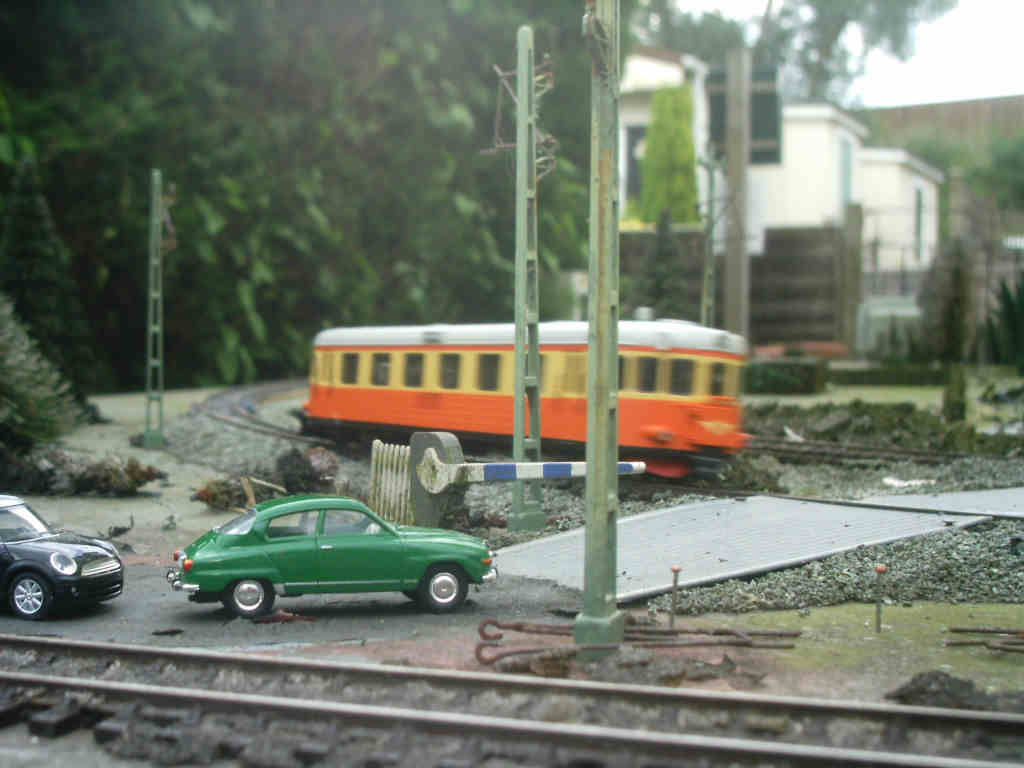
In these images (above), a heritage Y7 railbus contrasts with a modern black Rc-loco; and whilst the green car in the other image is probably the same epoch, the front can be seen of a much more modern car!

Living in the current times, it can be difficult to not take an interest in some modern artefacts.  Thankfully, this does not extend to the trains, but a few of the model buildings could perhaps be a bit too modern, as indeed are some of the cars and other road vehicles.  To offer justification for this, it was decided that the FLMJ is a ‘heritage railway set in the current day’, so some of the modern items could creep in.  And the local ‘kommun’ is said to be offering incentives to residents and businesses to respect the “heritage epoch”!

Next month, we’ll consider the scenery, or at least the scenic aspect of the railway.

Nyheter från maj 2022

Våra nyheter:

Vårt lok T45 har tagits ur lager, redo för vidare arbete. I skrivande stund har en förfrågan gjorts för att skaffa de nödvändiga delarna för att göra den till en fungerande modell, men denna förfrågan inkluderar en begäran om NEM standardhjul istället för RP25; förhoppningsvis får vi en uppdatering om det nästa månad . (Det fanns en antydan om att skaffa ett drivkit (chassi) privat, men allt verkar ha blivit tyst på det.)

Den ‘saknade’ NMJ ‘Kbps’-vagnen anlände i maj och det var glädjande att notera att numret har korrigerats (typ 335 istället för 370), och därmed är kontrollsiffran (‘4’) korrekt!

Tillverkarens Nyheter:

I de senaste nyheterna från HNoll verkar leveransen av nästa vagnar ha lagts tillbaka till efter sommaren! Förseningen har haft en förutsägbar effekt på finansieringen med betydligt högre kostnader för räntor som leder till högre produktionskostnader på framtida modeller än förväntat. Verksamheten bygger på lån. Man hade hoppats att HNoll nu skulle vara i en situation där framtida modeller till stor del kunde utvecklas med eget kapital. De är långt därifrån på grund av förseningarna.

Märklin/Trix har tillsammans gett ut respektive versioner av det danska Litra E-loket (3-räls från Märklin, 2-räls från Trix), för att hjälpa till att fira ett stort danskt järnvägsjubileum! Medan alla de svenska “F”-ångloken blev klass “E” i Danmark (efter att ha sålts till DSB), byggdes många fler på licens, och modellen representerar ett av de senare loken. Det betyder att det finns detaljskillnader som utesluter tillverkningen av ett passande svenskt F-lok. Återförsäljare hoppas på att en lämpligt omarbetad version kommer att bli tillgänglig senare (med samma chassi skulle båda tillverkarna vinna på extraförsäljning av svenska och danska versioner av det svenskbyggda loket), men som alltid är ingenting säkert! Ändå har det skett en ökning av antalet versioner av sämre kvalitet av dessa modeller från Heljan som dykt upp på andrahandsmarknaden, nyligen!

Andra intressanta nyheter:

Spårvägsmuseet öppnade igen på sin nya plats den 21 maj och med fritt inträde den helgen var det mycket hektiskt. Vi var glada över att se att trots att det är en mindre plats har ingen av charmen gått förlorad, och utställningsföremålens layout är inspirerande. Det är fortfarande fokuserat på transporten av huvudstaden. Det är lätt att ta sig till Spårvägsmuseet med blå buss nummer 6 (går mellan Karolinska sjukhuset och Ropsten), och röd buss nummer 75 (går mellan Centralstationen och Ropsten), båda går till Drevergatan. Själva museet finns på Gasverkstorget 1, 115 42 Stockholm. Även båt nummer 80 anlöper bryggan vid Ropsten, varifrån det är 10 minuters promenad till museet. Vi har återställt länken till deras webbplats på vår sida med relaterade länkar.

News from May 2022

Our News

Our T45 loco has been brought out of storage, ready for further work. At the time of writing, an enquiry has been made to obtain the necessary parts to make it into a working model, but this enquiry includes a request for NEM standard wheels instead of RP25, Hopefully, we’ll have an update on that next month. (There was a hint of obtaining a drive kit (chassis) privately, but all seems to have gone quiet on that.)

The ‘missing’ NMJ ‘Kbps’ wagon arrived in May, and it was pleasing to note that the number has been corrected (type 335 instead of 370), and thus the control digit (‘4’) is correct!

Manufacturer News

In the latest news from HNoll, delivery of the next carriages seems to have been put back to after the summer! The delay has had a predictable effect on the funding with significantly higher costs for interest rates leading to higher production costs on future models than expected. The business is based on loans. It had been hoped that by now, HNoll would now be in a situation where future models could largely be developed with equity. They are far from there, because of the delays.

Märklin/Trix have jointly issued respective versions of the Danish Litra E locomotive (3-rail from Märklin, 2-rail from Trix), to help celebrate a big Danish railway anniversary! Whilst all of the Swedish ‘F’ steam locos became class ‘E’ in Denmark (after being sold to the DSB), many more were built under licence, and the model represents one of the latter locos. This means that there are subtle but significant detail differences, precluding the production of a suitable Swedish ‘F’ loco. Retailers are hopeful that a suitably retooled version will become available later (using the same chassis, both manufacturers would gain with extra sales of Swedish and Danish versions of the Swedish-built loco), but as always, nothing is certain! Nevertheless, there has been an increase in the number of the poorer quality versions of these models from Heljan appearing on the second-hand market, recently!

Other News

Spårvägsmuseet reopened at its new location on May 21st, and with free entry on that weekend, it was understandably busy. We were delighted to see that despite being a smaller site, none of the charm has been lost, and the layout of the exhibits is inspiring. It remains focused on the transport of the capital city, (unlike the LTM in London which focuses more on the economic and social history of that city, competing with the London Museum). Spårvägsmuseet is easily reached by blue bus number 6 (running between Karolinska Hospital and Ropsten), and red bus number 75 (running between Centralstation and Ropsten), both calling at Drevergatan. The museum itself is at Gasverkstorget 1, 115 42 Stockholm. Even boat number 80 calls at the pier at Ropsten, from where there is a 10-minutes walk to the museum. We have reinstated the link to their website on our Related Links page.

In the image above, the mini-train is being driven by the ‘pedestrian’ at the very back, using a radio controller. This ensures more seats for passengers, and the driver has a good all-round vision of the passengers (safety), the train, and its environment, especially important given that it is not fenced off. The museum is on four levels all accessible by lift.

Behind the Scenes

Mini-Series about the FLMJ, 6: How it worked
The FLMJ was always a 12v dc analogue railway. DCC (Digital Command Control) has been looked at and played with on other people’s layouts, but on balance we have reached the decision that it is not right for the FLMJ.
The conventional analogue system on two rails provided a simple means of controlling the trains. By remembering that the Positive rail (+ve) is always the one on the right (despite Peco’s misguided advice to the contrary), the scope of the system is as good as the modeller is creative. With the FLMJ, all track sections were divided electrically (rather like signalling block sections on a larger-scale railway), and a toggle switch (with a centre-off position) was provided for each section. Moving the switch down connected that track to the local controller; moving it up connected it to a remote controller. If we had a location where coupling up (of double-locos) was required, then a simple on-off subsection would be provided; this was the case at Ålunden and intended for Fjällnäs. Eventually, we were able to control the entire railway from the Lövhöjden control panel, with the Ålunden track sections selected to the remote controller. (By that time, Månstorp had lost its local controls!) It had an added bonus of being able to be operated by one person alone, or by a group of people. As an original intention, this will be used on any new layout.

Between the controlled locations, there were specially controlled sections that could be controlled from either end; whichever end took control first, blocked out the controller from the other end. However, the other end could interrupt the continuity of the connection and take over! This was useful when running a train without wanting to stop it; the controllers would be synchronised (speed and direction) and then switched over to enable the smooth running of the train. Coloured indicators confirmed the status of these sections.

Different locations had different switch layouts, so that we could see which were the most user-friendly! At Ålunden, they were mounted in a row, and labelled to match the labels on the track diagram. At Lövhöjden, they were mounted onto the track diagram. One of the shunting areas had the switches in groups according to usage; and the locoshed area had two way centre-off sub-sections so that one line or the other could be connected, but not both! The new layout will have the switches arranged according to whatever feels right for the track plan; initially. But we wish to start with a new system that is interlocked with the signalling, so that by switching on a section with momentary contact, the controller follows the train according to the signalling and point settings. It will be an experiment, and until it is in a semi-advanced stage, we cannot sensibly say more about it, here, now.

Next month, having mentioned the signalling, we’ll take a look at that.