Category Archives: AJ News

News from Adnalms Järnvägar

News from November 2022

Our News

A set of Roco Uad/Uadp wagons arrived in November, but not without problems. The set comprises one Uad and three Uadp. According to resources, none of these wagons would duplicate what we already have. But the set was second hand. The Uad has been exchanged at some time, and the one in the box is a duplicate! All Uadp had ac wheel-sets, so these needed to be changed at further expense! We need to get into the habit of taking a magnifying glass with us to exhibitions because these wagons’ numbers are very tiny, and with second-hand purchases, there is always a risk that we’re not getting what we’re expecting. (Hopefully, a future order to Byggsvenskt.nu will give us a unique wagon number!)

To the casual observer, the purchase of the Roco model of the Co8a would seem a bit strange, especially when one considers that we’ve had two of these before, and sold them. Why? Because we could not find any information supporting their authenticity, and we suspected that they were 1:100 scale length, given that they are quite short. The fact that they also had the older style gangways did nothing to encourage an interest in them. NOW, however, we know that the OKB had two of these, built as copies of very similar carriages purchased new from Germany in the 1920s. They were indeed much shorter than other carriages in use on SJ (though the model is still a bit short; in scale terms by about 60cm), and unlike the ‘composite’ carriages, for which we were able to easily find reference, they were withdrawn quite early. With the restructuring of proposed train formations (for a new railway), a use for this carriage became apparent, so we’d been on the look-out for a while; but the model had to fit certain criteria, It needed to be complete without damage; it needed NEM couplings; it needed a box. The inner tray for the box was damaged, but with the experience of building a new one for a Heljan model recently, satisfied that the outer box was OK, we went ahead with the purchase of a suitably priced model.

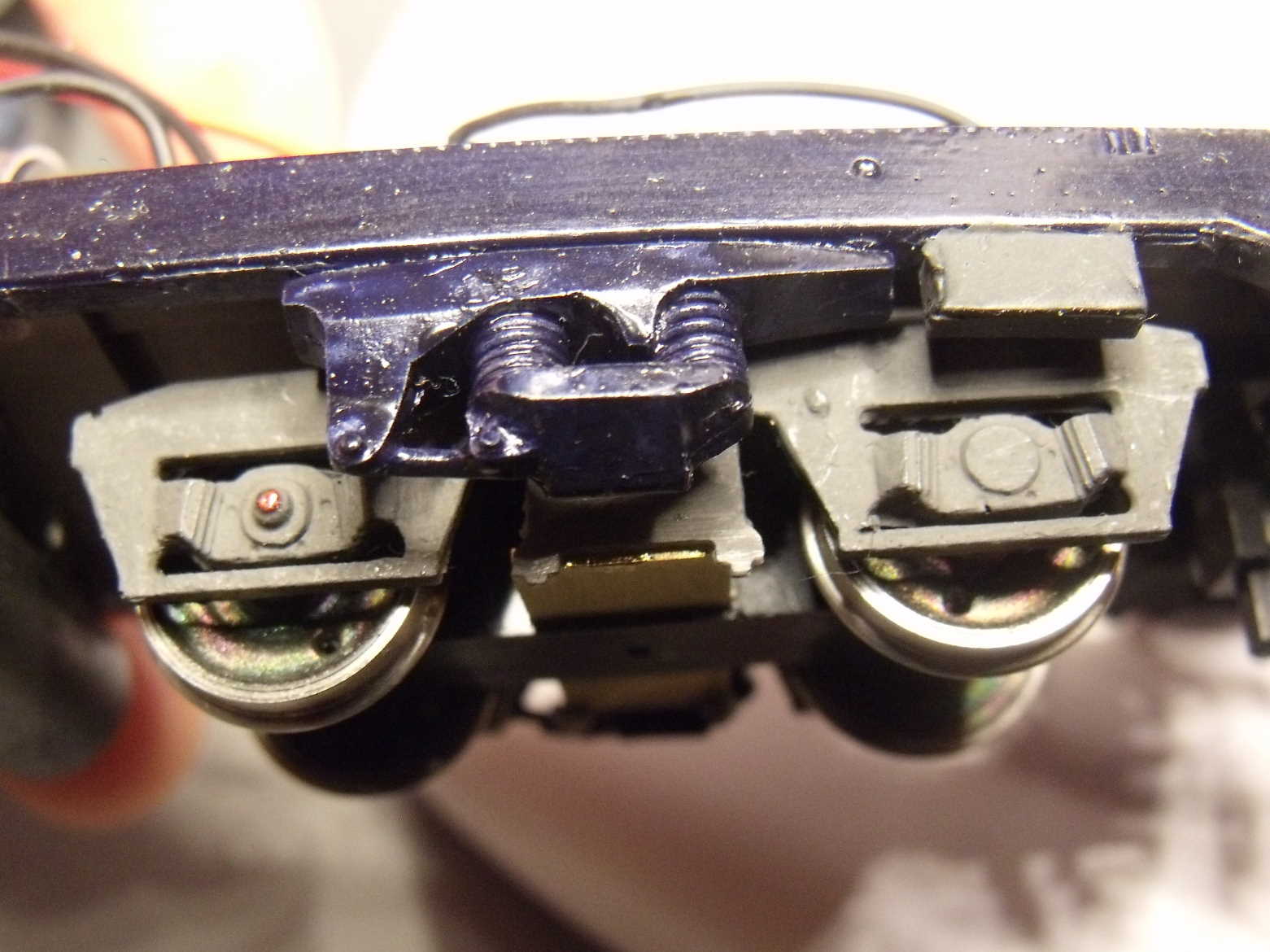
As the month drew to a close, a second Heljan T21 was purchased! Its price was below the limit that we had set, and it was in reasonable condition. Again, one might ask why? A second one had been wanted since before the railway closed, and being common for these locos to work in pairs, that interest still existed. Having worked extensively on the first (T21 64: see updates during 2020), we were ready for the challenge! Naturally, many things had fallen off, but all the essential parts (except for one plough) were present and correct. This now gives us a full time (evening) job; to prepare the model for reliable service; and this includes remedial measures to the motor cover so that we don’t need to replace it. With our existing one, the motor gear rubbed on the white-metal casing causing a lot of friction and a lot of swarf adding to the friction—then it died completely! The remedial work included the purchase of a third party motor and grinding down the space inside the cover! During the initial investigation with our newer acquisition, we refitted all the glazing and one underframe item. We also fitted the window to the ‘B’-end door because it looked a bit silly with the badly fitting blanking plate! With one plough missing (and one loose in the packaging) we removed the others (there are four in total; one under each buffer, not full width). Looking back through photos of the work on the other loco, that also has no ploughs fitted! Getting the body off was as usual, tricky, despite following the instructions in Heljan’s manual. They have used a tape at the ends to block the light from shining through the plastic body and this had become sticky on both sides. But once off, we removed the tape and painted matt black inside. At the end of the initial investigation, some of the loco was put back together, but without the cab or hoods, seeing that more work would be required here quite soon and we didn’t want to risk unnecessary damage!

Manufacturer News

Not content with delighting modellers with a new loco, the T23, Jeco had on display at Hjulmarknaden, two new trailers for the Y6-series of railbuses. One is a combined seating/luggage trailer (of which one type is now in service at the Nene Valley Railway in England), and the other is an all-luggage trailer (full length on bogies). These are long overdue and no doubt purchases will be made in the FLMJ’s favour! There is no mention of them on the website presently, and no supporting literature was at the event!
Another interesting thing from Hjulmarknaden was a new-ish firm selling track setting templates, rather like the ones we had in England, but for much larger radius curves. Quite possibly we will be investing in a complete set once a start has been made on the new railway.

Other News

A short article in the current “Tåg”, mentions that this autumn (2022) is the 100th anniversary of the start of what we know as H0-scale! Well, to be correct, one should say the track gauge of 16.5mm. In the infancy of model trains, it was the gauge rather than the scale that was the starting point. Larger scales had been available before then, but as space became a premium, something smaller was desired. In the late autumn of 1922 the first small trains of this type were introduced. They were manufactured by the German firm Bing in Nürnberg but were initially introduced to the British market. Scale and accuracy was not important, they just needed to represent something vaguely familiar. Electric models arrived a few years later, operating at 4-8v. In 1935, Trix and Märklin came out with their respective ranges of model trains in Bing’s spirit. The development of modern H0 models was thus underway. But “Tåg’s” writer observes that the honour of being first goes to Bing!
(The term ‘H0’ simply means “Half-0” as in half 0-gauge; which is actually 32mm, so there is a slight discrepancy! The ‘0’ is a number, not a capital (or upper-case) ‘O’. The term ‘00’, like small paint-brushes, just adds an extra number 0 for the next size down – so yes, TT was originally known in the UK as ‘000’!)

We mentioned the 1409 website recently; and using it, we were able to track and then go out to get a photo of this train at Myrbacken! We understand that the train started with just the two Rc-locos, but after hitting a moose, causing minor loco-damage, the leading loco was brought to the rescue!

In our update from September, we commented about an event that had been advertised, but didn’t seem to be taking place. In conversation with a trader at Hjulmarknaden in November, we were told that the event did take place at another location, but it was VERY poorly attended. No prizes for guessing why!

Behind the Scenes

Mini-Series about the FLMJ, 12: Faring up for the Future
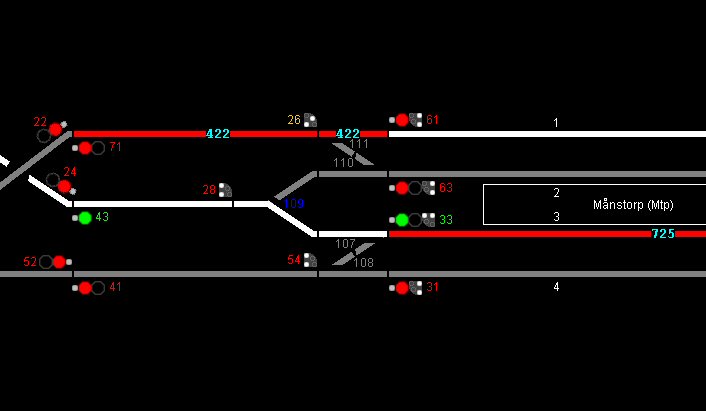
It is impossible to make any plans for the new railway until the location has been found. A perfect situation would be for us to be able to recreate what we had; maybe with the original track plan reinstated at Månstorp (before the truncation mentioned earlier in the year). More space, however, would give us bigger station areas at Lövhöjden and Månstorp; less space would need further thinking about. But this is not a doom-and-gloom prospect. We did look at a location near Karlsborg which would have been much smaller, but the shape of the area available inspired a new layout design, whilst enabling us to keep the FLMJ title! We just need to be creative and think outside the box; and as the saying goes, “only dead ideas stay inside the box”!

Since the FLMJ was closed we have kept the timetable and scheduling up to date, so that we can land on our feet when we are able to start again. Nothing (important) has been forgotten, nothing has gone to waste. We have also created a so-called ”Fantasy Layout” which enables us to trial other timetabling elements, other signalling practices, other track layouts, and many more other things that are essential to the making of the successful operation and development of a model railway. Many aspects of the new railway can be planned at this stage, and this will help us when we are ready to plan it in finer detail.

It is just over four years, now, since the FLMJ was closed. In the time since then, personal commitments have taken priority, and many hurdles have needed to be overcome; a process that continues. It is said that a bad situation is the condiment that gives the eventual good situation its flavour. Real difficulties can be overcome; it is only the imaginary ones that are unconquerable. Over this last year, we have given you a slight insight to the Railway. A more thorough description will be in our forthcoming book.

Next month: we start a new series looking at the publications (Adnalms Förening (Järnvägar)) that have been produced over the years, from the regular journal to the year books and everything in between.

News from October 2022

Our News

With a work-free weekend mid-month, there was a plan to paint over the Z66 000 number on the little shunting loco so that we could apply the Z69 659 decals; but the decals were in a safe place and couldn’t be found! So, instead, we repaired the broken buffer on one of the FV1/F5-L models. Comparing this with the other two that we have here, we found that one of the others also had a damaged buffer and we could see that the cause was the nature of the inner packaging that is supposed to support the model and protect it from damage! This was also repaired. Using available time, we finished by modifying the homemade inner ‘tray’ for the equally homemade box for the FV1 that was bought second-hand without an original box. This will protect it from further damage.

As the month drew to a close, and having located the decals, Z69 659 was accordingly branded, and is now fit for full service.

We took delivery of the replacement buffers for the N-loco in October, but time has not yet been allocated for fitting them. We are looking at a weekend in December…!

Manufacturer News

Without a doubt, the biggest news of the year has to be the announcement of a new loco, this from Jeco; the T23 diesel. There will be six different numbers, and it will be available in analogue and digital, and two livery versions. During the 1950s, SJ bought 25 narrow-gauge ‘Tp’ locomotives to replace the steam locomotives on the 891mm gauge lines. However, as the narrow-gauge lines were shut down one by one, it soon became clear to SJ that they had more locomotives than they needed, and they were unsuccessful in selling them; so, it was decided to rebuild fifteen of them into standard gauge locomotives. The rebuilds took place in collaboration between SJ’s workshop in Örebro and AB Svenska Järnvägsverkstäderna in Falun. A new framework had to be constructed and the locomotive bodies widened. Axle-description changed to D (0-8-0 in British nomenclature) instead of 1’C1’ (2-6-2), but still with coupling rod drive. The locomotives were given a livery similar to T21 in red-brown with yellow decorative stripes. They were used in freight trains and shunting in, among other places, Halmstad and Jönköping, but the period of service was short. Towards the end of the 1970s, the locomotives were taken out of service and set aside as standby locomotives. One locomotive (115) was sold as an industrial locomotive to Gullfiber and ended up in the early 1990s with the freight company Österlentåg. After the company went bankrupt, the locomotive was sold to a scrap company. In 2002, Banverket decided to dispose of the T23 locomotives that were on standby and they were sold to various museum associations and scrap dealers. Several T23 locomotives are therefore preserved; represented by five of the six to be produced as models.

Jeco has also renewed their intention to produce more Rc-series locomotives, including Rc1 and Rc4 in orange livery, and several more modern liveries on Rc2 and Rc3.

Dekas is extending their range of grain wagons with three marked ‘Udg’, suitable for the earlier part of Epoch-IV; and a couple as S-RT (Epoch-VI). The S-RT Ugkkpp is a model of SJ sand-train covered hopper wagon, used from 2015, and currently. These are all expected January 2023.

Brekina has released a Büssing Senator 12D bus in “Stockholms Spårvägar” (SS) livery. Described as a 1962 model, it is actually in rebuilt condition with doors on the right for right-hand traffic (from September 1967). At least one of these has been preserved in the Stockholm area. A sample has arrived here; very nicely made, but disappointingly without any decals for route number or destination!

Whilst doing a round-up of manufacturers’ updates (which we don’t do as often as we ought), we found a dead link, and upon further investigation, found that Brimalm Engineering AB was declared bankrupt in 2017. Brimalm was best known for hand-built models in etched brass, aimed at the high-earners and collectors, and made in very limited editions. It is generally considered, however, that Brimalm did nothing for model railways as a ‘whole’; the models were priced in a different league to the interests of serious railway modellers. They were often considered to be in a similar class with “Fabergé eggs”, more about investment than true railway modelling, and certainly nothing to attract children and youth into the hobby. Naturally, businesses of this nature have a high risk of collapse in the slightest wobble in the global economy, and this seems to have been the case.

Other News

In our review of the holiday around Swedish Railway places this year, reference was made to hospital carriages, of which no information could be found. SJK’s latest edition of Tåg carries an article about hospital (and ambulance) carriages, but seemingly no mention of these two (one at Oxelösund, and one at Grängesberg). Reference was made however to two Bo14b carriages, 1899 and 1901, which had been converted to So10, and the descriptions fit (and further research shews that these were originally wooden bodied Co6 carriages). But their demise is quoted (in Tåg) as one at Nässjö Railway Museum and parts of the other at Gävle Railway Museum. Digging deeper, we found that 1899 was purchased from Gävle a few years ago and is at the FSVJ at Oxelösund. It is believed that the reference to ‘1899’ on the ‘parts’ probably relates to something else, or something that had been a temporary fit! 1901 was last said to be in railway ‘department’ use, and the one photo that we have of the carriage at Grängesberg does show a tiny part of a wagon number under the grey paint; making this very likely to be 1901. The website for Nässjö’s Railway Museum says nothing about the rolling stock there, and we’ve not visited (since 1998), so we are cautiously confident that we have identified both carriages.

We recently had a good look around our website to see if anything needed updating. Oh yes; and a few typos need correcting also. We will be spending the time between now and the end of the year to tweak and polish, but there seems little point in cataloguing them here. Any big changes will, of course, get a mention.

Behind the Scenes

Mini-Series about the FLMJ, 11: The Team behind the Railway

Whilst the FLMJ was managed by one person, it ought to be remembered that it was owned by Adnalms Järnvägar, and the operation and maintenance of the Railway was carried out by a team of dedicated volunteers. These friends of the Railway were known as a club, Adnalms Järnvägsklubb (AJK); and when the belligerent site owner decided to ban clubs from the (residential) estate, we changed our status to ’Friends of the Railway’ thus Adnalms Järnvägsförening (AJF)! (The site owners really were control freaks who imposed many pointless and unnecessary rules and prohibitions; they even tried to prevent the development of the railway!) The railway’s investment was assumed to come from one source, the Manager (or Director General to use the official title), but this was not the case. There were several outside sources who were suitably inspired by the railway to want to contribute to its success and development. But the Railway’s influence resulted in a number of volunteers building their own Swedish or multinational railway layouts, and to them we are sorry for the FLMJ’s closure.

Adnalms Järnvägsförening (the ’Friends’ of the Railway) continues to this day, albeit as a remote club sharing news, ideas, and inspiration, largely via this website. The Friends will continue to receive our support and encouragement especially with the development of their own Swedish railway modelling. Adnalms Järnvägsklubb (the Club) will be re-established once a start has been made on the new railway. We have no delusions about how big such a club could become, especially considering that ‘DCC’, in which we have no interest, has quite a large following here; and the railway will be designed in the same way as before, so that it can be operated by just the one person alone if necessary, or by a team.

Because of the nature of sharing this hobby, our updates tend to use ‘we’ instead of ‘I’; and it is fair to record that almost everything that is done – even the outings – has more than just the one person taking part. The summer tour of railway museums was mostly in the accompaniment of one or more friends; the work on developing a temporary layout here in Odensala is being made possible by housemates’ assistance; and so on.

Next month, in our final instalment*, we’ll look at the possibilities for the way forward.
*Well, we actually have something ‘different’ but related, planned, for 2023!

News from September 2022

Our News:

With the purchase of suitable materials, work continued on the T45 locomotive. A plastic block was inserted at each end under the body, at chassis level, and suitably glued, drilled and tapped, we are now able to secure the body to the chassis at the ends. This eliminates the visual effects of the slightly bowed chassis. The locomotive is now almost ready for running in. The bogie sides and bolsters (cosmetic items on a model) seem to have been put in a safe place, so they will be fitted later; but for now there is no further work to be done to this model. This does not mean it is complete, however. Not purchased all those years ago when we bought the model were things like handrails, wipers and suchlike; so we hope to acquire these in the coming months (preferably as an add-on kit, but scratch-built if not available), probably from ‘Hjulmarknaden’.

Manufacturer News:

HNoll has been hit by further problems, some with much wider knock-on effects. The 3D CAD designer at Dekas, who draws HNoll’s models, has resigned, and will not be replaced. The models that have been drawn will be manufactured, but what is on the drawing board will need to be completed, probably by another party. This means that the delivery of carriages will be further delayed indefinitely. Furthermore, prices are going up; materials, labour, freight and increased living costs in Sweden. The prices of HNoll’s models will be adjusted. The passenger carriages that are on their way (currently held in Chinese customs) will be able to keep their recommended price of 995:-. But, the B4/BF4/BF7 carriages will be adjusted to 1195:-, and there is no known delivery time!

Last month, we announced the availability of the PCX87 Volvo 343, but ours didn’t get delivered until September, so we had no picture. Here is one of two of the models: to advertise the 343 as a cheaper model than the 240 which was available at the same time, Volvo produced them in primary colours.

Other News:

The model exhibition at Kårsta, as mentioned on our website, didn’t exist! (We won’t be promoting Staffshobbyhörna again!) Their advert didn’t give a specific address for the event, so we went to the only address given on their website, Kårsta stationsväg 16, 186 60 Kårsta; which seems to be a residential property, not the venue of an event with at least 16 traders! We were not the only ones to go there. One other punter made a few phone calls (none to the organiser because no number was given) and found out about a rumour of an event near Vallentuna, not so far away; but with no address, we (and the other punters) abandoned the mission and went home! (By the time we realised that this was a spoof, the train that brought us to Kårsta had departed, and it was an hour to the next one, so the general mood was not good!)

On to a nicer item; we have discovered what seems to be a new website in Sweden, which we have linked to from this website. It shews the Swedish railway map and the location of nearly all trains in traffic, colour coded according to how well they are performing in relation to the timetable. This is useful for passengers who might be wondering where their delayed train is, and interesting for enthusiasts for all sorts of hobby related reasons. (We can now see when a goods train is about to run past our window and therefore be ready with a camera!) The unusual URL is 1409.se.

Behind the Scenes:

Mini-Series about the FLMJ, 10: Track and Infrastructure

From inception, the FLMJ used Peco Code-100 track. Code-100 refers to an imperial measurement of rail height, 100 thousandths of an inch (one-tenth is easier to read)! This is a little overscale, and Peco has subsequently created Code-75 track, which is actually a bit too small for European standard. Roco, among others, created Code-83 (which Peco also does, now), and with which the KRBJ experimented in 1992. (The KRBJ’s experiment failed because the points had inbuilt contacts that were not weather-proof!) We also had a particular liking for Code-100 because its bulkiness resisted the problems of the uneven nature of the garden-located railway, it resisted moving with the deteriorating baseboards and resisted vandalism from the local cats!

But, the way forward is different. We have no desire to build the railway outdoors again (and here in Sweden, H0 scale would not be compatible with the weather). So, we are confident about moving down to Code-83. This gives us the opportunity to investigate other brands alongside Peco, and sadly, it seems that the best producer of Code-83 was Shinohara, who closed down in 2018. We also investigated Tillig for their dual-gauge elements, but they only feature H0e (9mm) and H0m (12mm), not H0n3 (10,5mm), which would be best for representing the very Swedish gauge of 891mm. So, that brings us to Roco. Their finer-scale turnouts (points) are at 10° instead of Peco’s 12°, but curiously, not their diamond crossings which are at 15°. This was the biggest cause of hesitation with Roco, but there is an interesting consideration that the final form of the FLMJ in the UK had no diamond crossings; so we could still move forward with this brand. There is also an absence of three-way points in Roco’s range, but this does not create any major problems for us. As with Peco, everything is produced with timber profile sleepers (actually made of plastic, of course), but the long flexible panels are also available with concrete. (Tillig, whose range is very limited, also offer imitation steel sleepers!) We have four short panels for display purposes, and a point will be purchased before too long to experiment with. Peco has had to be ‘dropped’, due to the higher costs caused by Brexit from the EU (but more due to the subsequent departure from the EEA as well); and supply problems due to their difficulties in finding a way to produce materials during the Covid pandemic, which other manufacturers seemed able to do.

The FLMJ, for a few years, was fitted with a not-quite-complete catenary system. We had purchased the somewhat cumbersome Jeco variety instead of finescale Entec, due to considerations of cost (so much needed) and the ability to stand up to the cats! The system was not completed due to issues with stability and rust; but, even without the contact wire, images of the railway at this time are impressive and inspiring. Some of the catenary bridges across the station layouts had been made to our specification, in terms of track spacing; it is doubtful that we’ll be able to use them again, but this is also something that cannot be predicted. Towards the end of the double-track main line era, we received some ready-made Entec masts. These were much stronger than we had thought they might be, and so there is a fair possibility that any new layout will have a mixture of the two marques.

Next month, we’ll pay tribute to the team who made the FLMJ what it was!

News from August 2022

Our News

No railway modelling activity has occurred this last month! Summer shut-down is typical for Sweden, so it was not possible to buy materials, either. Now that the Autumn is setting in, things should pick up a bit, and in September there is one event that we hope to get to.

As hinted previously, we have now added a more in-depth review of the tour of railway installations here in Sweden. You can find it under ‘General Articles’ from the home page.
(In the article, mention is made of problems with a new Doro phone. This has now been replaced following its inability to display incoming SMS; a problem other Doro owners have reported. So, for the first time, we provide consumer advice not related to railways: don’t buy a Doro!)

Manufacturer News

Danish manufacturer Dekas has advised of their Swedish outline models, that IBAB TMX 1014 (DK-8750121~4) has arrived and that most of the dealers pre-orders have been dispatched. The rerun of the TMX from Vida and Tågkraft (blue and orange) should arrive mid-September. (Our photo below shews the Heljan version of this loco!)

Fleischmann and Roco have introduced a new article numbering system, but in the examples that they give in their news item about it, do not fully tally with the descriptions, and it seems that there will now be no distinction between Fleischmann and Roco products.

PCX87’s Volvo 343 is now in the shops, as is the second batch of 240 sedans and estates.

Other News

The last C6 train ran on the Blue line on Sunday 7th August. We are a little confused about what the event signified. The train was brought in for the occasion from another line; the C14 (of the same “first generation”) will be in service on that line for possibly two more years; so the event wasn’t a true end of an era, as the promotional texts implied! (We understand that the blue line had a small allocation of C6 from 1975 to 2003/4, running alongside C7, C8, C9 and C15. But the C6 was used more on the red line.) Nevertheless, it was an enjoyable day out, to ride on the old noisy and bumpy rolling stock, and to meet an old friend from the UK!

Behind the Scenes

Before we get underway with our Mini-Series about the FLMJ; following our review of the Railway’s Epoch, better clarification and understanding was requested, so here is a brief summary.

For authentic representation of a period of railway history on model railway layouts in Europe, a division into different eras/epochs was established. Often this information on the epoch is given in the catalogues and/or on the product packaging. It is NEM recognised. The published periods are quite controversial, as they tend to have no direct reference between the epoch designation and a specific year or a specific decade. The time epochs could just as easily be given in the time segments of the decades or with specific year numbers, as is usual in North America.
As a rule of thumb, then:
~Epoch-I until around 1925.
~Epoch-II from around 1920 to around 1950.
~Epoch-III from around 1945 to around 1970.
~Epoch-IV from around 1965 to around 1990.
~Epoch-V from around 1985 to around 2010.
~Epoch-VI from around 2005.
Sweden’s new ‘blue’ themed liveries were introduced in 1989 and are said to be the start of Sweden’s Epoch-V. Previously, a major reclassification of rolling stock occurred around 1970, so that could be the Swedish start of Epoch-IV, not 1965 as suggested above. (But this is complicated by the 1967 arrival of the revolutionising Rc-loco!) So, the Epochs are vague within countries, not just between them.

The United Kingdom uses it’s own system and is already into Epoch-9!

Mini-Series about the FLMJ, 9: The Scenic aspect

Scenery was a sore point on the FLMJ. Very little was weather-proof, and nothing was cat-proof! In 1996, in the final days of the KRBJ, the whole infrastructure suffered extensive vandalism. Subsequently, only the track and platforms became permanent features. Everything else was taken in at the end of the day. This meant that it took a couple of hours to set up each time we wanted to operate the railway, and the same again to put away. This was in addition to cleaning the track in the mornings, and drying things off in the evenings if we had endured typical British weather! For some weekend ‘open’ events, not everything did get put away on the Saturday evening, just hidden from incidental view; but a good night’s sleep was not then possible!

All locations had a number of model buildings (which were mounted over locating blocks to ensure that they were correctly positioned) and most of the roads were painted down. Lövhöjden and the nearby Kopparberg received a bit more attention. Gradients and contours appeared in the scenery, along with corrective measures to keep the buildings upright in strong winds! Greenery was added, and the area around the loco-shed especially, became very photogenic. But the final and delightful addition was the lighting, around the loco-shed area and in the church much farther away.

The church in question was a model of the church from Seglora, now preserved at Skansen. Other authentic buildings were the Diö and Åmål station buildings at Månstorp and Lövhöjden respectively; but many other authentic representations existed all over the layout. Special mention should be made of the block of flats kit produced by Auhagen, of which we had two; of German origin, but so authentic for 1940s/1950s Sweden and still current today.

Most of the model cars were faithful to the epoch (see last month’s update), but we decided that rather than reject interesting models, we would treat the whole diorama as a heritage setting, and allow modern vehicles to creep in. Sometimes, these represent cars that friends have. But currently, thinking of Swedish brands, the most modern Saab is a 900 from the mid-80s and the most modern Volvo is the 850 from the early 90s. But whatever our new diorama is, it will have to accept a Swedish Koenigsegg from 2015! One of our members also has a private collection of SL buses, which are quite modern; but too nice to not have on the layout! Doh!

Before moving to the address where the FLMJ existed, the Director General had managed the Herpham & District Railway, a combined H0e/00-9 model railway; which was more of a scenic diorama with the small railway running through it. It was inspirational, charming, and a delightful setting that people enjoyed. With the new FLMJ being planned for an indoor location, the scenic possibilities are inspiring.

Next month, back to the railway itself, we’ll look at the track and infrastructure!

News from July 2022

Our News

Work has started on the second significant phase of the construction of the T45 diesel locomotive.  This is the fitting of the motor, wheels, and complete drive-gear.  The start of this work was reasonably straight forward.  With the temporary ‘accommodation bogies’ removed, the new ones (from SV&LV – Skultorps Vagn & LokVerkstad) fitted perfectly into place; but it was a very fiddly job to fit the securing nut on each bogie, due to being difficult to access, and having very fine threads!  The motor is a tight squeeze into the recess specially made for it, but there is no means of securing it.  It might not need securing; testing at a later date will confirm one way or the other. Between the motor and each bogie there is a prop shaft (cardan shaft), and everything turns freely.  Electrically, we decided that it would be wise to be able to remove components if the need arises, but lacking any plug couplers, the pairs of cables from the motor and each bogie were soldered to a contact strip that we glued onto the chassis (instead of soldering it all together directly).  Then we reassembled the model and found that the chassis still bows slightly, so we will make up new securing points at each end, which we will use with two more M2 screws.  Unfortunately, some of the more cosmetic components for the loco have been left behind in the storage facility, so these will be procured at a later date.  With the absence of the full workshop facility, it should not be considered bad that the work described above took 4¾ hours.  A week or so later (17th July), the loco was tested on a track with controller, with pleasing results.  Clearly, it will need running in, but just to see it move a short distance under proper power was a great boost to the morale.

Odensala Prästgård is the name of our temporary diorama.  There is the mainline between Märsta and Knivsta quite close to the temporary lodgings, and there used to be a station at Odensala, many years ago.  So, the idea is to expand on the idea of a siding being retained, leading to a small area with just a few tracks for maintenance and other things; also giving us good photography opportunities!  With the purchase of a new car (in 1:1 scale) draining funds, construction has been delayed slightly, but the T45 (see above) is keeping us busy!

Manufacturer News

In a recent update from HNoll, they write that a delivery is expected by boat from China in 2-3 months, but not including the A11/B11 carriages (we’re not sure what is included).  But there will be a few more restaurant, couchette and sleeper carriages, some with new numbers.

Other News

As hinted last month, the summer tour of railway establishments actually started in June.  Participants numbered from 1 to 8 depending on venue.

We started at Nynäshamns Järnvägsmuseum, adjacent to Nynäs Gård station.  This is a small museum and a bit too cramped, so photo opportunities were poor.  But it has the usual hands-on policy, so we were able to look in every nook and cranny wherever our fancy took us.  Naturally, this included the cab of E class 1189.

A few days later, we went to the Uppsala Lenna Järnväg (known also as the LennaKatten).  Of the three trains in service, only one was steam-hauled, so that was our choice.  A diesel hauled train was available, as was a diesel railbus train.  After such a long time since last riding behind a steam loco, advantage was taken of the end platform on the leading carriage, and a delightful experience it was.

On the following day, we went to the permanent Model Railway Exhibition at Söderby/Alunda.  This is a collection of model railways and train sets, mostly H0, but not entirely, and aimed more at the family audience than the true railway modeller.  Interesting, but unlikely to revisit.

After a day’s rest, we went to Oxelösund, the “O” in TGOJ, to visit the FSVJ (Föreningen Sörmlands VeteranJärnväg) there.  As with the museum at Nynäshamn, this is a static museum, and we were able to look over, among other things, a Ma-loco of the TGOJ variety, two of the four 1950s TGOJ carriages (the other two were present, but closed), and their former conference carriage (which started out as one of SJ’s first two restaurant carriages in 1929), where a Fika was enjoyed!  Returning from Oxelösund, an unplanned detour was made to Läggesta for a ride on the ÖSlJ, with a steam loco, to Mariefred and back!

After another day’s rest we went on a tour that included three nights in B+B (at Örebro).  The first of these four days was at Grängesberg, the “G” in TGOJ.  Here, we saw some of the items modelled at the FLMJ; carriages type BCo7, Co8f, F5; and the Volvo rail-car.  Whilst a few nicely restored items are kept under cover in the roundhouse, too many artefacts are rotting away outside in the elements, and we can understand why some items (the 1950s carriages, for example) have been removed from here.

The second day was at Hallsberg, “Hallsbergs Modelljärnvägsförening”; a significant model railway layout, open to the public, adjoining the Bergöövåningen exhibition.  The main feature of the layout is the diorama of Hallsberg’s station, both the railway and the environment around it; and all of the local buildings have been faithfully recreated in miniature.  Afterwards, back to the 1:1 scale Hallsberg station for a few hours taking photographs, mostly goods trains, headed by Rc-locomotives, including a former ÖBB version of the Rc2!

The third day was at Nora and the overgrown line to Järle (where there was an exceptionally long turnover, despite there being nothing there).  There is another line towards Pershyttan (which was not operating, it seemed).  And that was about it.  A good look around the yard was inspiring (to see some particular items) but also depressing (to see items in the process of being scrapped)!  Travel was in a wooden planked carriage type Co4a-Å, coupled with two Norwegian carriages, both type B22 despite their many differences.  Due to a special event taking place in Nora, the local fishing club decided it appropriate to charge for parking where it should have been free; but at 20kr, it wasn’t worth the fuss or argument!

The final day was at Miniature Kingdom at Kungsör.  This is a Swedish equivalent of the Wunderland at Hamburg, but obviously smaller.  But it is quite impressive.  Like the FLMJ, it does not represent any particular area in exact detail; rather it shews a lot of Swedish landmarks, featuring elements from Stockholm, Norrland, Västerås, Örebro, and of course, Kungsör.  The layout is still under development, but this does not detract from the enjoyment of the exhibit, it provides a good behind-the-scenes exhibit without actually going behind the scenes.

A more thorough description of the staycation is being prepared for this website.

Behind the Scenes

Mini-Series about the FLMJ, 8: Epoch-IV

From inception, the FLMJ reflected the current Epoch.  But gradually, the availability of models disappeared.  A few modern goods wagons were being produced and locomotives were quite up to date.  But with only 1980s carriages in use, and the models being very limited in range (and certainly no unit trains being available); the FLMJ was becoming less and less authentic.  So, we stopped the clock and actually put it back to Epoch IV, which for us, represents the period through the 1970s and 1980s; but with a little late 60s and early 90s added.  And this is in addition to “heritage” trains!  Currently, this is a very comfortable decision to have made.  We have a good selection of 1960s and 1980s carriages available now or proposed (though 1940s/1970s styles are lacking), and the Y1 and Y6 generation of railbuses are about right.  We would be very happy for affordable models of the X9 to become available (at ‘average modeller’ prices), but otherwise all is well catered for.  In this epoch, the carriages are brown (mostly), and locos are either brown or orange.  Our most modern trains (just peeking into the 1990s) are the X2000 and Y2 (the latter still awaited, having parted with a terrible Heljan version); both in original liveries.  It is also the period when the railway system and the trains were operated by railway companies, unlike most of the current operators who have interests elsewhere, and there was a greater sense of pride and identity.  Indeed, the 150th anniversary of Stockholm’s Centralstation last year, was ignored completely because the organisations involved with the building today have no real interest in railways!

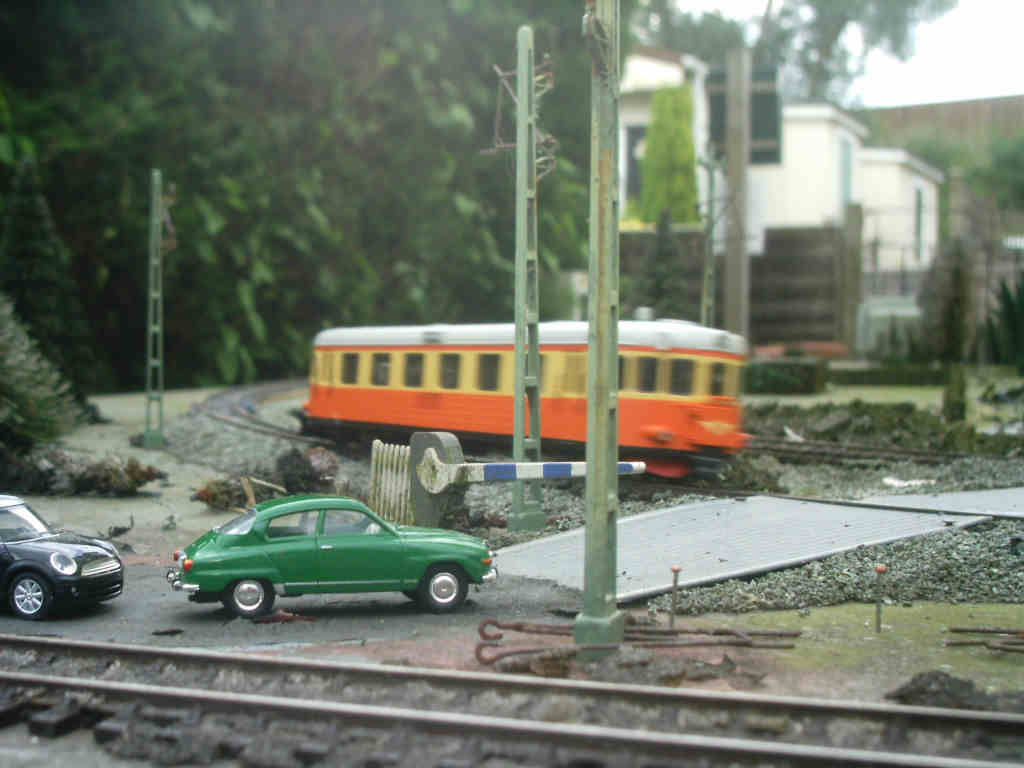
In these images (above), a heritage Y7 railbus contrasts with a modern black Rc-loco; and whilst the green car in the other image is probably the same epoch, the front can be seen of a much more modern car!

Living in the current times, it can be difficult to not take an interest in some modern artefacts.  Thankfully, this does not extend to the trains, but a few of the model buildings could perhaps be a bit too modern, as indeed are some of the cars and other road vehicles.  To offer justification for this, it was decided that the FLMJ is a ‘heritage railway set in the current day’, so some of the modern items could creep in.  And the local ‘kommun’ is said to be offering incentives to residents and businesses to respect the “heritage epoch”!

Next month, we’ll consider the scenery, or at least the scenic aspect of the railway.

News from June 2022

Our News

After many discussions on the subject with local friends, we are about to embark on the construction of a small diorama that will include the possibility to run trains. It will be smaller than Köpingsvik, but not the proposed Byxelkrok layout, because we want overhead cabling. With two weeks vacation, we should be able to make a start…

Manufacturer News

Despite the problems in China, Dekas has been able to deliver the ‘’/‘Ugkkpp’ wagons.  Overall quality is up the standards previously enjoyed with Dekas models, and these were well worth waiting for.  Sadly, there are two mistakes, common to the Danish manufacturers: the NEM coupling pockets are not correctly set so there is a risk of buffer-locking; and all four with UIC numbers (which have arrived here,) have incorrect ‘control’ digits!

Noch is a name that doesn’t often appear here, but one of their new items for this year is a news kiosk, which, probably by coincidence, looks very similar to the kiosks outside Skansen; article 14320.

Other News

The Swedish midsummer is celebrated, it seems, with more vigour than Christmas!  This seemed an opportunity to take stock of the transition so far, and with a couple of weeks booked off work, some intensive research is planned for about the time that this update goes live!  So, we’ll have more on this, next time.

The first of our outings has already occurred, and it was an opportunity to see (and climb aboard) E 1189, of which we have the Jeco model!

Behind the Scenes

Mini-Series about the FLMJ, 7: Signalling

Last month, in our review of control systems we mentioned Signalling.  As an Epoch-IV secondary line, we were blessed with a simple, yet effective signalling project.  There was a time when the route from Ålunden to Lövhöjden was double track, and the whole railway was to be the subject of a CTC (Centralised Traffic Control) from a computer program.  This had been developed by one of the team members, and it contributed nicely to him getting a university Degree.  But, that is too modern and too ’busy’ for anything that we desire now.

First, here is a very simplified description of the development of Swedish signalling layouts.

The ’T’ semaphore signal would stand in the middle of the station and had an arm pointing both ways perpendicular to the track; the driver of an approaching train paid attention to the one pointing to the left.  There was a board outside the station which the train must not pass if the arm is horizontal (at ’danger’).  Often, the arm would be operated by a crank-handle at the base of the post.  The station master would give a hand signal regarding permission to proceed from the station.

Then, the signals were moved to where the boards had stood, thus proper ’home’ signals.  They were soon joined by ’starter’ signals for departures; but the station master would still give a hand signal within the station area to confirm that the starter signal had been cleared, and to which train (if there were several) the signal applied.

Now, all signals are given by fixed signals; except where radio block or other dubious systems have replaced them.  And of course, they are colour light signals, now!

For the FLMJ, given that it is a secondary route reflecting the Epoch-IV period (more about that next month), we are going for the ’home’ and ’starter’ signals (or ”Infartssignaler” and ”utfartssignaler” in Swedish) option.  Maybe a small station on a branch line can have an historical ‘T’ semaphore (as we have one in stock and would like to use it)!  But otherwise, colour light signalling would be appropriate.  (Well, we always fancied the idea of semaphore at Fjällnäs; but we’ll see!)

Operationally, there are a few considerations that would help make this sort of system function well on a model railway.  Very basic interlocking would be good for the starter signals at each end of each section.  Using DC analogue for the trains, polarity in the track contributes to part of this interlocking.  Home signals can give a few different proceed aspects according to line status ahead (so-called “Speed based signalling”), and this can be influenced by the setting of points, and to a lesser extent the setting of the track isolation switches.

However, it would be pointless describing a proposed signalling system for any new railway, because the technicality of it is very involved, and it would be a waste of time to go into that sort of detail before we know what we have available.  But the point is that it will be thorough, authentic and simple; and of course, interlocked!

Next month, we’ll look at “Epoch-IV” and what it means for the FLMJ.

News from May 2022

Our News

Our T45 loco has been brought out of storage, ready for further work. At the time of writing, an enquiry has been made to obtain the necessary parts to make it into a working model, but this enquiry includes a request for NEM standard wheels instead of RP25, Hopefully, we’ll have an update on that next month. (There was a hint of obtaining a drive kit (chassis) privately, but all seems to have gone quiet on that.)

The ‘missing’ NMJ ‘Kbps’ wagon arrived in May, and it was pleasing to note that the number has been corrected (type 335 instead of 370), and thus the control digit (‘4’) is correct!

Manufacturer News

In the latest news from HNoll, delivery of the next carriages seems to have been put back to after the summer! The delay has had a predictable effect on the funding with significantly higher costs for interest rates leading to higher production costs on future models than expected. The business is based on loans. It had been hoped that by now, HNoll would now be in a situation where future models could largely be developed with equity. They are far from there, because of the delays.

Märklin/Trix have jointly issued respective versions of the Danish Litra E locomotive (3-rail from Märklin, 2-rail from Trix), to help celebrate a big Danish railway anniversary! Whilst all of the Swedish ‘F’ steam locos became class ‘E’ in Denmark (after being sold to the DSB), many more were built under licence, and the model represents one of the latter locos. This means that there are subtle but significant detail differences, precluding the production of a suitable Swedish ‘F’ loco. Retailers are hopeful that a suitably retooled version will become available later (using the same chassis, both manufacturers would gain with extra sales of Swedish and Danish versions of the Swedish-built loco), but as always, nothing is certain! Nevertheless, there has been an increase in the number of the poorer quality versions of these models from Heljan appearing on the second-hand market, recently!

Other News

Spårvägsmuseet reopened at its new location on May 21st, and with free entry on that weekend, it was understandably busy. We were delighted to see that despite being a smaller site, none of the charm has been lost, and the layout of the exhibits is inspiring. It remains focused on the transport of the capital city, (unlike the LTM in London which focuses more on the economic and social history of that city, competing with the London Museum). Spårvägsmuseet is easily reached by blue bus number 6 (running between Karolinska Hospital and Ropsten), and red bus number 75 (running between Centralstation and Ropsten), both calling at Drevergatan. The museum itself is at Gasverkstorget 1, 115 42 Stockholm. Even boat number 80 calls at the pier at Ropsten, from where there is a 10-minutes walk to the museum. We have reinstated the link to their website on our Related Links page.

In the image above, the mini-train is being driven by the ‘pedestrian’ at the very back, using a radio controller. This ensures more seats for passengers, and the driver has a good all-round vision of the passengers (safety), the train, and its environment, especially important given that it is not fenced off. The museum is on four levels all accessible by lift.

Behind the Scenes

Mini-Series about the FLMJ, 6: How it worked
The FLMJ was always a 12v dc analogue railway. DCC (Digital Command Control) has been looked at and played with on other people’s layouts, but on balance we have reached the decision that it is not right for the FLMJ.
The conventional analogue system on two rails provided a simple means of controlling the trains. By remembering that the Positive rail (+ve) is always the one on the right (despite Peco’s misguided advice to the contrary), the scope of the system is as good as the modeller is creative. With the FLMJ, all track sections were divided electrically (rather like signalling block sections on a larger-scale railway), and a toggle switch (with a centre-off position) was provided for each section. Moving the switch down connected that track to the local controller; moving it up connected it to a remote controller. If we had a location where coupling up (of double-locos) was required, then a simple on-off subsection would be provided; this was the case at Ålunden and intended for Fjällnäs. Eventually, we were able to control the entire railway from the Lövhöjden control panel, with the Ålunden track sections selected to the remote controller. (By that time, Månstorp had lost its local controls!) It had an added bonus of being able to be operated by one person alone, or by a group of people. As an original intention, this will be used on any new layout.

Between the controlled locations, there were specially controlled sections that could be controlled from either end; whichever end took control first, blocked out the controller from the other end. However, the other end could interrupt the continuity of the connection and take over! This was useful when running a train without wanting to stop it; the controllers would be synchronised (speed and direction) and then switched over to enable the smooth running of the train. Coloured indicators confirmed the status of these sections.

Different locations had different switch layouts, so that we could see which were the most user-friendly! At Ålunden, they were mounted in a row, and labelled to match the labels on the track diagram. At Lövhöjden, they were mounted onto the track diagram. One of the shunting areas had the switches in groups according to usage; and the locoshed area had two way centre-off sub-sections so that one line or the other could be connected, but not both! The new layout will have the switches arranged according to whatever feels right for the track plan; initially. But we wish to start with a new system that is interlocked with the signalling, so that by switching on a section with momentary contact, the controller follows the train according to the signalling and point settings. It will be an experiment, and until it is in a semi-advanced stage, we cannot sensibly say more about it, here, now.

Next month, having mentioned the signalling, we’ll take a look at that.

News from April 2022

Our News

A set of six Märklin ‘Mas’ iron ore wagons has arrived (albeit fitted with DC insulated wheelsets). They have six-digit numbers instead of the five-digit numbers as carried on the Roco versions. This means that they are models of the newly built wagons from the 1950s, not the rebuilt 1908 ones from then. More about these farther down…

Desperate for the whaff of a steam locomotive, a trip was arranged to the Locoshed open day at Krylbo on 30 April, and B class 1324 could be smelt from the car park! Mission accomplished! But, this was also a good chance to have a look around as much of the shed as was open, buy a couple of items from traders, including the ‘SLM’ from 1973, and be in a proper railway environment again!

Manufacturer News

We have some news from Dekas. A shutdown has been introduced in DongGuan in southern China, to limit the spread of Covid infection. This is where their factory is located. Unfortunately, this means that the factory has been closed indefinitely. This applies not only to Dekas’ own products, but also to their OEM customers (McK, HNoll, ExactTrain, ASM and Lemke/HobbyTrain). This news reinforces the updates from HNoll.

On a brighter note, PCX87 is understood to be preparing a model in H0-scale of the Volvo 343 from 1976. This is an often overlooked car because it was always in the shadow of the 244/245 cars from that epoch, and we are delighted that PCX87 is to fill that gap. The model will be available thus: 870300 yellow, 870301 green, 870302 silver, 870303 red (and a limited edition ‘light blue metallic’ version exclusive to Model Car World in Germany).

Other News

Spårvägsmuseet opens at its new location, Gasverkstorget 1, (short bus ride from Ropsten,) on 21st May. The old site at Sofia closed a few years ago, and its reopening is a much anticipated event. (With the model railway exhibition on this day at Mölndal being cancelled, our weekend has been saved!)

This website … we have uploaded an extra 12 pictures into the category, “Rebuilt FLMJ (2016+)” on our photos page, only one of which already appears elsewhere on the site!

A brief history of the Iron Ore wagons

We hinted last month at a review of the Iron Ore wagons. It has not been possible to fully identify every type that has run, but we have been able to create a summary (here) which will become a much fuller article on this website, soon. With the models, we refer to ‘ready to run’ (r-t-r).

The story starts in 1886, with 375 type ‘Maä’ wagons built in England. When the firm went bankrupt in 1894, the Swedes built 295 more of the same wagon, but labelled it ‘Mam’. Both versions later became type ‘M1’. Many were later transferred to the TGOJ for their Iron Ore railway between Grängesberg and Oxelösund.
A new version was designed in Sweden with 75 prototypes in 1900. These were followed by 454 slightly modified versions in 1902, 255 further modified versions in 1903, and then 2730 of the penultimate design in 1908. These were all labelled ‘M2’, and would later become ‘Mas’, then ‘Ud’, and finally ‘Foo’/‘Foo-x’.
In 1950, another new version appeared (and many older 1908 wagons were rebuilt to a similar body design). These 1740 wagons were labelled ‘Mas’ from new, then ‘Ud’, and finally ‘Foo’/‘Foo-x’. Some of these wagons are referred to as the 1952 version; put simply, the 1950 version was built in Sweden, the 1952 version in Belgium and Germany.

In 1956, a few design experiments led to the construction of 11 prototype ‘Mar’ wagons, but the results were not encouraging, and the project was abandoned as a favourable 4-axle bogie design was identified!

In 1965, 199 4-axle bogie wagons type ‘Mb65’ were introduced, but still, they were not satisfactory. They remained in service, not entirely on Ore duties, and were substantially modified. Thus, relabelled to ‘Uad65’ or more correctly, ‘Uads’, they became eventually ‘Faoos’/‘Faoos-x’ and ‘Faoos-t’/‘Faoos-tx’.
Quite urgently, a modified ‘Uads’ was required, and the 1968 wagon was the answer, built in 732 samples. These became ‘Uad’ and later ‘Faoo’. Then, in 1970, 808 wagons of a modified version for the carriage of Iron Ore ‘pellets’ were introduced. These were ‘Uadp’, and later ‘Faoo-x’.
The desire for heavier trains carrying more cargo led to the ‘Uno’ wagon from South Africa. Only 68 wagons of this type were delivered in 2000, as they could not cope with the arctic winter conditions, so the balance of the order was cancelled.
To cope with this failure, and the need to move more cargo, 110 wagons based on the ‘Uad’/‘Uadp’ design were built from 2005. They were quite visibly different, and labelled ‘Uadk’.
Eventually, a Swedish designed and built wagon appeared. This wagon was built in two styles, and operates in 1000+ pairs as a master and slave. Individually, they are both type ‘Fanoo’, but the pair is ‘Fammoorr’! Interestingly, as single wagons, the ‘Fanoo’ is used a little farther south, in Norway between the Kvannevann mine and pit, and the port in Mo I Rana.
Finally, the ‘Fammrr’ is a pair of wagons operated (150 pairs) by another company (not LKAB) between a transhipment site at Pitkärärvi to Narvik. The mine is actually at Pajala, and especially modified lorries ply the route between the mine and the transhipment site! This wagon does not have bottom discharge, and is known as a ‘Helix Dumper’, with the body rotating 148 degrees on its chassis!

  • The ‘M2’/‘Mas’ in original condition has been modelled by NMJ and sold in packs of four, with mostly different running numbers.
  • The ‘Mas’ in rebuilt condition (after the arrival of the new 1950s version) has been modelled by Roco and sold in packs of four, with different running numbers.
    • (NMJ and Roco collaborated on this project to produce the models with the same chassis.)
  • The ‘Mas’ as the 1950 new production has been modelled by Märklin (with a 2-rail compatible version marketed by Trix,) and sold in packs of six, with different running numbers.
    • The new and the rebuilt 1950s wagons can be distinguished by 6-digit running numbers on the new and 5 on the rebuilt!
  • The ‘Uad’/‘Uadp’ has been modelled by Roco and sold in packs of four, with mostly different running numbers. Some packs have four ‘Uad’, some have four ‘Uadp’, some have a mixture.
    • There is also a solitary ‘Uad’ wagon with a grossly overscale working tail lamp!
  • The ‘Fammoorr’ has been modelled by Roco and sold in packs of two pairs (four ‘Fanoo’ wagons).

We are still researching these wagons and are curious to know more about the following:

  1. Roco’s ‘Uad’ has a reinforced top, but photos and images shew versions with slightly rounded tops also. Reference to Mb79 106759 as a photo on the internet should illustrate what we mean. How many of these were there and where do they fit in? Did they have UIC numbers, eventually? They are also seen in LEG’s program about the Dm3.
  2. More information on the ‘Uads’ which seems to be very different to the Mb79 mentioned above.
  3. Two versions of the Uadp are known; one with a flat top (as depicted on the Roco model), and one with a bowed top (as depicted on one of UGJ’s kits); and both seen in the aforementioned LEG program! Were they modified at random, or were a number built in this way?
  4. We also need some photos that we may use to accompany the article!

Behind the Scenes

Mini-Series about the FLMJ, 5: Train Formations

The FLMJ had an intensive passenger train schedule, but the goods trains were more for show whilst we were still developing the railway with facilities for them. There would be goods facilities at Gärde, Fjällnäs, Industriområdet and Jonshamn; the latter two reached only by diesel-hauled trains, often by shunters picking wagons out from an electric-hauled train at Lövhöjden, as described in an earlier review! In fact, the loco-shed at Lövhöjden was ‘home’ to shunting diesel locos of classes Z65 and Z70! See one of the photos in the meta-slider on our homepage! We were starting to get a good schedule going when closure brought everything to an abrupt halt. But we had enough of a start to be able to pick up on it whenever we get going again.

Passenger trains were easier to develop given that many of our members had travelled as passengers on the Swedish railways! With this experience, we created a schedule for InterCity, InterRegio, Local, and Night (sleeper) trains. All trains (except ‘night’) operated on a two-hourly interval, and considering that the InterCity trains would have come from a long distance, they were changed for each service each day! The local trains would come onto the layout from the shadow station, and stay there until the evening; shuttling between the various locations that they served. Naturally, we were limited to the models that were available (which largely influenced our eventual Epoch decision—but that’s for another time), and any new set up will see a few changes.

Our InterCity trains comprised four carriages, one of which would have first class seating. But there were no catering carriages, because none were available as models. Since then, both 1960s and 1980s rakes have had new models procured, and the trains can be five carriages long (RB1 catering carriage in the 1960s rakes, and R4R in the 1980s rake). Even our 1940s set now has the B3S for catering! With new 1980s models arriving from HNoll, we are looking at acquiring a second 1980s rake, and making them both seven carriages long! The X2000 also falls into the InterCity category of course, and that is a fixed ‘unit’ formation.

InterRegio trains comprised three carriages, one of which had composite seating (areas for first and second class). There was no need for catering carriages, and there seems no need to change these rakes. Our two main rakes comprise 1960s carriages (types ‘AB3’+‘B1’+‘B5’), but there are others, including the TGOJ 1940s rake and a 1960s rake in 1990s livery!

Local trains would normally consist of Y6 generation railbuses; but in any new set-up, we have the Y1/YF1, and soon the Dekas Y2 unit should arrive. These are all diesel units of course, but we have a new chassis to put under our X10 electric unit, so soon that will be just as reliable and useable. There were and remain also, some loco hauled local trains, one with the AB4 and BF2 carriages, and one with a set of B6 carriages, for example; but not forgetting the heritage 2-axle models!

Night/Sleeper trains will have changed dramatically since the old FLMJ closed. Then, we had a primary set comprising our two Lima sleeper carriages, Lima restaurant carriage, an often-changed seating carriage, and a Lima baggage carriage. The UGJ couchette carriages were usually run with our international carriages from Russia and Norway, but this ‘second’ set’ had no fixed formation. With the arrival of HNoll’s 1980s carriages, this has changed. A Roco B7 has replaced the often-changing seating carriage, and the baggage carriage has been replaced by three HNoll BC4 couchette carriages. The second set comprises the three UGJ BC1 couchette carriages, a HNoll R4R catering carriage, Roco B7, and two HNoll sleepers, types WL4 and WL6. (We purchased only one of each sleeper carriage because they were never brown, and we don’t want too many things in the 1990s livery!) The R4R could be changed to an R4 if HNoll does develop this. The Norwegian and Russian carriages (and a German seating carriage) are now reserved for special duties.

Special mention should be made of our 1930s rake of carriages, which don’t ‘fit’ into any of the above categories; but they have a special niche in Heritage trains. The rake is four carriages long, plus a 2-axle goods carriage. There is a small area for first class seating in one of the carriages, and there is a catering carriage.

Everything had its place in the timetable. This made the operation of the railway easier, and more organised. The timetable allowed time for getting models out of their boxes and putting them away (as Ålunden had only four tracks); and deliberate brief periods of absolute inactivity were timed perfectly for Fika and Lunch breaks!

Next month we’ll look at how it all worked; without getting too technical!

News from March 2022

Our News

No news from us directly this month. We have been conducting some research into the Iron Ore wagons that are used up in the north, but we currently have more questions than answers, so a summary here will have to wait!

Manufacturer News

The PCX87 model of the Volvo 164 has arrived into shops now, a very nice model of the earliest version from the late 1960s. As usual, it is available in four colours, and we expect this to be another limited edition.

Observation regarding the PCX87 Volvo 164!

Once the Volvo flagship, we justified ordering one of each of the four colours offered with this model. However, our maroon one was faulty.

Look at the first photo, and especially at the windscreen; it seems to have slipped. We decided to investigate this here (our other three were fine). Should you have a need to take apart one of these models, observe these notes. As with many model cars in this scale, you start by gently prising out the bumpers. Then you should be able to prise the body off the chassis. Not quite; with this one, you also need to prise out the chrome grille, which is not a flat moulding, it sits in a recess and need to be pushed from inside. Of course this is not easy with the chassis in place, but certain very fine modelling tools will be useful. There are pins on the chassis which are a snug fit into sockets on the body, so the whole assembly needs to be gently prised apart. Once apart, the window unit (one piece moulding for all windows) was pushed up into place and we found that it was a snap fit, suggesting that it had not been properly assembled, not that it had come loose in transit. Before, reassembling, we filed down the tab on the back of the grille so that the chassis is less dependent on it, but the grille seems to be a good enough fit to not need a drop of glue. Bumpers are of course a snug fit, and it is important to note which way up the rear one goes – it’s quite obvious at the front. Finally, at all stages, remember to take great care handling the model, the door-mirrors are very vulnerable!

Other News

A Social Media post from the Nene Valley Railway on Sunday 20th March, read, “Swedish railcar ran well in service today. Friday saw the trailer car connected at Overton and after a successful pairing the two ran up to Wansford being driven from the trailer car. A few little jobs to finish and the two car pairing should enter service just after Easter!” This is certainly good news and will be a pleasant train to see and travel in.

If you are looking for a good time to visit Sweden, consider this event…
Since the Swedish Transport Administration is installing the new ERTMS signalling system on the Iron Ore Railway, up in the north, they wanted to run actual ore trains with the Railway Museum’s locomotives one last time. (Heritage locos are not fitted with the new signalling interfaces!) They also want to celebrate the 120-year anniversary of the northern section of the ore line, and to coincide with the Kiruna Festival.

Kiruna Festival, Thursday 30 June – Saturday 2 July

  • Scheduled events in Kiruna:
  • Exhibit of historic and modern locomotives at Kiruna Station on Thursday and Friday afternoons. Steam locomotive R 976 from 1909, electric locomotive Dm3 1246-1247-1248 “Oskar” from 1970 and Rc1 1007 from 1967. Exact times for the locomotive exhibits to be announced this spring.
  • Short daytime tours by steam train for the public in Kiruna on all three days. Tentative pick-up and drop-off at Kiruna Station, free of charge, no pre-booking – just show up and come on board.
  • A lunch train on all three days, round trip from Kiruna to Abisko pulled by electric locomotive Da 888 from 1955, which used to serve the Iron Ore Line. This needs to be pre-booked.
  • Historic ore trains, night towards Sunday 3 July
  • During the lightest hours of the midnight sun, two historic ore trains will run along the Kiruna–Vassijaure route. They are running these trains at night because trackwork is taking place in the morning on the northern part of the Iron Ore Line, and because traffic is minimal this late at night.
  • Ore train with steam locomotive R 976. This steam locomotive was built to pull the ore trains on the most demanding section, from Abisko Östra to Riksgränsen at the Norwegian border, so these locomotives became the most robust ever built for Swedish train service. The planned wagon weight is 1,400 tonnes – exactly what the R locomotives are built to pull.
  • Ore train with electric locomotive Dm3 1246-1248-1248. This is the classic electric locomotive type that operated on the Iron Ore Line up to 2013, and in its time was one of Europe’s strongest electric locomotives with close to 10,000 horsepower. The Dm3 is built to pull a wagon weight of 5,200 tonnes. Loaded ore wagons from LKAB will be pulled behind it.
  • After both ore trains arrive in Vassijaure, all loaded wagons will be switched to one train and pulled by LKAB to Narvik (R 976 and Dm3) will carry ore that will actually be transported to Narvik.

Experiencing the magic of these trains doesn’t cost you a thing – all you need to do is get yourself out into nature in the middle of the night. Please keep in mind that because these are museum locomotives, they might not perform as intended. But the Railway Museum will do everything in its power to make it work out.

Here are some photo tips:

  • On the afternoon of Monday 27 June, Rc1 1007 will pull a train along the same route with all their passenger carriages and staff. The train will arrive in Kiruna on Tuesday afternoon.
  • Late Saturday night on 2 July, Rc1 1007 will pull a freight train from Kiruna to Abisko Östra.
  • During the week of 23 May, Dm3 will slowly pull a decoupled (cold) R 976 at 40 km/hr from Gävle to Kiruna. The trip will take about 2-3 days.
  • On Monday evening, 4 July, the Rc1 will pull a train from Abisko Östra down to Gävle with all passenger carriages and staff who will arrive in Gävle on Tuesday evening.
  • On Tuesday, 5 July, Dm3 will bring a decoupled, cold R 976 to Gävle. This train will also operate at 40 km/hr and reach Gävle in 2-3 days.
  • Note that these trains are for display only and will not carry passengers.

More details at: https://www.jarnvagsmuseet.se/en/trains-trips/current-programme

Behind the Scenes

Mini-Series about the FLMJ, 4: Gärde and Fjällnäs

On its way northwards from Lövhöjden, the Railway would pass Gärde. This mid-way halt would be served only by local trains. However, when the railway did reach this station, InterRegio trains often made the extended journey, and on the rare occasion, an InterCity train would also venture this far! The track layout was essentially simple, and the ‘headshunt’ was clearly the start of the line farther north to Fjällnäs. Sadly, the baseboard materials were faulty and needed replacing; but the station never did get rebuilt.

Gärde nearly got more tracks than just those described above. It was considered for the terminus of a narrow gauge tourist railway using H0e 9mm track (600mm in scale terms). However, we decided that this gauge would be too difficult to manage in the outdoor environment, so the plans were abandoned and the entire collection sold off. If a new “FLMJ” is built in Sweden, and there is room for a narrow gauge section, then H0n3 10,5mm track will be selected (representing the 891mm gauge, or ‘three Swedish feet’)!

Fjällnäs, sadly, only ever existed on paper (or hard-drive)! The name had been used on the final layout before the Park Home was exchanged, but the intended terminus was beyond our reach. Had the circumstances that led to the Railway’s closure not occurred, then it is fair to suggest that the terminus would have been reached now. There was a “2020 Vision” for the Railway, and everything was on time according to the schedule. As a terminus, the ore trains would require the loco running round to take the train to and from Arjeplog, where there was said to be the ore mine! (The wagons would be loaded here, and emptied at Ålunden!) Arjeplog would quite possibly be located in the second shed.

Next month, we’ll look at the train formations.

News from February 2022

Our News

We have spent some more time on research! Ever since their purchase in 2010, the two D30 wagons have been something of a mystery. They are shorter than the DV30 (which were modified from standard ‘Gbs’ wagons); but now we have found some interesting information. Three ‘Grh’ wagons from 1927 (numbers 31391-3) were rebuilt 1941 as ‘D4 Modell 41’ (and numbered 3511-3). In 1948 they became ‘D30’, and were withdrawn and scrapped in the period 1969-73. (In 1929, 4 ‘Gs’ wagons were changed to mail packing wagons type ‘D2’, which gave them periodic maintenance at the same interval as applied to passenger carriages. For this purpose, the older style ‘Gs’ wagons with an 8-meter body and brake compartment were chosen.) The ‘D4’ wagon type was a successor to the ‘D2’ but with greater capacity. In 1944, a further 2 wagons were rebuilt, but of the type ‘G’ standard freight wagons (slightly lower height and much longer wheel-base), and became ‘D30 Modell 44’.

Manufacturer News

Heljan is understood to be producing two sets of three carriages in “Snälltåget” livery; one set with three ‘Bc-t’ carriages (60801), and one set with three ‘BC2’ carriages (60803). Both sets should retail for 2,395 SEK. Curiously, the first promotional photos comprise three images, one with the former DSB design carriages as models, one with drawings of the same, and one with a real Swedish ‘AB3K’! The ‘Bc-t’ are indeed former DSB class ‘B’ seating carriages, converted to couchette carriages. However, the ‘BC2’ are SJ carriages from the 1940s, rebuilt in the 1970s, and not shewn in any of Heljan’s images. Similar carriages to the former DSB ones, operated by Snälltåget, are the ‘Bmpz’ (ex-NS) and ‘Bvcmz’ (ex-DB); so we are curious to know exactly what Heljan will produce. They’re all too modern for the FLMJ, but if the label, ‘BC2’ is correct, then a couple (or set of three) will find their way here for repainting into the original SJ brown livery! However, to throw a spanner into the works, Heljan had an exhibit at the Model Rail Scotland event at the end of February, where they were asked about these carriages, and their representative said that they have already been and gone and sold out; which is strange considering that the shops have only just started advertising them as ‘announced models’. (We also enquired about their IC3 train being reissued, which they said happened a couple of years ago and is also sold out, but it is listed as a new item (unpowered) on their website at the time of writing this report!) Curious!
Still with Heljan, we have seen suppliers advertising their ‘F5’ (‘FV1’ in modern terminology) as a reissue in an assortment of versions. Presently, only drawings exist, no preproduction model photos; but there seems no point in asking Heljan directly about them.

NMJ is producing some SJ refrigerator wagons, type ‘Hs‘ (pre-UIC) or ‘Icmo‘ (UIC). Unfortunately, they are in their ‘Superline’ range and will therefore cost €299 each!

Behind the Scenes

Mini-Series about the FLMJ, 3: Siljansbanan and the areas around it

The Siljansbanan gave the Railway a circuit around the home. It was a branch line and said to be non-electrified. However, it was used by all types of trains for running-in and testing purposes, and the non-electric rule was broken many, many times! (Because this line completed a circuit around the home, which had been named ‘Siljan’, Siljansbanan seemed an obvious name for it!) To give it some character (and purpose), a small station was provided, appropriately named Siljansnäs. Then, came the point for a track to an industrial area, which would be somewhere for people to practice shunting skills, and somewhere to be even more creative with the layout and scenery. It took a long time to develop, but as with many things, the final plan that was in use at the time of closure, was seen as ideal, and it is hoped to replicate it in the future. It provided for three industries and had a loop for running-round the loco. Later, a second point was added at the station, for a line leading to a harbour area, which was named Jonshamn (meaning “John’s Harbour”, named after a late friend who had lived on the same Park). It wasn’t in place for long enough to determine if it was ’right’, but it will be added, space permitting, to any new diorama; but if possible, as an extension from the industrial area (“Industriområdet” in Swedish). It’s two long tracks had a crossover and there were two small goods sheds. A better proposal would include an oil terminal and maybe a cement factory! But we’ll see how things develop!
Operationally, if a goods train was not diesel-hauled, or it was bound for Gärde/Fjällnäs with a few drop off wagons, then a Z65 or Z70 shunter would bring the wagons from Lövhöjden to Gärde and then to Industriområdet or Jonshamn as required. There was also one shunter with conventional couplings for the benefit of so-fitted visiting wagons! Ideally, a V5 would also be available for this purpose, but the Märklin ones (converted to two-rail) were not up to the job in several respects, and gradually our V5 models were sold off. Jonshamn, having longer sidings, would also sometimes see a T43 or even a T44 diesel loco with longer train; and the T21 was no stranger here, either!
Not overlooking Siljansnäs station; this had the generic Jeco model for the building, and a very similar structure has been found at Göringen in Dalarna: note that Siljansnäs is in Dalarna! In its final years it had only a single track through the station and the two points to the two goods lines. It had previously seen a passing loop, and at different stages had an island platform, or side platforms. If we are able to recreate this area, but with Jonshamn as an extension from Industriområdet, then there might be an access loop in the station area at Siljansnäs, but such plans are premature at this stage!

Next month, we’ll look at Gärde and the proposed Fjällnäs.