Tag Archives: Rickbacken

Nyheter för tredje kvartalet 2026

Nyheter om svenska modelljärnvägar

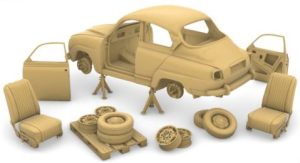
En 3D-utskriven modell från SSR Models (www.model-craft.se/brand/ssr-models) av en Saab 96 V4 under renovering finns tillgänglig som ett färdigt lackeringsbyggsats. Bland många andra byggsatser producerar de även en modell av en man som ska lackera om bilen! Intressanta och ovanliga modeller för alla diorama.

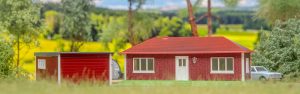
Wiking, känt för modellbilar i instegssegmentet, har presenterat en modell av ett svenskt hus (artikel 112001) och separat ett garage (artikel 114005). Vi är inte övertygade om äktheten hos dessa modeller; den faluröda färgen med vita hörn är korrekt, men profilen är tveksam! Den är märkt “Bullerbü”, vilket är den tyska översättningen av Bullerbyn, och därför möjligen kopplad till “Barnen i Bullerbyn” av Astrid Lindgren, som gjordes till två filmer i mitten av 1980-talet. Men inget av husen där ser ut som den här modellen. Caveat Emptor.

Våra järnvägsnyheter

Vi har ett långtidslån av en modell av Jecos Rc4. Den har ett irriterande problem. De riktade lamporna är inte så riktade som de borde vara – det finns ett flimmer eller ett svagt sken i “fel” ände. Vanligtvis är detta ett resultat av optisk bleed-over och åtgärdas genom att applicera silverfärg och sedan mattsvart färg mellan fiberoptiken. Men på den här modellen sitter lysdioderna direkt vid lampöppningarna. Problemet är ett problem med motelektromagnetisk ström, vilket tar längre tid att åtgärda och har bara varit ett problem sedan tillverkarna slutade tillverka modeller för analoga järnvägar. (En digital modell är utrustad med ett så kallat “blankingchip” så att den kan köras på analog järnväg, men om det inte görs ordentligt kommer det med detta problem med motelektromagnetisk ström.) Roco producerar också Rc4 (och i samma orangea färg), och de producerar en “mer analog” version, som inte har detta problem.

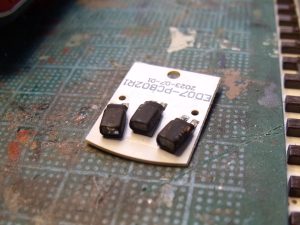
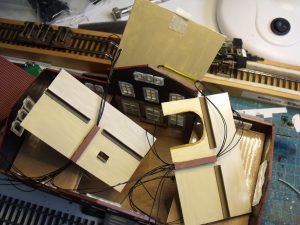
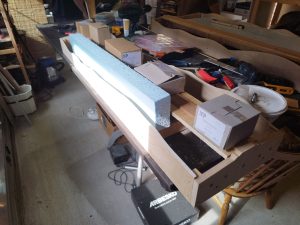
Byggandet av modellen för Rickbackens station har avstannat efter att vi upptäckte att 12V-lamporna som vi köpte faktiskt var 1,5V och att alla nu behöver bytas ut! (Vi fick höra att de var 12V när vi frågade om lämpliga motstånd för dem!) Bilden ger en indikation på hur mycket arbete det innebär att byta ut alla.

Andra järnvägsnyheter

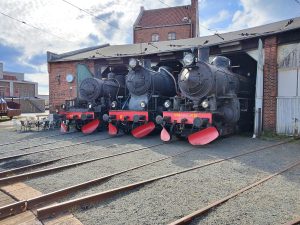
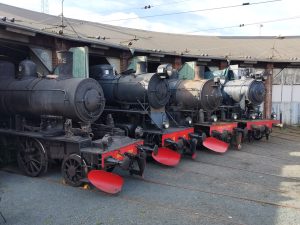
Under en nyligen genomförd “arbetshelg” på Nässjö järnvägsmuseum utnyttjades den mycket sällsynta möjligheten att ställa upp alla fyra ångloken där; E2 1092, A5 1545 (men bevarade i originalskick som KJ 17), B 1038 och L5 1778 (men väntar på restaurering som NOJ 33). NOJ 33 fanns faktiskt inte i stallet och ingick inte i uppställningen förrän någon insåg att denna möjlighet kanske aldrig skulle hända igen, så efter 40± minuters rangerande av vagnar och lok nåddes loket och lades till i uppställningen!

Nässjö järnvägsmuseum har också gett möjlighet att hjälpa till med konstruktionen av “moduler” till sin modelljärnväg i H0-skala. Det ger lämplig övning för framtida golvlister när RTJ kan komma igång, så erfarenheten är värdefull.

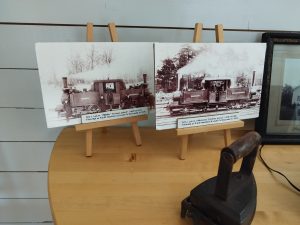
Under ett nyligen besök på Bruzaholms Bruksmuseum hittade vi dessa bilder på två av de brittiskt byggda Fairlie-loken som köptes in för byggandet och efterföljande användning längs linjen genom byn. Fairlie-patentet var bra för kraftigt böjda linjer, vilket faktiskt är så Nässjö Oskarshamns Järnväg alltid har varit känd som Bockabanan.

(Bilderna visas tillsammans med våra nyheter på engelska)
News for Third quarter, 2026

Swedish railway news

Further to the announcement of new sleeper carriages and locomotives to pull them, SJ is ordering new daytime stock to augment the existing X2000 trains. These will have a higher speed capability (250 km/h) than the existing track allows for (200 km/h) and the first of them is expected to arrive next year.

Work has started on replacing the catenary poles along the railway from Borlänge to Mora, through the heart of Dalarna. These unusual poles were noticed during the first holiday in 1990; they’re wooden, like telephone cable poles, but carrying 16kV cables! The new ones will be steel, thus a sad sense of nostalgia.

Swedish model news

A 3D printed model by SSR Models (www.model-craft.se/brand/ssr-models) of a Saab 96 V4 under renovation is available as a ready-to-paint kit. Amongst many other kits, they also produce a model of a man about to respray the car! Interesting and unusual models for any diorama.

Wiking, known for entry-level model cars has announced a model of a Swedish house (article 112001) and separately a garage (article 114005). We are not convinced of the authenticity of these models; the Falu-red with white corners is correct, but the profile is questionable! It is labelled “Bullerbü,” which is the German translation of Bullerbyn, and therefore possibly connected with “The Children of Noisy Village” by Astrid Lindgren, made into two films in the mid-1980s. But none of the houses there look like this model. Caveat Emptor.

Our railway news

We have on long-term loan, a model of Jeco’s Rc4. It has an irritating problem. The directional lamps are not as directional as they ought to be – there is a flicker or faint glow at the ‘wrong’ end. Usually this is a result of optical bleed-over and is cured by the application of silver, then matt black paint between the fibre optics. But on this model, the LEDs are directly at the lamp apertures. The problem is a feedback issue, which will take longer to fix, and has only been an issue since manufacturers stopped making models for analogue railways. (A digital model is fitted with a so-called ‘blanking chip’ so that it can run on Analogue, but if not done properly, comes with this feedback problem.) Roco also produces the Rc4 (and in the same orange livery), and they produce a ‘more analogue’ version, which does not have this problem.

The construction of the model for Rickbacken station has ground to a halt, after it was found that the 12V bulbs that we had been sold were in fact 1,5V and all now need replacing! The picture gives an indication of how much work is involved with replacing all of them.

Other railway news

During a recent ‘work party’ at Nässjö railway museum, advantage was taken of the very rare opportunity to line up all four steam locomotives there; E2 1092, A5 1545 (but preserved in original condition as KJ 17), B 1038 and L5 1778 (but awaiting restoration as NOJ 33). NOJ 33 was not actually in the shed, and not part of the line-up until someone realised that this opportunity might never happen again, so after 40± minutes of shunting wagons and locos about, the loco was reached and added to the line-up!

Also, from Nässjö railway museum, is the opportunity to help with the construction of ‘modules’ for their H0-scale model railway. These modules are built according to a standard, especially in relation to how the tracks line up at the end of the baseboard module. Then, any two can be coupled together – anywhere – from any builder – at any event! Literally, it’s not quite like that, after all some modules have single track sections, some have double, but in essence that is how it works. Coupling them together in this way is really only suitable (easily) for digital control, so our interest is somewhat limited; but it does provide suitable practice for future baseboard building sessions once the RTJ can get started, so the experience is valuable.

During a recent visit to Bruzaholm’s Bruksmuseum, we found these pictures of two of the British built Fairlie locomotives that were bought for the construction and subsequent use along the line through the village. The Fairlie patent was good for heavily curved lines, which is in fact how the Nässjö Oskarshamn Railway has always been known as Bockabanan (the curved railway). This has also caused some confusion with poor translations relating our earlier research in that the word Bock also means goat – and we wondered what was the significance of naming the line after these animals – it wasn’t!