En del arbete utfördes på T21 87 under januari. “Bågen” i A-ändens buffertbalk gjordes större så att kopplingarna nu kan användas, och ersättningsbuffertar har monterats. Beskrivningen av det sistnämnda jobbet ges i den engelskspråkiga uppdateringen. En del arbete utfördes också på T45 328. Under januari monterade vi boggisidorna och bolster på modellen, vilket förbättrade dess utseende. Sedan monterade vi plogarna framför boggierna och sedan stegen och ledstängerna. Vi skulle också vilja få in mer vikt under kroppen eftersom loket verkar för lätt Som förväntat tog vi emot våra HNoll-vagnar av typen A7R och B7R. Dessa modeller är mycket överlägsna i kvalitet jämfört med Roco A7/B7, och de kommer i skyddslådor, vilket Roco-modellerna inte gör! De är ungefär bara 200kr dyrare än Roco, vilket tyder på att Roco är överprissatta!
Tillverkarens Nyheter
Trix ska producera en likström version av nya Märklin Rc5. Det kommer att vara i 1990-talets orange färg (med logotypen “flygande falukorv”); och märkt som Rc5 1364, säljs som artikelnummer 25281. Tidiga bilder tyder dock på att chassit är för mörkt och att taket har helt fel färg! HNolls nästa vagnar kommer troligen att vara B4 och olika derivat (BF4 & BF7), och dessa förväntas anlända i slutet av året, eller i början av 2024. Vi är intresserade av att skaffa två till de vanliga InterCity-tågen; och kanske en tredjedel för ett av sovtågen! (Vagnarna fick först identiteten B4 av SJ, men denna ändrades senare till den mer korrekta BF4 där F står för lastutrymme.) Märklin annonserar ut ett paket med tre vagnar typ Tbis571, artikel 47303. Dessa SJ-vagnar är tvåaxlade skjuttaks-/skjutväggsbilar och är i rödbrun grundfärg med grå skjutdörrar och skjuttakar. Utförandet har konvexa skjutdörrar och är utan bromsmansplattformar. Modellerna ser ut som de gjorde runt 1985. På modellerna glider faktiskt taken upp, men inte dörrarna. Vi känner inte till en Trix likström version, men DC-hjulset per bil är artikel E700580.
Andra intressanta nyheter
Om du letar efter en ursäkt för att fira något i år, överväg följande. 2023 är det 100-årsjubileum av elektrifieringen av Malmbanan; 70-årsjubileum av introduktionen av loktyperna Dm och Ma, och YCo6 rälsbus; och 30-årsjubileum av bildandet av Scandinavian railways Society (i Storbritannien), vars 100:e upplaga av deras tidskrift utkommer under året.
Work progressed on the recently acquired T21 87 diesel during January. One small challenge was the ‘arch’ in the A-end buffer beam which prevented couplings from being used. This has now been widened (one of the compromises one has to sometimes make with working models), but it is still an arch; just wider. The bigger challenge was the buffers. Heljan provides unpainted brass buffers with the model, which protrude too much and are not sprung. Not being sprung is not a problem, as long as the user does not intend to use the factory fitted chain-link coupling! But protruding too much prevents the use of close couplings. The buffers were hollow and had been mounted (with glue) over studs, so we followed a simple procedure, yet precise, to replace them.
Thankfully Heljan used weak glue and with pliers we were able to pull the buffers off.
Using a fine drill, we drilled through the studs’ centrelines and through the buffer beams.
Going through the buffer beams meant that we had reference points, so we could next remove the studs.
We then widened the drilled holes to fit the new Bachmann buffers; loose fitted them and then took them out, so that we could refit the buffer beams to the loco without the buffers; thus revealing the need to drill a little way into the chassis also.
Being on the edge of a sub-frame (not the actual chassis itself), we instead used a file to make clearances for the backs of the buffers.
Then the buffers were lightly glued into place, and the beams back onto the loco. Job Done!
The Bachmann product, incidentally, is article number 36-032, a pack of eight round sprung buffers, intended for the British 00-gauge market, but perfectly fitting – mentioned just in case any of our readers are looking for ways of rebuilding their Heljan T21 locos!
Missing its body, here is T21 87 shewing the enlarged arch in the buffer beam, and the new Bachmann buffers!
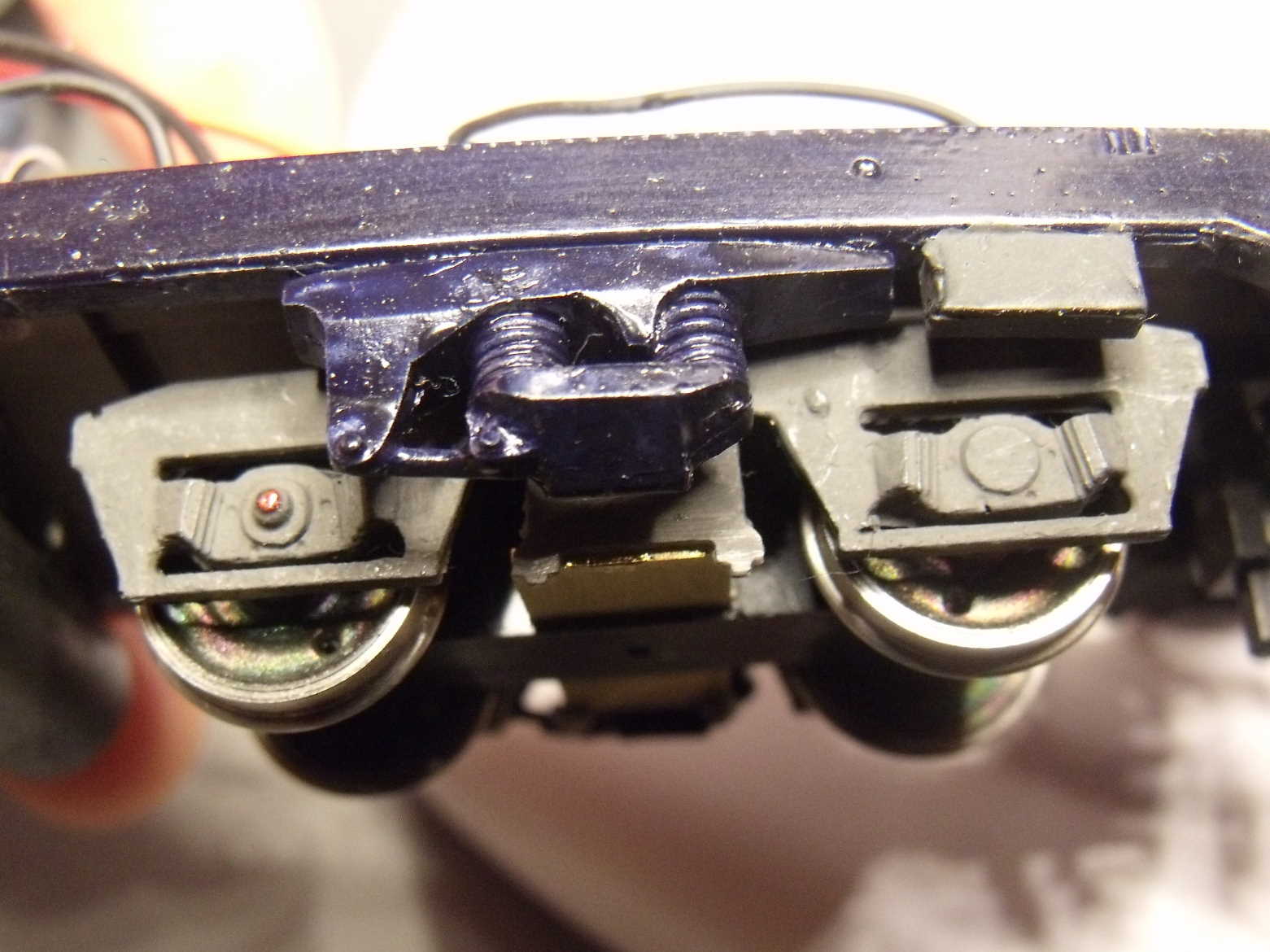
We also worked on our T45 328. During January, we fitted the bogie sides and bolsters to the model, greatly improving its appearance. We were able to discard some plexiglass pieces because they had been supplied with the model for use with the then-recommended drive-chassis from a provider in Helsingborg; but we used the more modern chassis from SV&LV, where the bogies were suitably designed for these pieces to be redundant. We had two of each type of bolster, and as with the Rc-locos, it is quite random which way round they are fitted. The one good picture that we have of the real T45 328 shews both bolsters ‘pointing’ inwards on the one side visible in the photo, so that is how we have mounted ours. Then we noticed that these are actually mentioned in the instructions and two were wrong, so they were exchanged (the bolsters should point outwards on the other side)! The next challenge with this model was fitting the etched brass components, ploughs onto the bogies, steps, and then the handrails. In all cases, we had to improvise because there was no clearly marked fitting place for any! The ploughs needed to be quite forward from the bogies, so these are mounted onto the couplings (with spacers). The handrails seemed totally wrong when all available photos were studied, so with 0,5mm brass rod we manufactured our own! Although far from perfect, we are pleased with the results, and in the process, we mounted the extra low level steps. Job Done! However, we would also like to fit more weight under the body because the loco seems too light…! More about the T45 below!
Bogie detail on the T45, shewing the side mouldings (plastic) and the sprung bolsters (metal). The bolsters have subsequently been repainted to correctly match the bogie-sides!T45 328 on the work-table, now with correct-colour bolsters; plus ploughs, steps and handrails – ready to enter service!
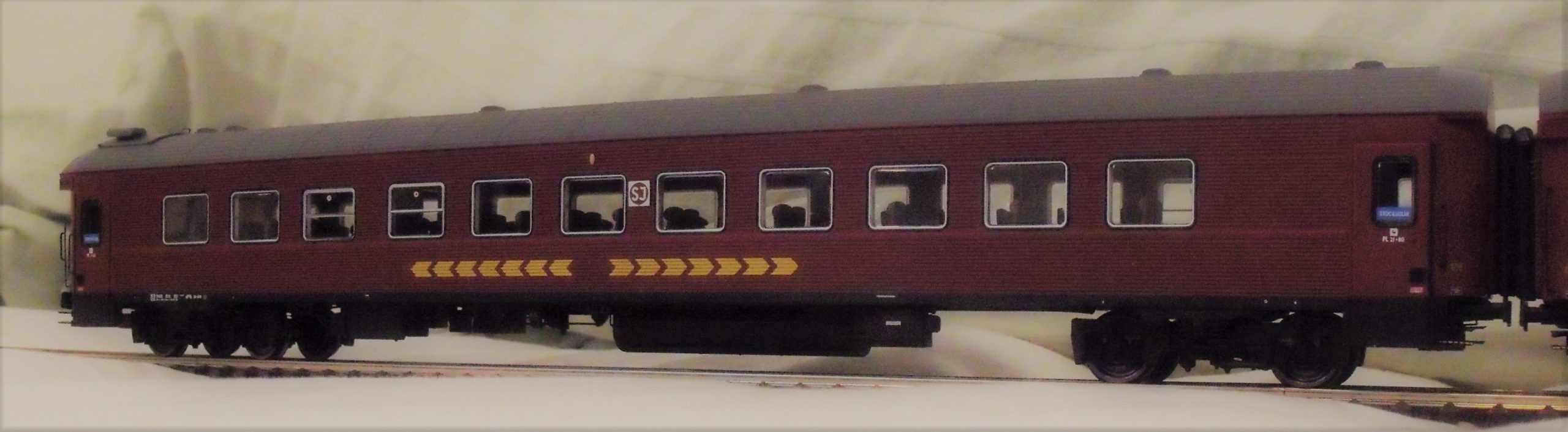
As expected our HNoll delivery arrived early January, comprising two A7R and two B7R carriages. These models are far superior in quality to the Roco versions, although the differences are subtle at a quick glance. The fact that the Roco models are only ±£20 cheaper, and come in unprotective brittle plastic tubs (instead of protective boxes), suggests that they are somewhat overpriced!
One of the HNoll B7R carriages, seen after delivery.One of the HNoll A7R carriages, seen after delivery.
Finally, recent correspondence suggested that the Uad/Uadp iron ore wagons had their first two digits changed at some point from 20 to 41. We tried this change with the three that have incorrect ‘control digits’ (given that none of them shew the first four digits on the wagons), and thus the ‘control digit’ was accepted as correct. Job Done!
Manufacturer News
Trix is to release a 2-rail version of the new Märklin Rc5. In the orange livery, but 1990 condition (with the “flying falukorv (sausage)” logo), it will be Rc5 1364 and sold as article number 25281. However, early photos suggest that the chassis is too dark and the roof is completely the wrong colour!
HNoll’s next carriages will probably be the B4 and various derivatives (BF4 & BF7), and these are expected at the end of the year, or early 2024. We are interested in acquiring two, for the regular InterCity trains; and maybe a third for one of the sleeper trains! (The carriages were first given the identity B4 by SJ, but this was later changed to the more correct BF4 where F stands for cargo space.)
Märklin is advertising a pack of three wagons type Tbis571, article 47303. These SJ wagons are two-axle sliding roof / sliding wall vans, and are in a reddish-brown basic paint scheme with grey sliding doors and sliding rooves. The version has convex sliding doors and are without brakeman’s platforms. The models look as they did around 1985. On the models the rooves do actually slide open, but not the doors. We are unaware of a Trix 2-rail version, but DC wheelsets per car is article E700580.
Other News
More about the loco type T45. ASEA (Allmänna Svenska Elektriska Aktiebolaget), which for a long time was Sweden’s largest manufacturer of electric locomotives, also tried its hand at building diesel locomotives in the early 1970s. The idea was to challenge Nohab in Trollhättan, which until then had dominated the Swedish diesel locomotive market. A bogie locomotive was constructed where, among other things, the bogies and parts of the electrical equipment were the same as in the Rc locomotives, thus offering a standardisation of spare sparts. Otherwise, the locomotive was a collaboration: the diesel engine was of the SEMT-Pielstick system and was manufactured by Hedemora Verkstäder, while Norwegian Thune was responsible for the mechanical parts and the locomotive bodies. In terms of appearance, the locomotives were quite similar to the T43 and T44 locomotives, and they became the T45. Up to three locomotives could be multiple-worked. In 1969, SJ signed a contract with ASEA to rent the five locomotives that were manufactured. They were delivered in 1971-1972 in an orange/white livery similar to the Rc locos, but with ASEA branding, and no SJ logo. The locomotives were placed in Borlänge and pulled both freight trains and passenger trains on the then still unelectrified line to Mora. In 1976, SJ returned the T45 locomotives to ASEA. Operational reliability had not been so good, mainly due to problems with the diesel engines and SJ did not really want another diesel locomotive type. ASEA tried to sell them abroad but there was no interest. Only one locomotive (324) was sold to the mining company A/S Sydvaranger in Kirkenes in Norway. The remaining locomotives became shunting locomotives in various Swedish industries, including at the ironworks in Avesta and Hofors. The investment was therefore not a success and ASEA did not build any more diesel locomotives. Today, there are no T45s left in traffic and all locomotives except one have been scrapped. T45 327 is preserved at the Gefle-Dala Railway Museum Association in Falun [www.mfgdj.nu].
About 328: Manufactured by ASEA, Västerås, Sweden in 1972. Manufacturing number 1702. Leased 1972-76 by SJ from ASEA. Based at Borlänge 1972-75. 328 was sold in 1978 as a shunting locomotive to SKF Steel in Hofors, where it was given the ownership number 8631. In Hofors, the locomotive was useful on the industrial track from the mill to the station, which runs at a very steep incline (approx. 15‰). The locomotive was supplied (by SKF) with handrails around the platforms, automatic couplings, lighting and TV cameras over the ends. In 1992, SJ took over the shunting at the mill and the locomotive ended up with SJ in Gävle. When SJ took over the locomotive, it received a small refurbishment and was test driven for some speculators. However, the locomotive had some remaining faults, and was worn, and in addition, an odd locomotive construction does not warrant any sale. The locomotive was then disposed of to the Railway Museum in Gävle, but in autumn 1994 it was sold to SP Tågservice in Östersund. In Östersund, the locomotive was revised and in May 1995 it was put back into operation, now leased to Banverket for macadam (ballast) train service. During that summer, the locomotive suffered a serious failure of the diesel engine due to overloading; the diesel engine was removed from the locomotive and sent back to Hedemora. However, it was judged to be so costly to repair the locomotive that it was instead scrapped. The bogies were sent to SSAB in Domnarvet, which used them under its locomotive, 327. (327 had been sold in 1995 to SSAB in Donmarvet, where it was overhauled for approximately SEK 1 million and received, among other things, the bogies from 328.) (Information from mostly jarnvag.net and svenska-lok.se)
If you’re looking for an excuse to celebrate something this year, consider the following. 2023 is the 100th anniversary of the electrification of the Malmbanan; 70th anniversary of the introduction of loco types Dm and Ma, and the YCo6 railbus; and 30th anniversary of the formation of the Scandinavian Railways Society, whose 100th edition of their journal will be published during the year.
Behind the Scenes
Mini-Series around the FLMJ; B: The Journal, FLMJ-Nytt
KRBJ-Nytt, which eventually became FLMJ-Nytt, was a general news journal. It enabled us in our pre-IT days to keep everybody up to date with the Railway’s development and other activities, and also carried special features such as book and video reviews, and anything else that we thought our readers might appreciate (and this even included one year with a cartoon strip)! The frequency changed over its course, finally settling on five editions annually (produced week numbers 5, 15, 25, 35, 45, so there was virtually no risk of losing copies in the Christmas post)! As the Publisher program was automatically updated, so did our curiosity and development, and the last few editions were very neatly presented. In addition to UK proliferation, copies were sent to readers around the world, including USA, UAE, Australia and the Nordic countries. Today, members of the Scandinavian Railways Society benefit from their journal, “Skandiapilen”, which is now edited by Adrian, and has a much more dynamic presence than anything produced before, both for the SRS and for us. It represents an idea of what FLMJ-Nytt could have looked like if it continued in print, today!
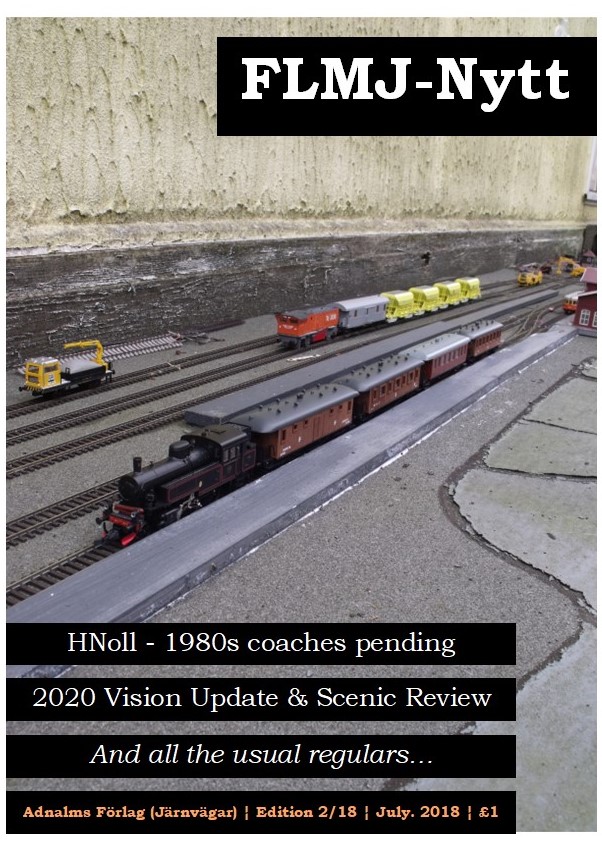
FLMJ-Nytt front cover of an edition from its last year in print.Skandiapilen for the SRS, from the same editor as FLMJ-Nytt!
Naturally, our readers had an interest in the KRBJ/FLMJ, so everything was related to that interest. With the closure of the FLMJ in 2018, it seemed pointless continuing whilst there was no actual railway to report from, and most (if not all) of our readers are online. Therefore, the decision has been taken to not restart it once a new railway does get going; but we’re not completely forgetting our publishing heritage, as we’ll discuss later in the year!
Next month: the ‘internal’ newsletter for the committed ‘members and friends’ of the Railway!
Under december numrerade vi om den dubbla grå barlastvagnen; ett jobb som gick ganska bra. Men vi upptäckte att den (och den andra som vi köpte samtidigt), hade AC-hjuluppsättningar och behövde bytas. Vi verkar sakta samla in värdelösa AC-hjuluppsättningar!
Vi har haft en genomgång av kopplingstyper på FLMJ:s rullande materiel och tagit beslutet att det nuvarande systemet behövde uppdateras och några kopplingstyper tas bort; andra tillade. Vi kommer att fortsätta att använda Roco-kopplingar för det mesta av rullande materiel. Se dock vår kommentar om Piko-kopplingar nedan. Vi kommer att eftermontera Dm3-loket och alla Uad/Uadp-vagnar med Rocos imiterade SA3-koppling och fasa ut Kadee eftersom det inte är tillräckligt tillförlitligt. Dm-loket och Mas-vagnarna skulle inte ha SA3-kopplingar så de kommer förmodligen att ha Piko-kopplingarna (om de är lätt tillgängliga). Vi överväger också att experimentera med NEM-monterade Scharfenberg-kopplingar för motorvagnstågen (X10, Y1/YF1, Y6/Y7, osv).
Tillverkarens Nyheter
Goda nyheter från HNoll är att vagnar äntligen har anlänt från Kina, cirka 24 månader efter schemat. Som vi förstår det har modellerna A7, A8 och B7 kommit, men inte A11 eller B11 på grund av ett tillverkningsfel (främst fel färg). Vi kommer att hämta FLMJ:s beställning under januari.
Förra månaden nämnde vi att MJ-Hobby hade några intressanta nya släp med Y6-seriens järnvägsbussar på displayen. Vi vet nu att de är typerna UBF7Z och UDFo15 och varje version kommer att finnas tillgänglig med tre nummer, och det kommer att finnas dc och ac versioner.
Andra intressanta nyheter
En liten nyhet om vår förfrågan med Bachmann UK (som det inte finns några svenska modeller från). De svarade mycket snabbt och grundligt på vår förfrågan om ett paket buffertar som de producerar (vi behövde veta måtten). Dessa är lämpliga för att ersätta de pålimmade buffertarna som sitter på T21-dieslarna, som sticker ut för mycket! Bachmann svarade på mindre än 24 timmar!
Nyligen hade vi möjlighet att prata med någon från Dekas. Vi kommenterade att alla fyra “Ugkkpp”-vagnar har felaktiga UIC-kontrollsiffror. Som svar trodde man att vagnarna imiterade vagnar som ses på fotografier, men Dekas skulle undersöka det. (De är fullt medvetna om hur systemet fungerar.) Så vi undrar om vagnarna kan vara felaktigt märkta i skala 1:1? Till exempel; de två första siffrorna ändras då och då (vi är inte säkra på varför), och kanske kontrollsiffran glömdes bort i processen? Mänskligt fel som väcker frågan om hur effektiv kontrollsiffran egentligen är! Siffran finns för att förhindra mänskliga misstag, men om felet finns där till att börja med…
A suitable weekend was found in which to renumber the duplicate grey ballast wagon; a job that went reasonably well. However, placing the wagon (and it’s ‘mate’ – a pack of two wagons) on the track revealed a dark irritation in the form of a short circuit! Both wagons, like the ore wagons mentioned last month, had ac wheel-sets and needed changing. Fortunately, the odd-one-out with the ore wagons had dc wheel-sets already so we had a head start (spare sets) and were able to change them on one wagon immediately; but the other has to wait until we can buy some more. We seem to be slowly collecting useless ac wheel-sets!
During December, we conducted a review of coupling types on the FLMJ’s rolling stock, and decided that the present system needed updating and some coupling types removed; others added. We will continue to use Roco close couplings for the majority of stock, despite their weak points. Both Fleischmann and Piko close couplings are more robust than Roco, but they have poor availability. Nevertheless, some trains are likely to be fitted with them (fixed rakes, for example; see below). We no longer need to identify H0 standard couplings fitted to chassis (as we now use Roco/Symoba conversion kits), or British pattern 00 couplings, or a few others; so these will go. We have decided, however, to retrofit the Dm3 loco and all Uad/Uadp wagons with Roco’s imitation SA3 coupling, and to phase out Kadee because that is too dependent on service and maintenance to be reliable (two Mas are out of service presently for this reason). The Dm loco and Mas wagons would not have SA3 couplings so they will probably be changed to Piko (or Roco). We are also considering experimentation with NEM mounted Scharfenberg couplings for the unit trains (X10, Y1/YF1, Y6/Y7, etc).
A Roco ballast wagon in unmarked grey livery; this one carrying a new number as it had been a duplicate!The Achilles’ heel of the Roco coupling is the extended ‘tongue’ which all too often bends outwards, rendering it useless!
Manufacturer News
HNoll is a little more upbeat now that carriages have finally arrived from China, some 24 months behind schedule. With horrendously rising utility costs in Sweden, it is not certain if people will still be able to afford them, but we hold our thumbs for a good result (and therefore more models). As we understand it the A7, A8 and B7 models have arrived, but not the A11 or B11 due to a fault in manufacturing (mainly wrong colour). We will be collecting the FLMJ’s order during January.
Last month, we mentioned that MJ-Hobby had some interesting new trailers to go with the Y6-series railbuses on display. We now know that they are types UBF7Z and UDFo15 and there will be three different numbers offered with each type, and there will be dc and ac versions. The UBF7Z is a driving trailer, with second-class seating and cargo space, adapted for running with X16/X17, and of which there were 31. They were previously type UBFo7ye. The UDFo15 was a non-driving trailer for mail and luggage, for running with diesel or electric units, and of which there were 25. None survived late enough to receive the later type designation (which would have probably been UDF15). They are not quite the same as the UDF20 (UDFo20) nor UF (UFo6); see our article on this website for more information [General Articles > Dateboxes (The Y6 Railbus)].
Other News
A little heads-up for Bachmann UK (from whom there are no Swedish models), for their very quick and informative response to our enquiry about a pack of buffers that they produce (we were needing to know the dimensions). These are suitable for replacing the glued-on-over-studs buffers fitted to the T21 diesels, which protrude too much! Bachmann responded in fewer than 24 hours!
Recently, we had the opportunity to speak with a representative from Dekas, and in praising them for the quality of their ‘Ugkkpp’ wagons especially, we asked if they would accept feedback in the form of constructive criticism, which they would. We commented on all four of these wagons having incorrect UIC control digits. In reply, it was thought that the wagons imitated some in photographs, but Dekas would investigate. (They are fully aware of how the system works.) So, we have wondered if the wagons could be incorrectly marked in 1:1 scale? For example; the first two digits are changed from time to time (not sure why), and maybe the check digit was overlooked in the process? Human error which raises the question of how effective the whole point of having the check digit really is! The digit exists to prevent human error, but if the error is there to start with…
Behind the Scenes
Mini-Series around the FLMJ Over the next few updates/months, we are going to look at how the FLMJ was promoted, with a special look at the publications that have been produced over the years.
Mini-Series around the FLMJ; A: The beginning For many years before the Railway existed, there had been other railways, the two most significant ones being the 00-gauge Grove Central Railway and the 00-9/H0e gauge Herpham and District (Light) Railway. Being brought up in a house where an old manual typewriter and Rex–Rotary duplicator were in frequent use, an interest in producing documentation of some sort was naturally kindled. Further to this, was the connection with the Great Cockcrow Railway, and therefore its owner, Ian Allan, a well known transport book publisher. Imitating IA’s so-called ‘ABC’ range of stock lists, one was produced for the Grove Central Railway in 1979. Then came a news book, and eventually, the regular “Grove Rail News” journal; produced in bound magazine format. For many years, stencils were ‘cut’ for the duplicator before the advent of widespread photocopying; but still started on a typewriter, admittedly now, an electric ‘golf-ball’ one! Progression to a so-called ‘daisy-wheel’ typewriter was ruled out because there was not enough torque to ‘cut’ the letters into the stencils!
By the time that the KRBJ was started, a typewriter and photocopier were the tools of the trade. Photocopying was with black ink only, and whilst the option of colour laser printing was desirable, the poor quality of the images (at that time) didn’t justify the extortionate expense. We were quite late at getting into the computer era; but when we did, the so-called “Publisher” program seemed to enable us to create small miracles, and was found to be more adaptable and flexible than the more common “Word” program. Third Party programs were also tried, but the ready-installed version shone through and is still used to this day, even if physical printing has all but disappeared. (The current updates are produced in “Publisher”, and are available as PDF prints, or uploaded by ‘copy-and-paste’ to the website.)
Considering the role of ‘Adnalms Förening (Järnvägar)’ (the name that we use for our printed publishing), in relation to everything connected with the FLMJ, we will spend the next few months looking at our journals, printed and otherwise, online presence, and various other means of communicating with you, people who are interested in our development and progression. Naturally, with the closure of our main asset, the FLMJ, big changes have become apparent; but maybe it was time for some of these changes to happen anyway? It will be seen, that we are thinking about a new format to take us forward, but quite how we create and present that format, is still being considered.
Next month: the journal that found its way around the world!
Vi har skaffat ytterligare en uppsättning Roco-malmvagnar, men dessa är begagnade. En av vagnarna är inte korrekt för detta set och det är faktiskt en dubblett av en som vi redan har! De övriga tre var för växelström! Vi har kunnat byta hjul, men vi måste beställa nya nummerdekaler – senare! Vi har skaffat ytterligare en Roco Co8a-vagn (fd OKB-typ). Vi sålde en (kanske två) tidigare eftersom vi inte kunde hitta några bevis som stöder deras äkthet. Nu vet vi att det är en sann modell, och vi kan dra nytta av den; så vi köpte en till. Vi har även skaffat ett andra Heljan T21 diesellokomotiv! Trots de många problemen med den här modellen hade vi alltid velat ha en andra, och den vi hittade låg under vårt maxpris och i någorlunda gott skick. Den kräver förstås mycket arbete innan den är säker och lämplig att använda!
Tillverkarens Nyheter:
Förutom fler Rc-lok och ett nytt T23-lok hade Jeco på Hjulmarknaden utställda två nya och annorlunda släp för att passa Y6-seriens rälsbussar. Det fanns ingen information om dem och ingenting fanns på deras hemsida, men vi håller tummen. Dessa borde vara mycket mer populära än den 2-axlade trailern som de kämpar för att sälja! Den ena är en kombinerad sitt-/bagagesläpvagn (varav en typ nu är i drift på Nene Valley Railway i England), och den andra är en allbagagevagn (fullängd på boggier).
Andra intressanta nyheter:
En kort artikel i aktuella ”Tåg”, nämner att det i höst (2022) är 100 år sedan starten av det vi känner som H0-skalan! Tja, för att vara korrekt bör man säga spårvidden på 16,5 mm. I modelltågens barndom var det snarare spårvidden än skalan som var utgångspunkten. Större skalor hade funnits innan dess, men eftersom utrymmet blev en premie önskades något mindre. På senhösten 1922 introducerades de första små tågen av denna typ. De tillverkades av det tyska företaget Bing i Nürnberg men introducerades till en början på den brittiska marknaden. Skala och noggrannhet var inte viktigt, de behövde bara representera något vagt bekant. Elektriska modeller kom några år senare, med 4-8v. 1935 kom Trix och Märklin ut med sina respektive serier av modelltåg i Bings anda. Utvecklingen av moderna H0-modeller var alltså igång. Men “Tågs” författare konstaterar att äran att vara först går till Bing! (Termen ‘H0’ betyder helt enkelt “Halv-0” som i halv 0-gauge; som faktiskt är 32 mm, så det finns en liten skillnad! ‘0’ är en siffra, inte en stor bokstav ‘O’. Termen ’00’, som små målarpenslar, lägger bara till ett extra nummer 0 för nästa storlek ner – så ja, TT var ursprungligen känd i Storbritannien som ‘000’!)
A set of Roco Uad/Uadp wagons arrived in November, but not without problems. The set comprises one Uad and three Uadp. According to resources, none of these wagons would duplicate what we already have. But the set was second hand. The Uad has been exchanged at some time, and the one in the box is a duplicate! All Uadp had ac wheel-sets, so these needed to be changed at further expense! We need to get into the habit of taking a magnifying glass with us to exhibitions because these wagons’ numbers are very tiny, and with second-hand purchases, there is always a risk that we’re not getting what we’re expecting. (Hopefully, a future order to Byggsvenskt.nu will give us a unique wagon number!)
Roco wagon set 67055, but compromised!
To the casual observer, the purchase of the Roco model of the Co8a would seem a bit strange, especially when one considers that we’ve had two of these before, and sold them. Why? Because we could not find any information supporting their authenticity, and we suspected that they were 1:100 scale length, given that they are quite short. The fact that they also had the older style gangways did nothing to encourage an interest in them. NOW, however, we know that the OKB had two of these, built as copies of very similar carriages purchased new from Germany in the 1920s. They were indeed much shorter than other carriages in use on SJ (though the model is still a bit short; in scale terms by about 60cm), and unlike the ‘composite’ carriages, for which we were able to easily find reference, they were withdrawn quite early. With the restructuring of proposed train formations (for a new railway), a use for this carriage became apparent, so we’d been on the look-out for a while; but the model had to fit certain criteria, It needed to be complete without damage; it needed NEM couplings; it needed a box. The inner tray for the box was damaged, but with the experience of building a new one for a Heljan model recently, satisfied that the outer box was OK, we went ahead with the purchase of a suitably priced model.
Roco carriage number 2990, a model of a former OKB design, but Co8a (later Bo8a) in SJ ownership.Roco Bo8a with its new inner tray.
As the month drew to a close, a second Heljan T21 was purchased! Its price was below the limit that we had set, and it was in reasonable condition. Again, one might ask why? A second one had been wanted since before the railway closed, and being common for these locos to work in pairs, that interest still existed. Having worked extensively on the first (T21 64: see updates during 2020), we were ready for the challenge! Naturally, many things had fallen off, but all the essential parts (except for one plough) were present and correct. This now gives us a full time (evening) job; to prepare the model for reliable service; and this includes remedial measures to the motor cover so that we don’t need to replace it. With our existing one, the motor gear rubbed on the white-metal casing causing a lot of friction and a lot of swarf adding to the friction—then it died completely! The remedial work included the purchase of a third party motor and grinding down the space inside the cover! During the initial investigation with our newer acquisition, we refitted all the glazing and one underframe item. We also fitted the window to the ‘B’-end door because it looked a bit silly with the badly fitting blanking plate! With one plough missing (and one loose in the packaging) we removed the others (there are four in total; one under each buffer, not full width). Looking back through photos of the work on the other loco, that also has no ploughs fitted! Getting the body off was as usual, tricky, despite following the instructions in Heljan’s manual. They have used a tape at the ends to block the light from shining through the plastic body and this had become sticky on both sides. But once off, we removed the tape and painted matt black inside. At the end of the initial investigation, some of the loco was put back together, but without the cab or hoods, seeing that more work would be required here quite soon and we didn’t want to risk unnecessary damage!
T21 87, seen after being taken out of its box after acquisition. As usual bits have fallen off!
Manufacturer News
Not content with delighting modellers with a new loco, the T23, Jeco had on display at Hjulmarknaden, two new trailers for the Y6-series of railbuses. One is a combined seating/luggage trailer (of which one type is now in service at the Nene Valley Railway in England), and the other is an all-luggage trailer (full length on bogies). These are long overdue and no doubt purchases will be made in the FLMJ’s favour! There is no mention of them on the website presently, and no supporting literature was at the event! Another interesting thing from Hjulmarknaden was a new-ish firm selling track setting templates, rather like the ones we had in England, but for much larger radius curves. Quite possibly we will be investing in a complete set once a start has been made on the new railway.
A poor quality image of the two trailers seen with the Jeco display; could models be on their way?
Other News
A short article in the current “Tåg”, mentions that this autumn (2022) is the 100th anniversary of the start of what we know as H0-scale! Well, to be correct, one should say the track gauge of 16.5mm. In the infancy of model trains, it was the gauge rather than the scale that was the starting point. Larger scales had been available before then, but as space became a premium, something smaller was desired. In the late autumn of 1922 the first small trains of this type were introduced. They were manufactured by the German firm Bing in Nürnberg but were initially introduced to the British market. Scale and accuracy was not important, they just needed to represent something vaguely familiar. Electric models arrived a few years later, operating at 4-8v. In 1935, Trix and Märklin came out with their respective ranges of model trains in Bing’s spirit. The development of modern H0 models was thus underway. But “Tåg’s” writer observes that the honour of being first goes to Bing! (The term ‘H0’ simply means “Half-0” as in half 0-gauge; which is actually 32mm, so there is a slight discrepancy! The ‘0’ is a number, not a capital (or upper-case) ‘O’. The term ‘00’, like small paint-brushes, just adds an extra number 0 for the next size down – so yes, TT was originally known in the UK as ‘000’!)
We mentioned the 1409 website recently; and using it, we were able to track and then go out to get a photo of this train at Myrbacken! We understand that the train started with just the two Rc-locos, but after hitting a moose, causing minor loco-damage, the leading loco was brought to the rescue!
HectorRail goods train at Myrbacken.
In our update from September, we commented about an event that had been advertised, but didn’t seem to be taking place. In conversation with a trader at Hjulmarknaden in November, we were told that the event did take place at another location, but it was VERY poorly attended. No prizes for guessing why!
Behind the Scenes
Mini-Series about the FLMJ, 12: Faring up for the Future It is impossible to make any plans for the new railway until the location has been found. A perfect situation would be for us to be able to recreate what we had; maybe with the original track plan reinstated at Månstorp (before the truncation mentioned earlier in the year). More space, however, would give us bigger station areas at Lövhöjden and Månstorp; less space would need further thinking about. But this is not a doom-and-gloom prospect. We did look at a location near Karlsborg which would have been much smaller, but the shape of the area available inspired a new layout design, whilst enabling us to keep the FLMJ title! We just need to be creative and think outside the box; and as the saying goes, “only dead ideas stay inside the box”!
Since the FLMJ was closed we have kept the timetable and scheduling up to date, so that we can land on our feet when we are able to start again. Nothing (important) has been forgotten, nothing has gone to waste. We have also created a so-called ”Fantasy Layout” which enables us to trial other timetabling elements, other signalling practices, other track layouts, and many more other things that are essential to the making of the successful operation and development of a model railway. Many aspects of the new railway can be planned at this stage, and this will help us when we are ready to plan it in finer detail.
It is just over four years, now, since the FLMJ was closed. In the time since then, personal commitments have taken priority, and many hurdles have needed to be overcome; a process that continues. It is said that a bad situation is the condiment that gives the eventual good situation its flavour. Real difficulties can be overcome; it is only the imaginary ones that are unconquerable. Over this last year, we have given you a slight insight to the Railway. A more thorough description will be in our forthcoming book.
Next month: we start a new series looking at the publications (Adnalms Förening (Järnvägar)) that have been produced over the years, from the regular journal to the year books and everything in between.
Mitt i månaden reparerade vi den trasiga bufferten på en av FV1/F5-L-modellerna. När vi jämförde detta med de andra två som vi har här, fann vi att en av de andra också hade en skadad buffert. Denna skada orsakades av originalförpackningen, så både buffert och förpackning har modifierats. Vi avslutade med att modifiera den hemmagjorda innerbrickan för den lika hemgjorda kartongen till FV1:an som köptes begagnad utan originalkartong. Detta kommer att skydda den från ytterligare skador.
När månaden gick mot sitt slut byttes växlingsloket Z66 000 till Z69 659 med de nya dekalerna.
Vi tog emot ersättningsbuffertarna till N-loket i oktober, men det har ännu inte avsatts tid för montering. Vi tittar på en helg i december…!
Tillverkarens Nyheter:
Årets största nyhet måste vara tillkännagivandet av ett nytt lok, detta från Jeco; T23 diesel. Det kommer att finnas sex olika nummer, och det kommer att finnas tillgängligt i analogt och digitalt, och två livery-versioner. Under 1950-talet köpte SJ 25 smalspåriga ’Tp’-lok för att ersätta ångloken på 891 mm spårvidden. Men när de smalspåriga linjerna lades ner en efter en stod det snart klart för SJ att de hade fler lok än de behövde, och de lyckades inte sälja dem; så beslutades det att bygga om femton av dem till standardspårlokomotiv. Ombyggnaderna skedde i samarbete mellan SJ’s verkstad i Örebro och AB Svenska Järnvägsverkstäderna i Falun. Ett nytt ramverk måste konstrueras och lokkarosserna breddas. Axelbeskrivning ändrad till D (0-8-0 i brittisk nomenklatur) istället för 1’C1′ (2-6-2), men fortfarande med kopplingsstångsdrift. Loken fick en färg liknande T21 i rödbrunt med gula dekorativa ränder. De användes i godståg och växling i bland annat Halmstad och Jönköping, men tjänstetiden var kort. Mot slutet av 1970-talet togs loken ur drift och avsattes som beredskapslok. Ett lok (115) såldes som industrilok till Gullfiber och hamnade i början av 1990-talet hos fraktföretaget Österlentåg. Efter att företaget gått i konkurs såldes loket till ett skrotföretag. 2002 beslutade Banverket att göra sig av med de T23-lok som stod i beredskap och de såldes till olika museiföreningar och skrothandlare. Flera T23-lok är därför bevarade; representeras av fem av de sex som ska produceras som modeller.
Jeco har också förnyat sin avsikt att producera fler lokomotiv i Rc-serien, inklusive Rc1 och Rc4 i orange färg, och flera mer moderna färger på Rc2 och Rc3.
Dekas utökar sitt sortiment av spannmålsvagnar med tre märkta ’Udg’, lämpliga för den tidigare delen av Epoch-IV; och ett par som S-RT (Epok-VI). S-RT Ugkkpp är en modell av SJ sandtåg täckt trattvagn, använd från 2015 och för närvarande. Dessa förväntas alla i januari 2023.
Brekina har gjort en modell av Büssing Senator 12D-bussen i ”Stockholms Spårvägar” (SS)-livery. Beskriven som 1962 års modell är den egentligen i ombyggt skick med dörrar till höger för högertrafik (från september 1967). Minst en av dessa finns bevarad i Stockholmsområdet. Ett prov har kommit hit; mycket snyggt gjort, men tråkigt nog utan några dekaler för ruttnummer eller destination!
När vi gjorde en sammanfattning av tillverkarnas uppdateringar (vilket vi inte gör så ofta som vi borde) hittade vi en död länk, och vid ytterligare undersökning fann vi att Brimalm Engineering AB försattes i konkurs 2017. Brimalm var mest känt för handbyggda modeller i etsad mässing, riktade till höginkomsttagare och samlare, och tillverkade i mycket begränsade upplagor. Det anses dock allmänt att Brimalm inte gjorde något för modelljärnvägar som en “helhet”; modellerna var prissatta i en annan liga än seriösa järnvägsmodellerares intressen. De ansågs ofta vara i en liknande klass med “Fabergé-ägg”, mer om investeringar än äkta järnvägsmodellering, och absolut inget för att locka barn och ungdomar till hobbyn. Naturligtvis har företag av den här karaktären en hög risk att kollapsa vid minsta vackling i den globala ekonomin, och så verkar det ha varit fallet.
Andra intressanta nyheter:
I vår genomgång av semestern kring Sveriges Järnvägsplatser i år hänvisades till sjukhusvagnar, om vilka ingen information gick att hitta. SJK:s senaste upplaga av Tåg innehåller en artikel om sjukhus- (och ambulans-) vagnar, men dessa två nämns tydligen inte (en vid Oxelösund och en på Grängesberg). Det hänvisades dock till två Bo14b-vagnar, 1899 och 1901, som hade byggts om till So10, och beskrivningarna passade (och ytterligare forskning visar att dessa ursprungligen var Co6-vagnar med träkaross). Men deras bortgång citeras (i Tåg) som den ena på Nässjö Järnvägsmuseum och delar av den andra på Gävle Järnvägsmuseum. När vi grävde djupare upptäckte vi att 1899 är inköpt från Gävle för några år sedan och finns på FSVJ i Oxelösund. Man tror att hänvisningen till ‘1899’ på ‘delarna’ förmodligen relaterar till något annat, eller något som hade passat tillfälligt! 1901 sades senast vara i järnvägsavdelningens bruk, och det ena fotot som vi har av vagnen vid Grängesberg visar visserligen en liten del av ett vagnnummer under den grå färgen; vilket med stor sannolikhet är 1901. Webbplatsen för Nässjös Järnvägsmuseum säger ingenting om den rullande materielen där, och vi har inte varit där (sedan 1998), så vi är försiktigt övertygade om att vi har identifierat båda vagnarna.
Vi tittade nyligen ordentligt på vår hemsida för att se om något behövde uppdateras. Åh ja; och några stavfel måste också korrigeras. Vi kommer att spendera tiden mellan nu och slutet av året för att finslipa och polera, men det verkar inte vara någon mening med att katalogisera dem här. Eventuella stora förändringar kommer naturligtvis att få ett omnämnande.
With a work-free weekend mid-month, there was a plan to paint over the Z66 000 number on the little shunting loco so that we could apply the Z69 659 decals; but the decals were in a safe place and couldn’t be found! So, instead, we repaired the broken buffer on one of the FV1/F5-L models. Comparing this with the other two that we have here, we found that one of the others also had a damaged buffer and we could see that the cause was the nature of the inner packaging that is supposed to support the model and protect it from damage! This was also repaired. Using available time, we finished by modifying the homemade inner ‘tray’ for the equally homemade box for the FV1 that was bought second-hand without an original box. This will protect it from further damage.
Two F5-L/FV1 models (nicely made by Heljan) on the workbench.An FV1 having its buffer straightened – by unconventional means, but effective!One of the F5-L/FV1 models in its new home-made box!Z69 659 now has a number to show it as such. For the Swedish scene, it is actually freelance!
As the month drew to a close, and having located the decals, Z69 659 was accordingly branded, and is now fit for full service.
We took delivery of the replacement buffers for the N-loco in October, but time has not yet been allocated for fitting them. We are looking at a weekend in December…!
Manufacturer News
Without a doubt, the biggest news of the year has to be the announcement of a new loco, this from Jeco; the T23 diesel. There will be six different numbers, and it will be available in analogue and digital, and two livery versions. During the 1950s, SJ bought 25 narrow-gauge ‘Tp’ locomotives to replace the steam locomotives on the 891mm gauge lines. However, as the narrow-gauge lines were shut down one by one, it soon became clear to SJ that they had more locomotives than they needed, and they were unsuccessful in selling them; so, it was decided to rebuild fifteen of them into standard gauge locomotives. The rebuilds took place in collaboration between SJ’s workshop in Örebro and AB Svenska Järnvägsverkstäderna in Falun. A new framework had to be constructed and the locomotive bodies widened. Axle-description changed to D (0-8-0 in British nomenclature) instead of 1’C1’ (2-6-2), but still with coupling rod drive. The locomotives were given a livery similar to T21 in red-brown with yellow decorative stripes. They were used in freight trains and shunting in, among other places, Halmstad and Jönköping, but the period of service was short. Towards the end of the 1970s, the locomotives were taken out of service and set aside as standby locomotives. One locomotive (115) was sold as an industrial locomotive to Gullfiber and ended up in the early 1990s with the freight company Österlentåg. After the company went bankrupt, the locomotive was sold to a scrap company. In 2002, Banverket decided to dispose of the T23 locomotives that were on standby and they were sold to various museum associations and scrap dealers. Several T23 locomotives are therefore preserved; represented by five of the six to be produced as models.
SJ T23 113 in a photo from the internet; model awaited from Jeco!
Jeco has also renewed their intention to produce more Rc-series locomotives, including Rc1 and Rc4 in orange livery, and several more modern liveries on Rc2 and Rc3.
Dekas is extending their range of grain wagons with three marked ‘Udg’, suitable for the earlier part of Epoch-IV; and a couple as S-RT (Epoch-VI). The S-RT Ugkkpp is a model of SJ sand-train covered hopper wagon, used from 2015, and currently. These are all expected January 2023.
Brekina has released a Büssing Senator 12D bus in “Stockholms Spårvägar” (SS) livery. Described as a 1962 model, it is actually in rebuilt condition with doors on the right for right-hand traffic (from September 1967). At least one of these has been preserved in the Stockholm area. A sample has arrived here; very nicely made, but disappointingly without any decals for route number or destination!
The Brekina model of the Büssing Senator 12D bus in Swedish SS livery.
Whilst doing a round-up of manufacturers’ updates (which we don’t do as often as we ought), we found a dead link, and upon further investigation, found that Brimalm Engineering AB was declared bankrupt in 2017. Brimalm was best known for hand-built models in etched brass, aimed at the high-earners and collectors, and made in very limited editions. It is generally considered, however, that Brimalm did nothing for model railways as a ‘whole’; the models were priced in a different league to the interests of serious railway modellers. They were often considered to be in a similar class with “Fabergé eggs”, more about investment than true railway modelling, and certainly nothing to attract children and youth into the hobby. Naturally, businesses of this nature have a high risk of collapse in the slightest wobble in the global economy, and this seems to have been the case.
Other News
In our review of the holiday around Swedish Railway places this year, reference was made to hospital carriages, of which no information could be found. SJK’s latest edition of Tåg carries an article about hospital (and ambulance) carriages, but seemingly no mention of these two (one at Oxelösund, and one at Grängesberg). Reference was made however to two Bo14b carriages, 1899 and 1901, which had been converted to So10, and the descriptions fit (and further research shews that these were originally wooden bodied Co6 carriages). But their demise is quoted (in Tåg) as one at Nässjö Railway Museum and parts of the other at Gävle Railway Museum. Digging deeper, we found that 1899 was purchased from Gävle a few years ago and is at the FSVJ at Oxelösund. It is believed that the reference to ‘1899’ on the ‘parts’ probably relates to something else, or something that had been a temporary fit! 1901 was last said to be in railway ‘department’ use, and the one photo that we have of the carriage at Grängesberg does show a tiny part of a wagon number under the grey paint; making this very likely to be 1901. The website for Nässjö’s Railway Museum says nothing about the rolling stock there, and we’ve not visited (since 1998), so we are cautiously confident that we have identified both carriages.
We recently had a good look around our website to see if anything needed updating. Oh yes; and a few typos need correcting also. We will be spending the time between now and the end of the year to tweak and polish, but there seems little point in cataloguing them here. Any big changes will, of course, get a mention.
Behind the Scenes
Mini-Series about the FLMJ, 11: The Team behind the Railway
Whilst the FLMJ was managed by one person, it ought to be remembered that it was owned by Adnalms Järnvägar, and the operation and maintenance of the Railway was carried out by a team of dedicated volunteers. These friends of the Railway were known as a club, Adnalms Järnvägsklubb (AJK); and when the belligerent site owner decided to ban clubs from the (residential) estate, we changed our status to ’Friends of the Railway’ thus Adnalms Järnvägsförening (AJF)! (The site owners really were control freaks who imposed many pointless and unnecessary rules and prohibitions; they even tried to prevent the development of the railway!) The railway’s investment was assumed to come from one source, the Manager (or Director General to use the official title), but this was not the case. There were several outside sources who were suitably inspired by the railway to want to contribute to its success and development. But the Railway’s influence resulted in a number of volunteers building their own Swedish or multinational railway layouts, and to them we are sorry for the FLMJ’s closure.
Adnalms Järnvägsförening (the ’Friends’ of the Railway) continues to this day, albeit as a remote club sharing news, ideas, and inspiration, largely via this website. The Friends will continue to receive our support and encouragement especially with the development of their own Swedish railway modelling. Adnalms Järnvägsklubb (the Club) will be re-established once a start has been made on the new railway. We have no delusions about how big such a club could become, especially considering that ‘DCC’, in which we have no interest, has quite a large following here; and the railway will be designed in the same way as before, so that it can be operated by just the one person alone if necessary, or by a team.
Because of the nature of sharing this hobby, our updates tend to use ‘we’ instead of ‘I’; and it is fair to record that almost everything that is done – even the outings – has more than just the one person taking part. The summer tour of railway museums was mostly in the accompaniment of one or more friends; the work on developing a temporary layout here in Odensala is being made possible by housemates’ assistance; and so on.
Next month, in our final instalment*, we’ll look at the possibilities for the way forward. *Well, we actually have something ‘different’ but related, planned, for 2023!
Med inköp av lämpligt material fortsatte arbetet med T45-loket. Ett plastblock sattes in i varje ände under karossen, i chassinivå, och efter att ha limmats, borrats och gängat kan vi nu fästa karossen i chassit i ändarna. Detta korrigerar de visuella effekterna av det lätt böjda chassit. Loket är nu nästan klart för inkörning. Boggisidorna och bolstren (kosmetiska föremål på modell) verkar ha lagts på ett säkert ställe, så de kommer att monteras senare; men för närvarande finns det inget ytterligare arbete att göra med denna modell. Detta betyder dock inte att det är komplett. När vi köpte modellen för många år sedan köpte vi inte saker som ledstänger, torkare och liknande; så vi hoppas kunna införskaffa dessa under de kommande månaderna (gärna som tilläggssats, men skrapbyggda om de inte finns), troligen från ‘Hjulmarknaden’.
Tillverkarens Nyheter:
HNoll har drabbats av ytterligare problem, några med mycket bredare knock-on-effekter. 3D CAD-designern på Dekas, som ritar HNolls modeller, har sagt upp sig, och kommer inte att ersättas. De modeller som har ritats kommer att tillverkas, men det som finns på ritbordet kommer behöva kompletteras av någon annan. Detta innebär att leveransen av vagnar kommer att försenas ytterligare på obestämd tid. Dessutom går priserna upp; material, arbetskraft, frakt och ökade levnadskostnader i Sverige. Priserna på HNolls modeller kommer att justeras. De passagerarvagnar som är på väg (för närvarande hålls i kinesisk tull) kommer att kunna hålla sitt rekommenderade pris på 995:-. Men, B4/BF4/BF7 vagnarna kommer att justeras till 1195:-, och det finns ingen känd leveranstid!
Förra månaden tillkännagav vi tillgängligheten av PCX87 Volvo 343, men vår levererades inte förrän i september, så vi hade ingen bild. På vår engelska nyheter, här vi en bild med två av modellerna: för att annonsera om 343:an som en billigare modell än 240:an som fanns tillgänglig samtidigt, tillverkade Volvo dem i primärfärger.
Andra intressanta nyheter:
Modellutställningen på Kårsta, som nämnts på vår hemsida, fanns inte! Deras annons gav ingen specifik adress för evenemanget, så vi gick till den enda adressen som anges på deras hemsida, Kårsta stationsväg 16, 186 60 Kårsta; som verkar vara en bostadsfastighet, inte platsen för ett evenemang med minst 16 handlare! Vi var inte de enda som åkte dit. En annan person ringde några telefonsamtal (inga till arrangören eftersom inget nummer anges) och fick reda på ett rykte om en händelse nära Vallentuna, inte så långt borta; men utan adress övergav vi (och de andra personerna) uppdraget och gick hem! (När vi insåg att detta var en parodi hade tåget som tog oss till Kårsta avgått, och det var en timme till nästa, så den allmänna stämningen var inte bra!)
Till en finare sak; vi har upptäckt vad som verkar vara en ny webbplats i Sverige, som vi har länkat till från denna webbplats. Den visar den svenska järnvägskartan och platsen för nästan alla tåg i trafik, färgkodade efter hur bra de presterar i förhållande till tidtabellen. Detta är användbart för passagerare som kanske undrar var deras försenade tåg är, och intressant för entusiaster av alla möjliga hobbyrelaterade skäl. (Vi kan nu se när ett godståg är på väg att köra förbi vårt fönster och står därför redo med en kamera!) Den ovanliga URL:en är 1409.se.
With the purchase of suitable materials, work continued on the T45 locomotive. A plastic block was inserted at each end under the body, at chassis level, and suitably glued, drilled and tapped, we are now able to secure the body to the chassis at the ends. This eliminates the visual effects of the slightly bowed chassis. The locomotive is now almost ready for running in. The bogie sides and bolsters (cosmetic items on a model) seem to have been put in a safe place, so they will be fitted later; but for now there is no further work to be done to this model. This does not mean it is complete, however. Not purchased all those years ago when we bought the model were things like handrails, wipers and suchlike; so we hope to acquire these in the coming months (preferably as an add-on kit, but scratch-built if not available), probably from ‘Hjulmarknaden’.
Either side of the coupling on the T45, can be seen the new screws to hold the body to the chassis.T45 328 ready for testing. Bogie sides and bolsters still need to be fitted; other missing parts (handrails) need to be purchased!
Manufacturer News:
HNoll has been hit by further problems, some with much wider knock-on effects. The 3D CAD designer at Dekas, who draws HNoll’s models, has resigned, and will not be replaced. The models that have been drawn will be manufactured, but what is on the drawing board will need to be completed, probably by another party. This means that the delivery of carriages will be further delayed indefinitely. Furthermore, prices are going up; materials, labour, freight and increased living costs in Sweden. The prices of HNoll’s models will be adjusted. The passenger carriages that are on their way (currently held in Chinese customs) will be able to keep their recommended price of 995:-. But, the B4/BF4/BF7 carriages will be adjusted to 1195:-, and there is no known delivery time!
Last month, we announced the availability of the PCX87 Volvo 343, but ours didn’t get delivered until September, so we had no picture. Here is one of two of the models: to advertise the 343 as a cheaper model than the 240 which was available at the same time, Volvo produced them in primary colours.
Two models of the Volvo 343 (from 1976).
Other News:
The model exhibition at Kårsta, as mentioned on our website, didn’t exist! (We won’t be promoting Staffshobbyhörna again!) Their advert didn’t give a specific address for the event, so we went to the only address given on their website, Kårsta stationsväg 16, 186 60 Kårsta; which seems to be a residential property, not the venue of an event with at least 16 traders! We were not the only ones to go there. One other punter made a few phone calls (none to the organiser because no number was given) and found out about a rumour of an event near Vallentuna, not so far away; but with no address, we (and the other punters) abandoned the mission and went home! (By the time we realised that this was a spoof, the train that brought us to Kårsta had departed, and it was an hour to the next one, so the general mood was not good!)
On to a nicer item; we have discovered what seems to be a new website in Sweden, which we have linked to from this website. It shews the Swedish railway map and the location of nearly all trains in traffic, colour coded according to how well they are performing in relation to the timetable. This is useful for passengers who might be wondering where their delayed train is, and interesting for enthusiasts for all sorts of hobby related reasons. (We can now see when a goods train is about to run past our window and therefore be ready with a camera!) The unusual URL is 1409.se.
A screenshot from 1409.se; by clicking on the train number, one can get basic information about the train.
Behind the Scenes:
Mini-Series about the FLMJ, 10: Track and Infrastructure
From inception, the FLMJ used Peco Code-100 track. Code-100 refers to an imperial measurement of rail height, 100 thousandths of an inch (one-tenth is easier to read)! This is a little overscale, and Peco has subsequently created Code-75 track, which is actually a bit too small for European standard. Roco, among others, created Code-83 (which Peco also does, now), and with which the KRBJ experimented in 1992. (The KRBJ’s experiment failed because the points had inbuilt contacts that were not weather-proof!) We also had a particular liking for Code-100 because its bulkiness resisted the problems of the uneven nature of the garden-located railway, it resisted moving with the deteriorating baseboards and resisted vandalism from the local cats!
From new, Lövhöjden had a lot of “Y” points at the up end, giving a very snake-like run for trains through the pointwork!The up end at Lövhöjden was eventually relaid with conventional points.
But, the way forward is different. We have no desire to build the railway outdoors again (and here in Sweden, H0 scale would not be compatible with the weather). So, we are confident about moving down to Code-83. This gives us the opportunity to investigate other brands alongside Peco, and sadly, it seems that the best producer of Code-83 was Shinohara, who closed down in 2018. We also investigated Tillig for their dual-gauge elements, but they only feature H0e (9mm) and H0m (12mm), not H0n3 (10,5mm), which would be best for representing the very Swedish gauge of 891mm. So, that brings us to Roco. Their finer-scale turnouts (points) are at 10° instead of Peco’s 12°, but curiously, not their diamond crossings which are at 15°. This was the biggest cause of hesitation with Roco, but there is an interesting consideration that the final form of the FLMJ in the UK had no diamond crossings; so we could still move forward with this brand. There is also an absence of three-way points in Roco’s range, but this does not create any major problems for us. As with Peco, everything is produced with timber profile sleepers (actually made of plastic, of course), but the long flexible panels are also available with concrete. (Tillig, whose range is very limited, also offer imitation steel sleepers!) We have four short panels for display purposes, and a point will be purchased before too long to experiment with. Peco has had to be ‘dropped’, due to the higher costs caused by Brexit from the EU (but more due to the subsequent departure from the EEA as well); and supply problems due to their difficulties in finding a way to produce materials during the Covid pandemic, which other manufacturers seemed able to do.
The FLMJ, for a few years, was fitted with a not-quite-complete catenary system. We had purchased the somewhat cumbersome Jeco variety instead of finescale Entec, due to considerations of cost (so much needed) and the ability to stand up to the cats! The system was not completed due to issues with stability and rust; but, even without the contact wire, images of the railway at this time are impressive and inspiring. Some of the catenary bridges across the station layouts had been made to our specification, in terms of track spacing; it is doubtful that we’ll be able to use them again, but this is also something that cannot be predicted. Towards the end of the double-track main line era, we received some ready-made Entec masts. These were much stronger than we had thought they might be, and so there is a fair possibility that any new layout will have a mixture of the two marques.
Rc5 1351 (visiting) approaching Lövhöjden. Catenary posts fitted, but no contact wires.X10 unit at Månstorp. Catenary bridge had extra spacing for the platform.A close-up view of a catenary bridge; a useful picture for when recreating this in miniature!
Next month, we’ll pay tribute to the team who made the FLMJ what it was!