Det har inte varit någon aktivitet på våra modeller under november.
Förståeligt nog kommer det inga RTJ-nyheter på några månader ännu. Källaren där RTJ kommer att byggas ansågs vid besiktning vara fuktig. Innan vi påbörjade någon grävning runt huset utanför (för att förbättra isoleringen) bestämde vi oss för att undersöka möjligheten att bristen på uppvärmning i kombination med en öppen golvbrunn kunde ha bidragit till detta. Vi har kunnat använda en kraftfull avfuktare, och redan resultatet är mest uppmuntrande: den har använts i två rum och väggarna där är nu torra. Uppvärmning kommer att tillhandahållas härnäst (en luftpump måste vänta tills det finns mer “investeringsresurs” (pengar) tillgängliga), och vi är försiktigt säkra på att starta järnvägen under våren, nästa år.
Tillverkarens Nyheter
Dekas ska producera fler versioner av sin framgångsrika svenska Hbis-vagn och några nya Ge/Gs-vagnar, några av de senare i ASG-färg.
Roco har annonserat en annan version av deras Dm3 lok; artikelnummer 7500006 är i tidigare skick (nummerserier 834-845, 942-957, 968-986, inte 1201-1250), men fotot är ett montage och de faktiska löpande numren är inte kända. Det finns även AC- och DCC-versioner med olika artikelnummer.
Andra intressanta nyheter
Den årliga Hjulmarknaden ägde rum på Solna i slutet av november, en vecka tidigare än den vanliga ”lördagen samma helg som första söndagen i advent”. På grund av förvirringen om datumet (som också hade citerats fel ett tag) ställdes långdistansbesökare (våra vänner och andra från Storbritannien, till exempel) upp och deltog inte.
Ändå kunde vi köpa en modellbil. En ganska speciell sådan, och modellen byggdes från grunden (så den är lite sällsynt och var inte billig, men inte för dyr heller). Det är en Kalmar Tjorven 441-C; ett fordon som används av Posten. De hade ett Daf-44-chassi och tillverkades i början av 1970-talet, men togs ur drift under 1976.
SJ har stängt alla biljettkontor och tagit bort alla biljettautomater. Detta betyder inte att resan är gratis; passagerare måste köpa online via hemsidan eller deras app. Vissa användares erfarenhet är att varken webbplatsen eller appen är särskilt effektiva; och det har i vissa fall visat sig omöjligt att köpa biljetter. “Chatbot” och kundtjänst är lika ohjälpsamma. Vi känner till minst två andra biljettleverantörer, och om våra undersökningar är framgångsrika kommer vi att länka till dem.
There has been no activity on our models during November.
Understandably, there will be no RTJ news for a few months, yet. The basement where the RTJ will be built was considered, at inspection, to be damp. Before commencing any digging around the house outside (in order to improve the insulation), we decided to investigate the possibility that the lack of heating, coupled with an open floor drain, could have contributed to this. We have been able to use a powerful dehumidifier, and already the results are most encouraging: it has been used in two rooms and the walls there are now dry. Heating will be provided next (an air pump will have to wait until there is more ‘investment resource’ (money) available), and we are cautiously confident of starting the Railway during the Spring, next year.
Manufacturer News
Dekas is to produce more versions of their successful Swedish ‘Hbis‘ wagon, and some new ‘Ge‘/’Gs‘ wagons, some of the latter in ASG livery.
Roco has announced a different version of their Dm3 loco; article number 7500006 is in the earlier condition (number series 834-845, 942-957, 968-986, not 1201-1250), but the photo is a montage and the actual running numbers are not known. There are also AC and DCC versions with different article numbers.
Other News
The annual Hjulmarknaden (“wheel fayre”) took place at Solna at the end of November, one week earlier than the usual “Saturday of the same weekend as the first Sunday in Advent” (first Sunday is four weeks before Christmas (not essentially the first in December), thus 27th November to 3rd December). Due to the confusion about the date (which had also been misquoted for a while), longer distance visitors (our friends and others from the UK, for example) were put off and didn’t attend.
Nevertheless, we were able to buy a model car. A rather special one, and the model was built from scratch (so it’s a bit rare, and wasn’t cheap, but not over-priced, either). It’s a Kalmar Tjorven 441-C; a vehicle used by the Swedish Post Service, with right-side drive so that the driver can put the mail into the roadside mailboxes without having to leave the vehicle. They had a Daf-44 chassis, and were produced in the early 1970s, but were taken out of service during 1976.
Scratch-built model of the Kalmar Tjorven postal vehicle.A Kalmar Tjorven in 00-scale, and Finnish postal livery; seen near Lövhöjden.
SJ has closed all ticket offices and removed all ticket machines. This doesn’t mean that travel is free; passengers must buy online via the website or their app. Experience by some users is that neither the website nor the app are particularly efficient or effective; and it has in some instances proven impossible to buy tickets. The ‘chatbot’ and customer service are equally unhelpful. We know of at least two ‘third party’ ticket providers, and if our investigations are successful, then we’ll link to them.
Behind the Scenes
Mini-Series around the FLMJ; L: That ‘other’ online channel
During the many years in the UK, the FLMJ had a ‘slight’ presence on YouTube; but this was more personal for the Director General who also posted videos from other railway activities, mainly do with railways in 7¼” gauge! In nearly all cases, the uploaded videos were ‘point and shoot’ with no editing. There was a pause function on one of the smartphones, but it was not reliable. Using time off (from having a layout to work on), some video editing resources have been looked at and played with. We think it would be nice if we can present a 5-10 minutes quarterly update video on progress with the new railway, but we have many obstacles to overcome. If we are able to do this, then we will advise, here!
Seemingly consigned to history is the involvement with 7¼” gauge railways. They are very rare here in Sweden, and none have authentic operation or signalling, something that Adrian had been accustomed to in the UK. But our ‘channel’ can still include other videos of more relevant interest!
Starting Next Month: We are going to say more about the new railway during next year’s “Behind the Scenes” in our monthly updates.
Strax efter ankomsten av Pocher C3b anlände deras DF5 under oktober! Det betyder att vi nu har båda deras 2-axliga personvagnar; båda mycket gamla, men båda imponerande noggranna i detalj; ovanligt för deras ålder! Den här har en låda, men vi behöver fortfarande jobba på kopplingarna! Den har redan fått några modifieringar, så återigen var priset angenämt.
Vi har fler nyheter om den nya järnvägen som ska byggas här, och det spännande projekt som den har potential att bli. Huvudjärnvägen i H0-skala/spår kommer att kallas Rickbacken—Töjnan Järnväg. Rickbacken blir huvuddiorama med en storstadsscen. Töjnan, och en tredje station, Skarpa Gård, blir mindre men kommer att få lika mycket uppmärksamhet i sin konstruktion och utveckling. Istället för att följa FLMJ:s tema nord-mitt-syd blir Rickbacken ett typiskt tätortsområde, Skarpa Gård blir öppet land och Töjnan blir mest industri. En sak som FLMJ saknade var en smalspårig linje, trots att smalspåret är så populärt och flitigt använt i Sverige; men trädgårdsmiljön var helt enkelt inte rätt. Vi har nu möjlighet till flera smalspåriga linjer, H0e (9 mm för att representera Sveriges 802 mm spårvidd), H0m (12 mm för att representera Sveriges 1067 mm “cape” spårvidd), och H0n3 (10,5 mm för att representera Sveriges 891 mm spårvidd); men tankar om H0n2 (7 mm för att representera Sveriges 600 mm industrimätare) och ännu mindre skulle vara för för tidigt i detta skede! Det har förekommit funderingar om en spårväg då denna skulle vara väldigt svensk, men trolleybussar är osannolikt för även om Sverige har dem, och har haft dem, så verkar det inte ha funnits några under Epok-IV! En extra möjlighet för huvudjärnvägen är att ha en “bara bra väder” utomhusdel. Men det ser en lång väg framåt och kanske inte kommer att förverkligas. Bygget bör starta 2024, efter att golv, tak och väggar har gjorts mer “hemtrevliga”.
Tillverkarens Nyheter
Efter en paus med uppdateringar (uppenbarligen inget nytt att rapportera), har HNoll nu meddelat att medan B4-vagnarna och liknande har betalats för, kommer de att levereras; men allt annat får vänta tills allas ekonomier har återhämtat sig. Även om det inte är helt goda nyheter, är det det mest förnuftiga alternativet med tanke på de rådande omständigheterna.
Vissa H0-skala Volvo 740-modeller har kommit från Minichamps, men bilderna tyder på att PCX87-modellerna är bättre detaljerade och bättre proportionerliga! Detta är överraskande med tanke på den höga detaljnivån som deras mer sportiga bilar har!
Andra intressanta nyheter
MJ-Hobby hade sin Tåglördag under oktober och som det börjar bli vanligt var det inspirerande för oss att se layouterna som visades för naturskön inspiration. Landskapet på FLMJ var väldigt grundläggande på grund av utomhushänsyn, en fullständig kontrast till den sista inomhusplaneringen som generaldirektören hade byggt på 1980-talet! Så hela teamet förbereder sig för den nya utmaningen.
Under tiden var ett tåg som körde längs det tidigare NOJ perfekt tidsbestämt för ett besök i området (till huset), och den typiska ångrelaterade lukten, förlåt, aromen från ångloket på baksidan var fantastisk!
Hot on the heels of the arrival of the Pocher C3b, their DF5 arrived during October! This means that we now have both of their 2-axle carriages; both very old, but both impressively accurate in detail; unusual for their age! This one has a box, but we still need to work on the couplings! It has already received some modifications, so again, its price was agreeable.
The Pocher DF5 (right) is seen adjacent to their C3b (on a display track).
We have more news about the new railway, and the exciting project that it has the potential to become.
The main H0-scale/gauge railway will be called the “Rickbacken—Töjnan Järnväg”. Rickbacken will be the main diorama with the largest scenic area. Töjnan, and a third station, Skarpa Gård, will be smaller but will receive as much attention in their construction and development. Instead of following the FLMJ’s theme of north-central-south, Rickbacken will be a typical town area, Skarpa Gård will be open country, and Töjnan will be mostly industrial. One thing that the FLMJ lacked was a narrow-gauge line, despite narrow-gauge being so popular and widely used in Sweden; but the garden environment just wasn’t right. We now have the possibility for several narrow-gauge lines, H0e (9mm to represent Sweden’s 802mm gauge), H0m (12mm to represent Sweden’s 1067mm ‘cape’ gauge), and H0n3 (10,5mm to represent Sweden’s 891mm gauge); but thoughts about H0n2 (7mm to represent Sweden’s 600mm industrial gauge) and even smaller would be too premature at this stage! There have been musings about a tramway as this would be very Swedish, but trolleybuses are unlikely because although Sweden has them, and has had them, there seems to be a gap during Epoch-IV! One extra possibility for the main railway, is to have a “good-weather-only” outdoor section. But, that is looking a long way ahead, and might not come to fruition.
Construction should start in 2024, after the floors, ceilings and walls have been made more ‘homely’.
Manufacturer News
After a pause with updates (evidently nothing new to report), HNoll has now advised that whilst the B4 carriages and those like them have been paid for, they will be delivered; but all else will have to wait until everybody’s economies have recovered. Whilst not entirely good news, it is the most sensible option given the current circumstances. Some H0-scale Volvo 740 models have arrived from Minichamps, but the pictures suggest that the PCX87 ones are better detailed, and better proportioned! This is surprising given the high level of detail that their more sporty cars have!
Other News
MJ-Hobby had their Tåglördag (train-Saturday) during October, and as is becoming typical, it was inspiring for us to see the layouts on display for scenic inspiration. Scenery upon the FLMJ was very basic due to the outdoor considerations, a complete contrast the last indoor layout that the Director General had built in the 1980s! So, the whole team is gearing up for the new challenge.
Scenic inspiration for our new railway. We do have this Y1/YF1 railbus combination, but our road vehicles will be in right-hand traffic (post 1967)!
In the meantime, a train operating along the former NOJ was perfectly timed for a visit to the area (to the house), and the typical steam-related smell, sorry, aroma from the steam loco at the back was awesome!
A preserved T41 diesel brings an enthusiasts’ special train along the former ‘Bockabanan’!A class A5 steam loco assists with propelling, ready to be at the front on the return trip!
Behind the Scenes
Mini-Series around the FLMJ; K: The future
We have looked at the many means of keeping our friends (known and otherwise) informed and up to date with the Railway’s progress. So, what about the future? We have already decided against continuation of “FLMJ-Nytt”, “AJ-Nyheter”, and the Year Book in their current formats. Updates on our website will naturally continue (updated monthly seems to make sense) and quite possibly the production of an annual review which combines elements of the Year Book and the Stock List (and the regular journal), could be a good idea. Naturally, the new railway will be written about in articles for the main magazines. But the old layout is not forgotten; and we are preparing a book about that Railway. All of the resources are being examined; the publicly available publications, and the various reports; all combined into one overview of what was a remarkable and unusual railway. From time to time, other social media platforms are mentioned and suggested. Some seem inappropriate, some have a poor reputation. But the way in which we use the website seems good enough for our purpose, so any progression onto these platforms seems unlikely, at least for now. An annual review has always been considered interesting. It puts the Railway’s development into perspective, and serves a sense of nostalgia. Over the last year, a new format has been developed, inspired by the “Lok & Vagnar” series produced by Stenvalls; but for us, remaining as an annual production. It will serve as an overview, and we would like to give it a new title, but we’re still working on that! It will be created in Publisher again, and a PDF version is likely to be made available online, or sent by email by request; with a paper copy being equally available. Desktop publishing in whatever form is widely produced today. In fact, today, even the term ‘desktop’ seems almost obsolete with people posting updates on the social media platforms via their smartphones. Presentation and layout (and quite often, grammar and spelling) are seemingly considered not so important on these platforms, and pre-selective text often leads to much mirth and embarrassment! For the foreseeable future, we will continue to use ‘desktop’; we will use ‘Publisher’ and PDF; our updates will be timebound (not casually as-and-whenever); and we will endeavour to present a professional image. But of course, as the times change, so might we change with them; but change needs to be for the better, not for change-sake!
Vi har införskaffat en Pochervagn typ C3b. Trots modellens ålder (den är från 1958) är den väldigt autentisk och väl detaljerad. Det enda produktionsfelet är att den är tryckt som en C3c (identiska vagnar förutom att C3c hade en toalett, men nummer 1449 var en C3b, och modellens interiör inkluderar inte toaletten)! Den har inga kopplingar (eller låda), därav det bra priset vi betalade för den, men båda sakerna kommer att lösas i sinom tid.
Den 30 september var det femårsjubileum av det sista tåget som körde på FLMJ, vår svenska modelljärnväg i H0-skala i trädgården runt ett Park Home i England. Det hade varit vår förhoppning att vi skulle markera detta femårsjubileum med ett ’första tåg’ på en ny järnväg; men även om det inte är möjligt nu (möjligheten har passerat), har vi åtminstone några goda, positiva nyheter om vägen framåt. En ny järnväg ska byggas i källaren under ett hus i södra Sverige, enligt överenskommelse med villaägarna där. Det kommer att bära andan från det tidigare FLMJ och använda så mycket av den rullande materielen och natursköna material från den som möjligt; men det blir inomhus. Även om det är möjligt att behålla FLMJ-namnet (genom att ha tre huvudstationer), har det beslutats att eftersom den nya layouten skulle vara så mycket annorlunda, skulle ett nytt namn vara bättre. Det nya namnet kommer att avslöjas när vi har låtit alla möjliga varianter privat, så att när det dyker upp här kan det förhoppningsvis vara absolut! Det är för tidigt att skriva om en ny järnväg i detalj, men här är en retas… Källaren består av 4 rum, arrangerade 2+2. Ett rum lämpar sig för ett stort diorama, så detta skulle ersätta FLMJ:s Lövhöjden, vår huvudort och järnvägscentrum. Ett rum bredvid fungerar också som tvättstuga, men med gott om plats bredvid ytterväggarna är troligen ett mer avlägset diorama här. Det tredje rummet har ett hinder i form av en inåtgående dörr (utåtgående dörrar från källare är inte en bra idé om det ligger snö på marken), och idéerna för detta rum är fortfarande lite vaga. Det fjärde rummet, som inkluderar trappan från huset, skulle kunna ge möjlighet till en smalspårig sektion! Vi hade velat ha en smalspårig linje för att stödja FLMJ, men att göra detta i trädgården var oklokt. Sverige har haft många smalspåriga järnvägar, och en del av järnvägarna från två av spåren (891mm & 1067mm) absorberades av SJ; så de är betydelsefulla. Retas avslutad; kanske mer nästa månad!
Tillverkarens Nyheter
Under ett samtal nyligen förstod man att Jecos föreslagna diesellokomotiv T23 kan vara tillgängligt inom de närmaste månaderna (kanske i tid till Hjulmarknaden?), och att den nya Rc-serien då borde vara snart efter. Vi frågade inte om släpvagnarna till rälsbuss!
Andra intressanta nyheter
Med mycket kort varsel nämnde vi på vår “kommande evenemang”-sida, evenemanget Höglandståg i Nässjö. Vi hade förbisett det, men vi insåg att det är nära där vår nya järnväg ska ligga. I första hand var detta en utställning av digitala modulära järnvägar; det fanns två järnvägar, en i vardera av de två använda rummen; den ena H0-skalan, den andra N. Operationellt var detta inte av intresse för oss (som DCC), och det var naturligtvis frustrerande att se de många oplanerade stopp och starter; och ett tåg som inte gick att stoppa när en del av det spårade ur! Men det var inspirerande att studera de olika scenerierna; alla sektioner byggdes (förmodligen) av olika människor, och så gjordes detta enligt olika standarder; men alla var inspirerande. Det fanns också ett bra urval av handlare där, och vi kunde köpa en äkta vagn av Märklin (och handlaren bytte ut hjulseten för att fungera på ett två-rälssystem, utan extra kostnad). Vi hoppas kunna besöka detta evenemang igen under kommande år.
We have acquired a Pocher carriage type C3b. Despite the age of the model (it dates from 1958), it is very authentic and well detailed. The only production fault is that it is printed as a C3c (identical carriages except that the C3c had a toilet, but number 1449 was a C3b, and the model’s interior does not include the toilet)! It has no couplings (or box), hence the good price that we paid for it, but both matters will be put right in due course.
C3b 1449, a model by Pocher, in need of a bit of TLC!
September 30th marked the fifth anniversary of the last train to run on the FLMJ, our Swedish H0-scale model railway in the garden around a Park Home in England. It had been our hope that we would mark this fifth anniversary with a ‘first train’ on a new layout; but whilst that is not now possible (the opportunity has passed), we do at least have some good, positive news of the way forward. A new railway is to be built in the basement under a house in southern Sweden, as agreed with the home owners there. It will carry the spirit of the former FLMJ, and use as much of the rolling stock and scenic materials therefrom as possible; but it will be indoors. Whilst it is possible to retain the FLMJ name (by virtue of having three principal stations), it has been decided that because the new layout would be so very different, a new name would be better. The new name will be divulged once we have privately sounded out all possible variations, so that by the time it appears here, it can hopefully be absolute! It is too early to write about a new railway in any detail, but here’s a taster. The basement is made up of 4 rooms, arranged 2+2. One room is suitable for a good-sized diorama, so this would take the place of the FLMJ’s Lövhöjden, our main town and main railway ‘centre.’ A room next to it also serves as the laundry-room, but with ample space alongside the outer walls, a more remote diorama is likely here. The third room has an obstacle in the form of an inward opening door (outward opening doors from basements are not a good idea if there’s snow on the ground), and ideas for this room are still a bit vague. The fourth room, which includes the stairs from the house, could provide opportunity for a narrow gauge section! We had wanted a narrow gauge line to support the FLMJ, but doing this in the garden was unwise. Sweden has had many narrow gauge railways, and some of the railways from two of the gauges (891mm & 1067mm) were absorbed by SJ; so they’re significant. Taster over; maybe more, next month!
This basement room will easily afford space for a 4,5 x 2,2m baseboard (just under 14′ by 7′ in English imperial)!
Manufacturer News
During conversation, it was understood that Jeco’s proposed T23 diesel locomotive could be available in the next couple of months (maybe in time for Hjulmarknaden?), and that the new Rc-series should then be soon after. We didn’t ask about the railbus trailers!
Other News
At relatively short notice, we mentioned the Höglandståg event on our website ‘forthcoming events’; having originally overlooked it, yet it is close to where our new railway will be. Primarily this was an exhibition of digital modular railways; two layouts, one in each of the two rooms in use; one H0-scale, the other N. Operationally, this was of no interest to us (being DCC), and it was naturally frustrating to see the many unscheduled stops and starts; and a train that couldn’t be stopped when part of it had derailed! But it was inspiring to study the different scenic efforts; all the sections were presumably built by different people, and so this was done to different standards; but all of them inspiring. There was also a good selection of traders there, and we were able to buy an authentic wagon by Märklin and have the wheel-sets changed to work on a two-rail system, without extra charge. We hope to visit this event again in subsequent years.
X11 3113, very similar to the X10, seen at Nässjö.
Behind the Scenes
Mini-Series around the FLMJ; J: U3A Presentations
The University of the Third Age is an international movement whose aims are the education and stimulation of mainly retired members of the community—those in their third ‘age’ of life. There is no universally accepted model for the U3A. It was founded in 1973 by Pierre Vellas in France. One of the FLMJ’s Friends is an active member/student of the U3A, and the Railway’s Director General was invited on more than one occasion to give a presentation to the local group. The FLMJ was the subject of one, and the Y6 generation of railbuses was another (there were others of a Swedish classical musical theme); and these presentations were very well received. These presentations would be supported by so-called PowerPoint displays, and they remain on file to this day. Initially, it seemed a little surreal that we should be giving a talk about a Swedish model railway to a group of people who were (probably) not railway modellers. But, the reality was that the interest was in the creativity that went into the railway, its construction, maintenance and operation. And because the FLMJ was in every respect a railway, (albeit too small to carry passengers,) rather than a train-set, its appeal was universal among people with a creative mindset. Above, we mentioned music; and this too, is a creative hobby, especially the process of playing the music (not so much just listening to something that has been pre-recorded). It should come as no surprise that having the creative mindset that was suitable for what we had with the FLMJ should also lend itself to musical creativity, and to be able to talk at other U3A meetings on that subject. And many well known professional musicians have declared their railway modelling interests to the public. Only a few years ago, Sir Rod Stewart’s American–themed diorama was featured in the railway modelling press; and what he had created is incredible by any standards. But, being creative is a very individual thing. If one person builds a railway, and another builds the trains, both are creative, neither are lacking creativity because ‘the other’ has created what they didn’t. At the U3A presentation, we were pleased to announce that we ran mostly ready-to-run models, and built kits from the boxes. By taking advantage of these possible “short cuts”, we were able to use OUR creativity in the many other aspects of the FLMJ. And that was the message we delivered.
Det är inte mycket nyheter den här månaden, och vi har skrivit detta en vecka för tidigt på grund av att vi varit borta från en WiFi eller annan internetuppkoppling i några dagar!
Den enda modelleringsaktiviteten under augusti följde förvärvet av en ny B1c-vagn, som behövde “rättas till”, därav ett bra pris! Det var inte särskilt svårt att fixera vikten på plats utan rätt platsetiketter, men medan vi hade modellen öppen bestämde vi oss för att tillverka och montera en saknad innervägg (modellen designades med väggen saknad).
There is not much news this month, and we have written this a week early due to being away from a WiFi or other internet connection for a few days!
The only modelling activity during August followed the acquisition of a new B1c carriage, which needed ‘putting right’, hence a good price! Fixing the weight into place without the proper locating tags was not very difficult, but whilst we had the model open, we decided to make and fit a missing interior wall (the model was designed with the wall missing).
The new wall, between the kitchen and corridor; made and fitted by us!
Behind the Scenes
Mini-Series around the FLMJ; I: Special Reports and Open Event Posters
From time to time, we produced special reports about specific subjects. After the FLMJ closed, a thorough investigation was conducted into various topics that would be relevant with any new layout, and it seemed prudent to publish these reports. (Ironically, the last report pre-closure, was the FLMJ’s “2020 vision” and how we would complete the construction of the railway (all the way to Fjällnäs) by 2020. Much to even our own surprise, we were on track on time, and it looked like being successful; but the need to move on (and away) became too apparent!) These new topics consider the trackage system that we ought to use for the new railway, the catenary, the signalling, and even the train formations. Once a start can be made on a new railway, we will consider publishing these reports, here!
In a way, our special reports can include the many articles that we have posted on the website. The layout is different, of course, but they all serve the same purpose, even if the printed ones are somewhat time-bound. They are about the promotion of this hobby and our activities, especially. And as a repository of researched material, we often find ourselves looking back over our work to refresh our memories with ongoing research!
As a rather unusual asset to the Park where it was located, the Railway attracted a lot of attention, and keeping the neighbours informed seemed important, and was certainly appreciated. For this reason, a template was created for the production of small A4 posters to promote upcoming open events. Officially, the Railway was only ever open to invited guests, (remember, it was on a private residential park,) but the neighbours were encouraged to consider themselves invited. And from them, we gained some of our longer standing members. Once in the garden, there would be information posters about the various aspects of the railway, rather similar to information boards at museums. It was, after all, the recreation of something in miniature, not a toy train set! The Railway operated to a timetable (with copious extra trains during open events), and the published timetable would be on display as well as the working one, which included goods and light loco movements, etc. In the final years, the graphic timetable was also available upon request! These posters even became collectable, and extra copies had to be made as souvenirs for guests who wished to have them. Therefore, layout and the whole presentation was as carefully thought out as with any of the journals or other publicity. And to this end, we created a corporate image, a sense of consistency, which looked so much nicer than randomly produced articles.
Vi har arbetat mer med vår modell av Åmåls stationsbyggnad under juli. Fönsterbågarna har limmats fast och sedan har glasmaterialet lagts bakom dem. Vi satte sedan ihop basen och satte ihop de fyra sidorna (stående på basen) hålls ihop med ett elastiskt band! Vi bestämde oss då för att lägga till en liten detalj som inte ingår i satsen, och med hjälp av 0,5 mm mässingsstång har vi nu en målad ledstång vid stegen.
Vi besökte LennaKatten (Uppsala Lenna Järnväg) för att ha en trevlig dag ute och forska i signaleringen där, speciellt den gamla ställverket vid Lenna, som har varit föremål för en kort bruksanvisning. Men det lämnade oss med fler frågor än svar. Vi hade även ett bra och lärorikt samtal med en signalkille på järnvägen. De flesta av våra frågor är nu besvarade, men några finns kvar. Vi skulle vilja återskapa detta på vår eventuella nya layout, därav det extra intresset.
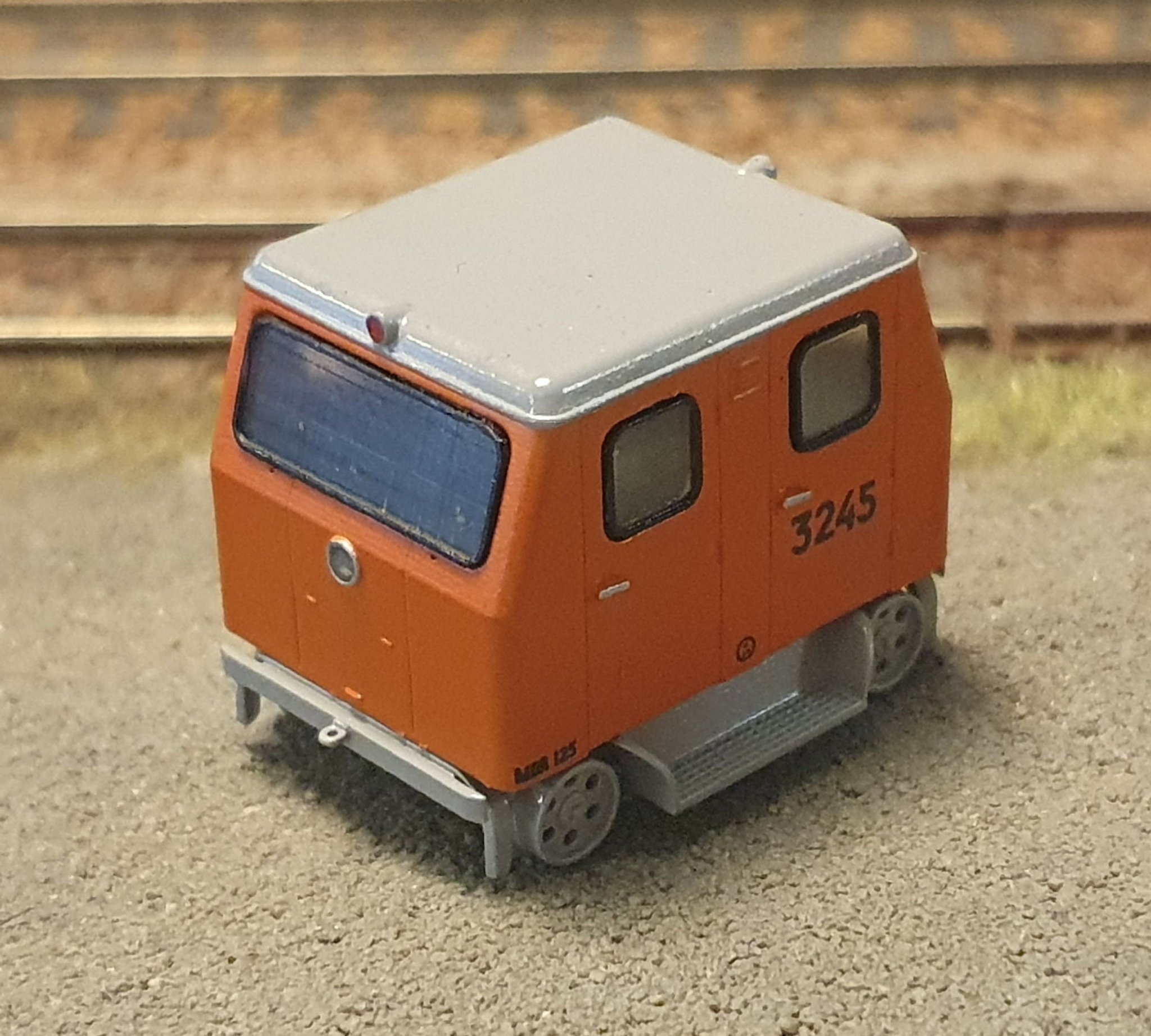
Vi har skaffat en annan dressin; inte ännu en ‘modifierad Volvo’ utan en specialbyggd MDR 125. Det är en statisk hartsmodell (och kan inte fås att fungera), men den kommer att se bra ut bara parkerad i ett sidospår någonstans! En av de vanligaste servicefordonstyperna genom tiderna är MDR (MDR = Motordressinen). Många hundra dressiner tillverkades från 1920-talet fram till 1960-talet. Dressinerna användes för bland annat persontransporter och inspektioner, men även ambulanstransporter på Malmbanan. Många har senare skrotats, men en del används än idag. De har dock i allt större utsträckning ersatts av dual-mode-fordon (bilar som kan användas på både väg och järnväg) som har fler användningsområden. Vår, nummer 3245, är från satsen MDR 125, nr. 3244-3309, med fyra dörrar, byggda av Bergbolagen Lindesberg 1956. De gick på bensin, och var även kända som ’köttbullar’ eller ’ärtor’ beroende på vem man frågar!
Andra intressanta nyheter
Vi har nyligen införskaffat en bok från 1979 om servicevagnar med UIC-nummer. Av den har vi lärt oss att UIC-bokstäverna för servicefordon inte följer samma regler som de flesta andra vagnar. Till exempel betyder ett “a” som andra tecken inte att fordonet är monterat på boggier. Även om detta förklarar hur vår ‘Qab’ bara kan ha två axlar (och ‘Qbd’ är på boggier), har det väckt en fråga om vår ‘Qab’, en Heljan-modell. Enligt boken gällde ‘Qab’ en typ av plog som aldrig faktiskt användes (en tilldelad kod). Tidigare FV1 skåpbilar visas som en typ ‘Qae’ (Q5) Impregneringsverk, senare Ogräsbekämpningsvagn, ‘Qgb’, lagervagn, ‘Qgg’, släpvagn, ‘Qlh-h’, städvagn (“-h” med torkning rum), och så fortsätter det. Det finns en nummerlista och vår vagn 945 4 229 ska vara en ‘Qgb’ fram till slutet av 1976, då den byggdes om till typ ‘Hvös’. Det var en före detta FV1, nummer 25770. Nu tog nyfikenheten verkligen överhanden och vi tittade i SMJ:s bok om 1930-talets vagnar. Nummer 25770 var en av de första, byggd av AB Svenska Järnvägsverkstäderna, Falun 1937. Här får vi dock veta att det efter en tid som ‘Qgb’ blev ‘Qfa’ (1986, efter att boken publicerats). Vi förstår att vagnen fortfarande finns i Nässjö, där det finns ett järnvägsmuseum, men detta är inte bekräftat. Däremot är våra ‘Qbd’ barlastvagnar (Roco) modeller av en typ som tidigare känd (pre-UIC) som ‘Q32b’, och byggdes av Talbot, 1957-58. Lätt!
Work continued on our newer replacement model of Åmål station building during July. All window frames were glued into place, and then the glazing material behind them. We then mounted the platform onto the base, and the plinths onto the walls; and put the four sides together, standing on the base, held together with an elastic band! We then decided to add a little detail not included in the kit, and using 0.5mm brass rod, we now have a painted handrail by the steps.
The four walls held together with a band, and mounted onto the base.We have added a handrail to our new model of Åmål station building. (The poor-fit gaps are due to the model not being glued together at this stage!)
A visit to the ‘LennaKatten’ (Uppsala Lenna Järnväg) seemed a good idea, at least for research purposes; but it was a nice day out in good company, anyway. The research element focussed around Lenna station, where the very traditional signalling (read: locking frame) has been the subject of a short instruction manual; but which left us with more questions than answers. Sadly, the passing loop there is not used in normal service, so observation of the procedures was not possible (it is “switched out” for automatic signal operation). But having a look around the site did help; and this was followed by a lengthy chat with a signalling guy at the railway. Most of our questions are now answered, but a few remain.
Loco 5, “Thor” at Marielund.Diesel-hauled trains on the ULJ are just as interesting.
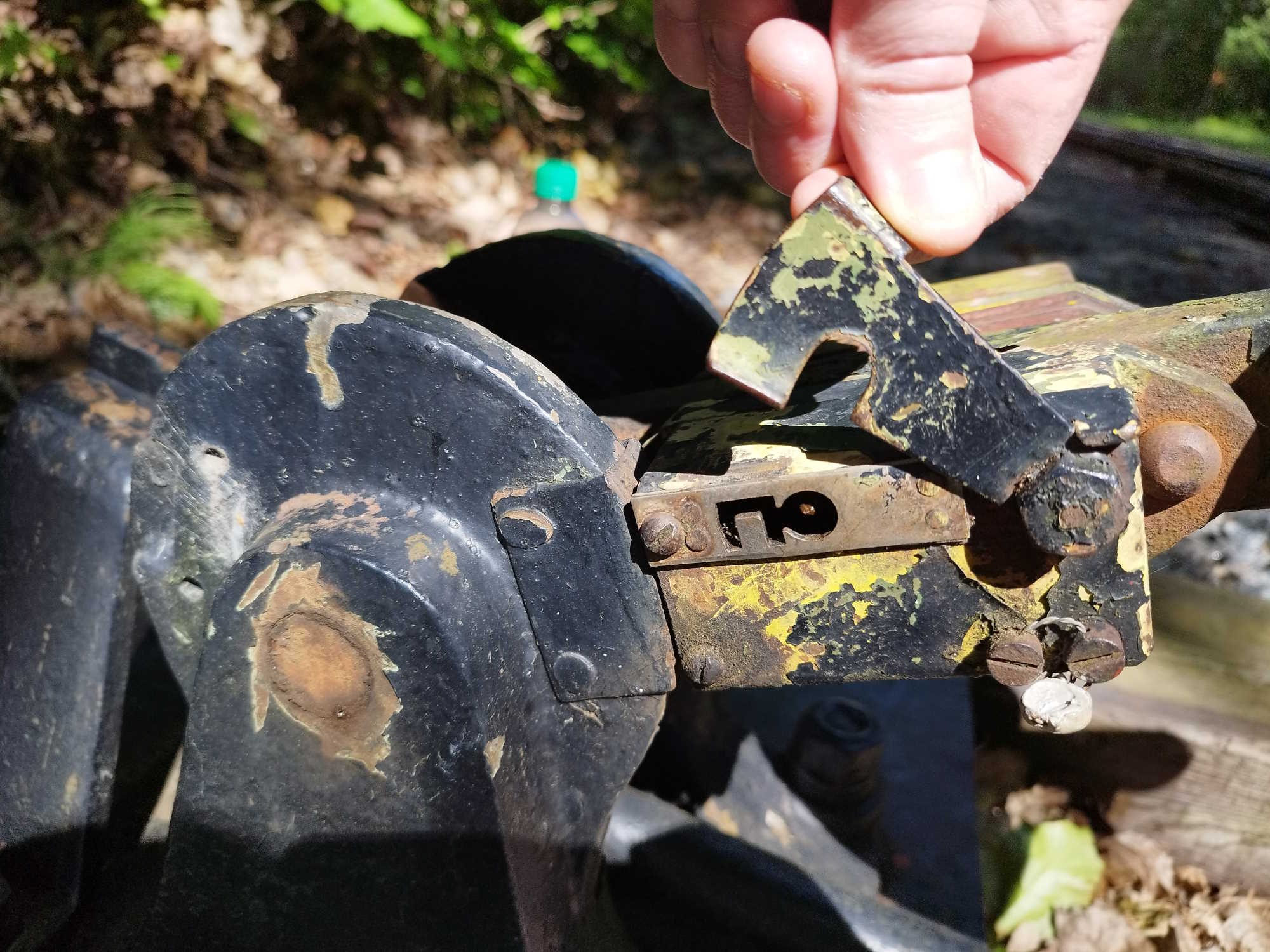
We may present an article about this subject at a later date, but for now, a brief overview; and readers who are not interested in railway signalling can skip this paragraph! The locking frame type used at Lenna has keys. These keys are used in the point levers (in pairs) and one or the other can be removed depending on point position. This removed key is inserted into the frame to unlock slide bars, which in turn can unlock the signals. If the Station Master has key type K3 in his possession, he knows that all points are in their normal position. Inserting K3 to a point lever, enables him to change the point, thus releasing a key type K1 or K2. In some instances, this key goes into the locking frame; in other instances the K1 or K2 goes into the lever at a corresponding point to release the other (K2 or K1), which is the one inserted to the locking frame. There are 16 different types of key, but only five are used at Lenna. We would like to recreate this on our eventual new layout, hence the extra interest.
This is the Locking Frame at Lenna; the levers operate the locking slide bars.Key K¹ is locked into place in the frame. K² is for the ‘other’ point. ‘A’ is one of the home signals. Note the different key profiles that are required.Key K³ is locked into the point and cannot be removed until the ‘other’ key has been inserted, and the point changed.Key K³ has been removed, locking this point in its position. (We know it’s a ‘K³’ from the profile.)
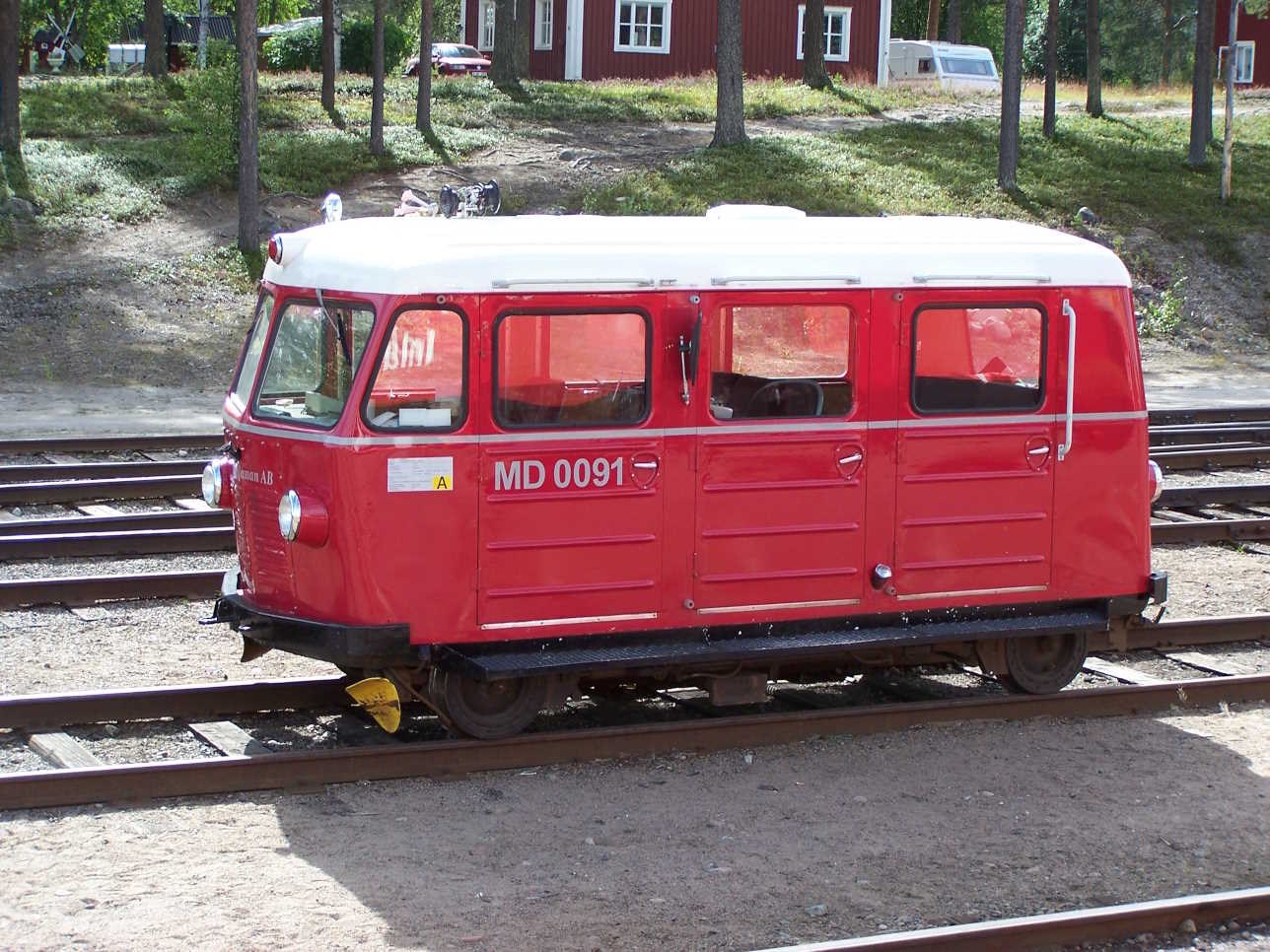
We have acquired another dressin; not another ‘modified Volvo’ but a purpose-built MDR125. It is a static resin model (and cannot be made to work), but it will look good just parked in a siding somewhere! One of the most common service vehicle types of all time is the MDR (MDR = Motordressinen). Many hundreds of dressines were produced from the 1920s until the 1960s. The dressines were used for, among other things, passenger transport and inspections, but also ambulance transport on the Malmbanan. Many have later been scrapped, but some are still used today. However, they have increasingly been replaced by motor trolleys and dual-mode vehicles (cars that can be used on both road and rail) which have more areas of use. (There is no direct English translation for Dressin, so this and the plural Dressines have been spelt accordingly to aid pronunciation, notwithstanding any misinterpretations!) Ours, number 3245 is from the batch MDR 125, nos. 3244-3309, with four doors, built by Bergbolagen Lindesberg in 1956. They ran on petrol, and were also known as ‘meatballs’ or ‘peas’ depending on who you ask!
Internet photo of the MDR 125; but these did not usually stand off the rails.Internet photo of MDR 125 3245 on the track; a nice addition to any siding!Three assorted MDR at a location somewhere along the Inlandsbanan.MD 0091 on the Inlandsbanan; typical of the quintessential Dressin.
Other News
We have recently acquired a book from 1979 about service wagons with UIC numbering. From it, we have learned that the UIC letters for service vehicles don’t follow the same rules as most other wagons. For example, an ‘a’ as the second character does not mean that the vehicle is mounted on bogies. Whilst this explains how our ‘Qab’ can have only two axles (and the ‘Qbd’ is on bogies), it has raised a question about our ‘Qab’, a Heljan model. According to the book, ‘Qab’ applied to a type of plough that was never actually used (an allocated code). Former FV1 vans are shewn as a type ‘Qae’ (Q5) Impregnation works, later Weed control wagon, ‘Qgb’, stores wagon, ‘Qgg’, trailer, ‘Qlh-h’, cleaning wagon (“-h” with drying room), and so it goes on. There is a number list and our wagon 945 4 229 should be a ‘Qgb’ until late 1976, when it was rebuilt to type ‘Hvös’. It was a former FV1, number 25770. Now, curiosity really did get the better of us and we looked in SMJ’s book on 1930s carriages. It was one of the first, built by AB Svenska Järnvägsverkstäderna, Falun in 1937. However, here we learn that after a time as ‘Qgb’, it became ‘Qfa’ (in 1986, after the book was published, so the type isn’t listed). We understand, but this is not confirmed, that the van still exists at Nässjö, where there is a railway museum.
The ‘Qab’ is a former Fv1 (F5).
By contrast, our ‘Qbd’ ballast wagons are (Roco) models of a type formerly known (pre-UIC) as ‘Q32b’, and were built by Talbot, 1957-58. Easy!
Behind the Scenes
Mini-Series around the FLMJ; H: The Website
As mentioned earlier in this mini-series, we were not the fastest to go online, and justifiably so. There seemed little need, and everything was ticking over nicely. But, we were often asked if the Railway had a website where people could follow its progress, and ‘put like that’, it seemed a good idea. One of our Friends created both of our websites; the original one using the technology that was available at the time, but was cumbersome to maintain; and the current one, which is closer to basic desktop publication, and can be regularly updated with ease by other members.
The website was naturally intended to bring news about the Railway, and how everything was progressing. It was like a blog, and to some extent remains as such. However, with so much research being necessary, and wanting to share this hobby as much as possible, the website also became a repository of articles relating to the Swedish railways, be they features about locomotives, wagons, signalling systems, or whatever else we have needed to research. And this seems to be the main attraction today (well of course, whilst the FLMJ is closed, there’s not much else to write about)! Much of our research material can be found on the internet, in Swedish; so we present it in English. Only our own updates are available in both languages, and this is something that needs to continue if the Railway is to truly ‘belong’ here.
Nevertheless, there is a genuine fear among railway groups that too much information on the internet is having a backlash, and membership numbers in societies catering for special interests within the hobby are dropping. These specialist Societies have been reporting an average of 20% loss in subscriptions. The British based Scandinavian Railways Society is suffering this effect, and both their former website and our website, may have been contributing to this effect; by giving away so much information online, that there seems little need to join a society, no matter how friendly! They have reigned in their website so that it promotes the Society without giving away too much general knowledge, but will soon have a members’ area where the articles can be placed. We will follow suit, but with edited copies of the articles freely visible, and the more detailed articles available to our Friends. We identify ‘Friend’ (note upper-case ‘F’) as someone who is actively involved with the Railway’s development, maintenance and operation; someone who would be if they weren’t so far away, or have other barriers (but, including regular guests); and someone who has shewn significant interest and with whom we have regular correspondence. So, we feel that this is a suitable way to move forward in this digital age without causing the specialist Societies, the SRS especially, to suffer.
Next month: the Special Reports and Local Promotion