
Rc3 1027 with Symoba couplings and standing on metal wheels of the correct diameter; now ready to roll!
Latest News
This website is an archive! For the latest news, please visit www.adnalm.org.uk
05.12.20 November has been a busy month...
Rc3 1027 is getting more ready to be used in double-heading and for testing new track before being connected to controllers.
Rc3 1027 with Symoba couplings and standing on metal wheels of the correct diameter; now ready to roll!
T21 64 returned to service (for proper running-in) at the beginning of the month.

T21 64 shewing the green control boxes - just a little detail that makes a difference.
T45 328 also made progress.

T45 328 with its buffer-beam numbers. The body is now properly secured to the chassis - but awaits a motor and drive-gears.
F 1207 had some significant progress during November. The biggest breakthrough came on the first weekend of the month, which some would argue is a little ironic: remember that this is an important Swedish locomotive, made by a Danish manufacturer… that weekend was the 500th anniversary of the Stockholm Bloodbath; we’ll leave it to you to look up the historical relevance!


Left - F 1207 back together, but without a motor.
Right - F 1207 headlights; the new Jeco/Liliput lamp is at the top, the lower Heljan ones need recolouring!
K24 1775 returned to the Railway during November. There was only one K24, and its number was 1776, so we shall see about getting ours corrected. Curiously, when Liliput first produced the model, they got the number correct; but they later issued it as 1775 and 1772, both incorrect, yet only 1772 came with etched numberplates!

K24 1775 awaiting testing and running in. All does seem to be well.
Yd 343 came in for a little more work.

'A' end markers on the Yd.
FM4 55420 has been painted. The decision was taken to reject the Orange “Mätvagn” livery for this model, and instead to paint it the same way as the R5, old SJ brown, but with black at window height. It is, after all, another ‘freelance’ carriage.

FM4 55420 with its decals, but still a lot more work to do.
R5 2602 has continued, following the collection of some old parts in store, spare parts from former UGJ models!

R5 2602 ready for traffic; a freelance model to be used until we have more authentic catering carriages!
The Tekla (aka Strömavtagarvagn) was recovered from storage, and some effort has been made to get that kit completed. A plan of action was for a whole week, with one job each day. Although the jobs were all quite small, this is a delicate kit, and should not be rushed! Of equal urgency was a box for it to go into because it is rather lightweight and prone to damage!

The 'Tekla' with Rc3 1027 - certainly not reaching the pantographs!
01.11.20 October has been a busy month...
Rc3 1027 has received some more work and investigation.

Rc3 1027 with both pans lowered.
A great sense of achievement occurred on October 6th; T21 64 ran under its own power! Two days later, it was run-in on a test track at another location. It sounded a little ‘rough’ and more work has been be necessary, but the light is in sight!

T21 64 with handrails refitted - at the time of publishing, one had come off already, but a new design of handrail and fitting is being developed.
T45 328 also received some more attention.


Left - T45 328 shewing the retrofitted Symboa coupling (before trimming).
Right - T45 328 with a Roco coupling head, alongside the next loco to be retrofitted, Rc3 1027!
F 1207 has been the recipient of a lot of work, and as October drew to a close, progress was quite apparent! There is much to write about, but we are providing a summary here, and will do a more thorough account for a special feature, in due course!


Left - With cladding (right) removed, the boiler (left) can be seen as a large weight for the loco; the smoke-box door has the new headlamp fitted, but this still needs to be wired in.
Right - The motor and fly-wheel (with cardan socket) from the F-loco. We need to replace this, but what with?
We Have done a little work on our new Hilding Carlsson Yd 343.

Yd 343 taken apart, shewing its simple-yet-effective means of power and assembly.
Y1 1308 and YF1 1331 have been fitted with Roco close-couplings into their NEM pockets. Fitting of things like mirrors has wisely been postponed until we are ready to start running them on a new layout.
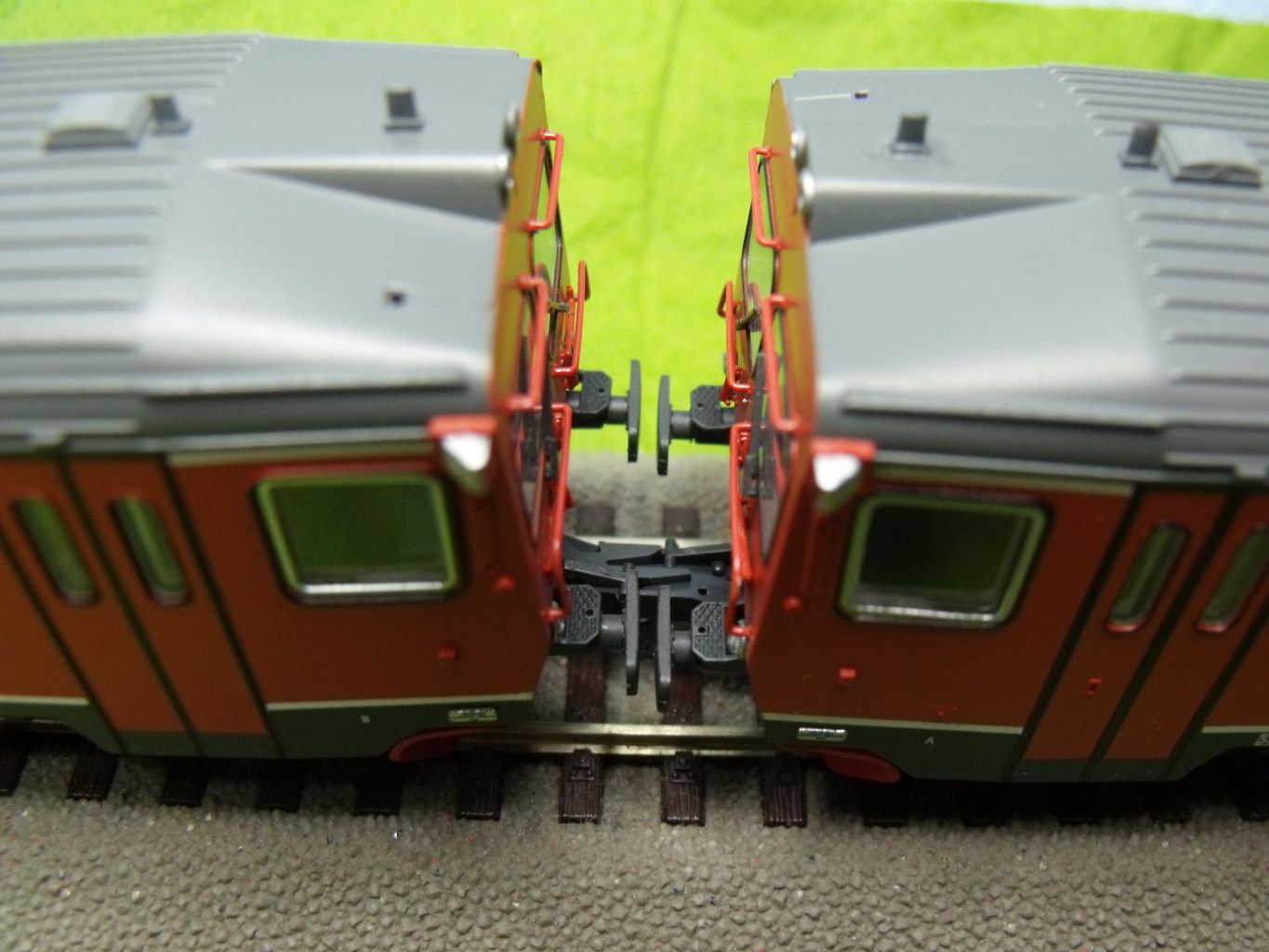
Close-coupled Y1/YF1.
Project FM4 has been rekindled, and whilst actual work has been minimal, a more sensible way forward has been identified.
Project R5 has also been rekindled, even though it is not so necessary now. We have been converting a Heljan URB2 catering carriage to a loco-hauled carriage in protest at the complete absence of catering vehicles in H0 for SJ. Now, of course, we have the NMJ RB1 available, and the HNoll R4 arriving soon! Our R5 is being completed as we have come so far with it.

Our 'freelance' R5 seen earlier in the month.
Having mentioned Symoba couplings; we have acquired a Height Gauge to comply with NEM-362, and this has been very useful for this purpose—especially with the modifications that have been made to the T21. It will be particularly useful also, on the Rc3 1027, T45 328, and R5 carriage, all of which are likely to receive this brand of coupling. We have put a link to the German-language Symoba website from this website.

The Symoba coupling gauge (repainted from black so we don't lose it) ready to test the T21.
We are considering the possibility of buying back the K24 steam loco (and doing some work on it to make it more authentic—see our recently updated guide to steam locos); there is a faint possibility of it receiving its earlier identity of NOJ number 29, but we’re not certain how easy that would be to do.
13.10.20
Flytten till Sverige:
Operation “Sverigepilen” has begun. Despite the desire to get the new railway built as quickly as possible (to combat the withdrawal symptoms), an effort is being made instead to build a smaller ‘portable’ railway first, whilst the best options for the permanent layout are considered. If we are able to continue to divide the railway scenically, so that it can represent the north, central and south areas, then the ‘FLMJ’ title will remain. If not, then a new name will be sought. The temporary layout, however, could have a name to represent a remoter area of Uppland (our new location, until a more permanent home can be found)! But, there is also the settling in to be done (and new employment to be found), so progress will be very slow to start with. (Remember, the KRBJ wasn’t started until a year after moving into the old UK address.)
Work continued on T21 64 repairs, and this has become a very big undertaking. In fact, in dialogue with a Swedish railway modeller, it was declared that if we succeed in getting the loco into full working order, it will probably be unique! With no layout, presently, there doesn’t seem to be much urgency to complete the repairs, but this loco is desired for the earliest works trains when we do start building…!


Left - The T21's new motor is in place, but the gear protrudes a little too much...!
Right - Slowly going back together. An assessment of the work to be done suggests that it will be November before the job is finished, assuming that we encounter no more problems!
An abandoned project has been resurrected; that of the construction of T45 328. We were thinking of selling this kit, but we would much rather bring it into service. There were only five of these ASEA diesel locomotives, leased to SJ for evaluation, but they did not lead to further orders.

The T45 has an unusual centre-cab window, faithfully reproduced for the model.
F 1207 has come into the workshop for evaluation, to see, first, if it has the same type of motor as the T21, being a Heljan model (albeit steam outline), and then to see how well it runs whilst out of the model. This loco runs very well once it has got going, even slowing down to a crawl, but it doesn’t start from rest at all well. Suggestions to the cause originally included dodgy valve-gear, bad connection somewhere in the drive train, or weak magnet in the motor. During the first test, we were unable to remove the motor without breaking cables, so that has stayed where it is; but we can see that it is not the same as in their T21 diesel! We did find, however, a DCC decoder in the tender, and this could be the cause of all the running problems—similarly fitted ‘guests’ to the FLMJ have always been problematic, so when the work resumes during October, this decoder will be removed and any ‘bridging’ pieces fitted in its place!

The F (steam) loco during works.
After a very long wait, Y1 1308 and YF1 1331 arrived from NMJ. These are truly beautiful models and represent these Italian designed railbuses in original condition; without the air intake units on the sides, and of course, in SJ orange livery. If a third unit is to arrive here, it will be with the intakes, because that was an early modification, and everyone involved with the FLMJ has no memory of them without!
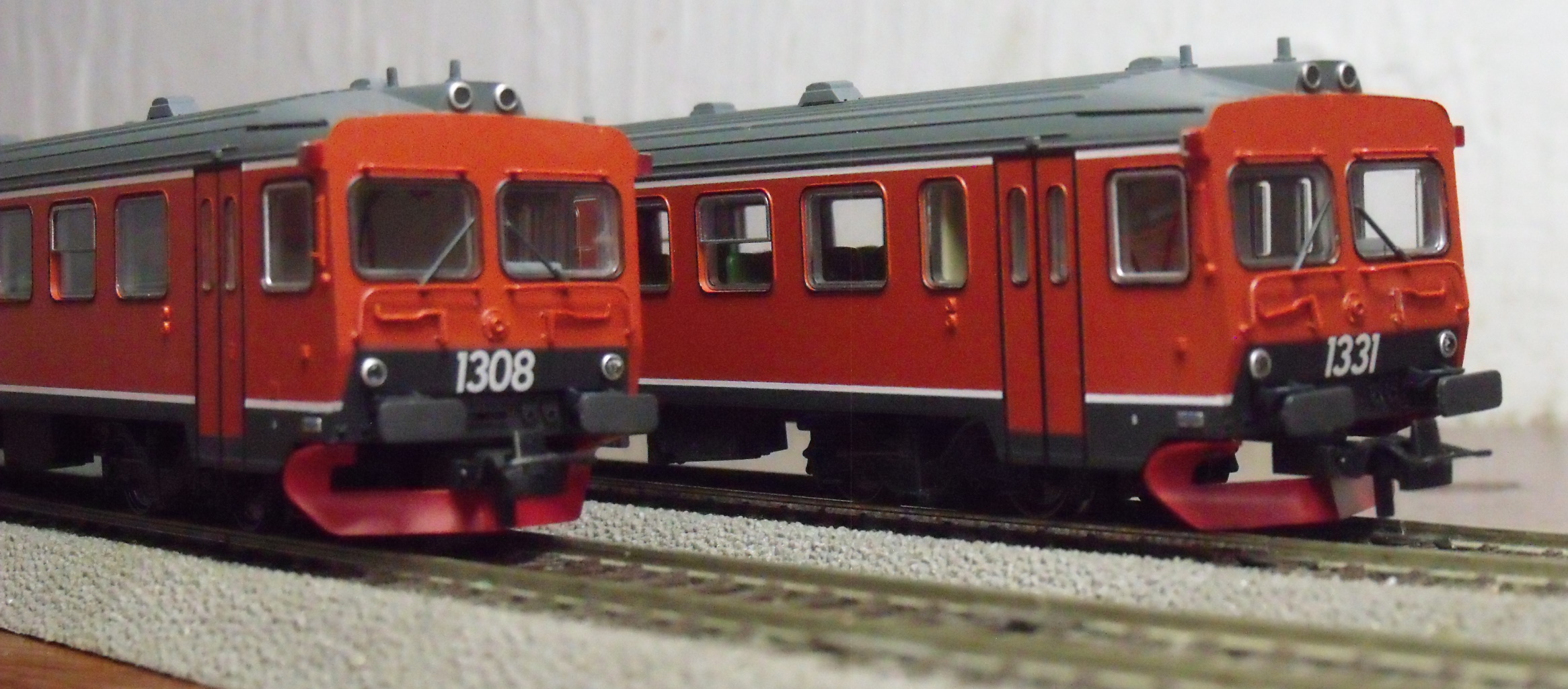
Y1 and YF1 railbuses, awaiting a layout to run on!
From one extreme to another; the almost oldest railbus type is the Hilding Carlsson Yd, and a Perlmodell model of one (with UF2 trailer) has been acquired. Bus and trailer are without numbers presently, but looking at Byggsvenskt’s website, we are intending to go for Yd 343 and UF2 1574. (The UF2 is the same as the UF6, but not modified!)

The Yd railbus. Note the luggage racks on the roof and vehicle ends. Also note the postbox on the left door!
We also acquired, quite a long time ago, a couple of ‘Yd’ railbus kits in almost scrap condition! One is in Hilding Carlsson cream, and the other in HNJ red. But, we found that the models are actually of the Yp railbus (for narrow-gauge), of which only three were ever built. We have found a new home for the HNJ one with a friend, but the HC one could be rebuilt to H0n3 gauge for a later FLMJ diversion!


Left - The HNJ railbus during the paint removing process, being a Yp, not a Yd, its new owner will give it a new livery.
Right - Our Yp railbus is in a rather forlorn condition; but not beyond repair and bringing into service - eventually.
We are pleased to have been able to help some of our friends acquire Swedish models. A standard Y7 from Jeco needed sorting because of a conflict between the English and Swedish banking systems; but also, two rare X10 units were procured! These models had been owned by SJ (despite being in SL livery) and were used on a demonstration layout at the ‘Tågetsdag’ event every summer for a few years, several years ago. They were well worn out, but had been renovated and offered for sale. Like the FLMJ’s X10, they have the terrible Tenshodo motor bogie, but Byggsvenskt produces a motorised chassis kit for these units, and this was recommended by the seller; so the FLMJ unit could be upgraded at the same time! The second FLMJ unit will remain without a motor so that it can run as a double whenever necessary.
We have recently been saddened to learn of the passing of friend, Richard Stokes. Whilst Richard had no direct involvement with the FLMJ, his profession as a Railway Signalling Engineer combined with his hobby interest at the Great Cockcrow Railway, led to much of the inspiration for Adrian to create the plans for the authentic signalling proposed for the FLMJ (as well as several other projects). Through Richard's friendship and guidance, the proposed signalling was based on absolute authenticity and not merely for decoration, which many other layouts have succumbed to. This influence was about to be realised upon the former FLMJ (all materials had recently been purchased) when the sudden closure had to be implemented instead. It was hoped that Richard would see the results of his kindness in the near future on the new layout. Richard died in September after a short illness, aged 78.

Aside from his influence upon the FLMJ, Richard's railway history is a story worth telling. Richard’s background was as an S&T engineer. He worked on the Hixon level crossing crash inquiry in 1968, and was Assistant S&T Engineer at Liverpool Street and the New Works Manager on the SW Division, where he was instrumental in resignalling Brockenhurst signalbox whilst still maintaining a near normal service. Richard subsequently went to the LM region before joining Eurostar, where he went on to become the Production Manager on the Channel Tunnel Rail Link.
He was one of the first senior BR managers to help start up European Passenger Services. He helped plan and develop the new Eurostar trains and service patterns through the Channel Tunnel to Paris and Brussels. He used his extensive contacts in SNCF, TML and SNCB to build strong relationships with counterparts across the channel, and helped to bring together the teams needed to design the new fleet of trains and create joint technical standards for that project.
After his retirement from CTRL in 2006, Richard worked on a number of projects including at the Ffestiniog and Welsh Highland Railways, and working with the European Cab Design Group to establish a standard cab design for all new trains throughout Europe. For many years Richard’s hobby was developing the signalling system used on the Great Cockcrow Railway near Chertsey, which is where he and Adrian met.
30.08.20 As already known, the D-loco needed some post-delivery (to traffic) adjustments and so on, and during August, the transfers/decals were lacquered; and then the loco was finally put away in its box, ready for traffic (or new pantographs)!
T21 64 broke-down during the old FLMJ’s last year, and it was found that the motor had simply stopped working. It also needed some cosmetic repairs.

The T21 in its current state; we have identified where the motor wires need soldering onto, but we need to find the cause of the ongoing problems before we do that!
Tc 306 entered service a few years ago, having been built on-site as a Modellproduktion body on a Roco chassis; and then there were issues with the gears not meshing properly! However, all sorted, we simply overlooked the fact that we had also bought a bag full of accessories from Entec to paint and fit to the model, so it was now time to do it. This also proved challenging! The instruction sheet is not at all clear (bad printing) and a lot of guess-work was necessary!

Tc 306 with steps, handrails, mirrors, wipers, etc. Some straightening up will be needed, but that is best done once it is safely on a home layout, rather than moved in and out of its box!
UF6 1576 is a model of a short baggage car of the type built by Hilding Carlsson. It would have been type UF2, and gone into trains with similar styled railbuses. But a few were modified to work with the newly delivered YCo6 variety, so this is the case with our model. It was purchased from a fayre in Stockholm, and we think it is a Lokstallet model. It needed three jobs to be done.

UF6 1576 coupled to Y7 1136, having been brought up to standard.
We have a Yp railbus on the workbench at the moment; but more about that, and one that we passed to a Friend, next time!
The three SMJ carriages have received lacquer over their transfers, but also some SJ brown paint has appeared on the etched end panels where appropriate. The final job here was to make an ‘interior’ for each of their boxes so that they could be safely put away. They’re all the same and a bit strange, but they make the most of the materials that we had available!

The SMJ carriages in their modified boxes.
Two NMJ RB1 carriages have arrived into store, and these will go into InterCity trains (already designated). Sadly, HNoll continues to have production issues with the R4R (which seems to be tooling and then a production queue at the Chinese factory), but they at least have the kindness to keep modellers up to date with the situation.

NMJ's RB1 carriages. [D. Hill]
Back in March, we advised about the proposed production of Swedish model cars from Minichamps, Saab and Volvo models. We are now aware that PCX87 is proposing a 1989 version of the Volvo 240GL estate. It would be interesting to compare this with the Minichamps 1986 model. (We would prefer, of course, late 1970s versions!)
In Website news, we have taken down the “Forthcoming Events” page because in the current climate, events are few and far between, and when things do get up and running again, we are going to be in a different place in different circumstances. Recognising the big changes taking place (and changing technology), we are working on the creation of a new website also, which we hope will look better and be more relevant, yet just as informative as now.
28.07.20 The D-loco 174 was dedicated to traffic on 24th July. To wait until all snagging had been completed would delay this indefinitely, and we learned from the construction of the UGJ carriages that there should come a point where the models are fit for service—subject to minor adjustments! At the beginning of July, the D-loco had the cab-end handrails fitted. These were completely new and made on-site; Jeco had been unable to complete the order and we wanted a matching set all round. Each handrail goes around the corner of the cab, and then up at the front, alongside the end door. Scratch-building these was an interesting challenge and at the first attempt only one out of four fitted properly. But after some effort (and one replacement), they all went in. Then, the outstanding Jeco ones arrived, so we have fitted them in, instead (because they look much better)! Next job was to take the door handrails off to paint them black. During re-fitting, one of them went ‘ping’, so we needed to make a new one (and then paint it again)! We have also put a little glue on the loose pantograph—only a little, of course, because we do intend to replace it whenever possible. Mid-July, the ‘174’ was applied to the buffer beams, and the metal plates were painted and fitted—the ’wrong’ number stayed black and we used transfers to apply the correct ’174’!

D 174 on a plinth, ready for service.
Slightly ahead of the D-lok, the three SMJ carriages were dedicated to traffic on 20th July. Again, to wait until all snagging had been done would probably result in them never entering service. July’s work on the SMJ carriages started with a blip! Before we could apply the decals to the C3g or CF3, we found that the sole bars needed painting black. On the C3d (the SJ model), these are part of the chassis and already the right colour. On these two (ex-OKB) models, they’re part of the bodies, and were therefore, the wrong colour. Whilst we were making this correction, we also painted the rooves (and on the C3d because it was too light)! The decals were applied during the month and now the carriages really do look the part! New handrails have also been made for these carriages (all three) because the first attempt was not really satisfactory. With poor drawings and few photos, we could see that the SJ carriage has a different style to the ex-OKB ones, and this has been reflected! Using our new method of locating the handrail in the lower hole and just gluing the top seemed to work well; we used a super-glue with brush or nozzle; the former making the job remarkably easy! Last month, we commented on the C3d being reverted to its originally proposed number, 1984 because we had found the number on the decal sheet. The same has now happened with the C3g, so it is 2994 as originally proposed! But, here’s another change; the CF3 is 3015 (instead of 3017). This is so that we could pinch the ‘17’ (and the ‘4’ from 3014) on the sheet to make up the buffer-beam numbers for the D-loco (see above)! But, job done.
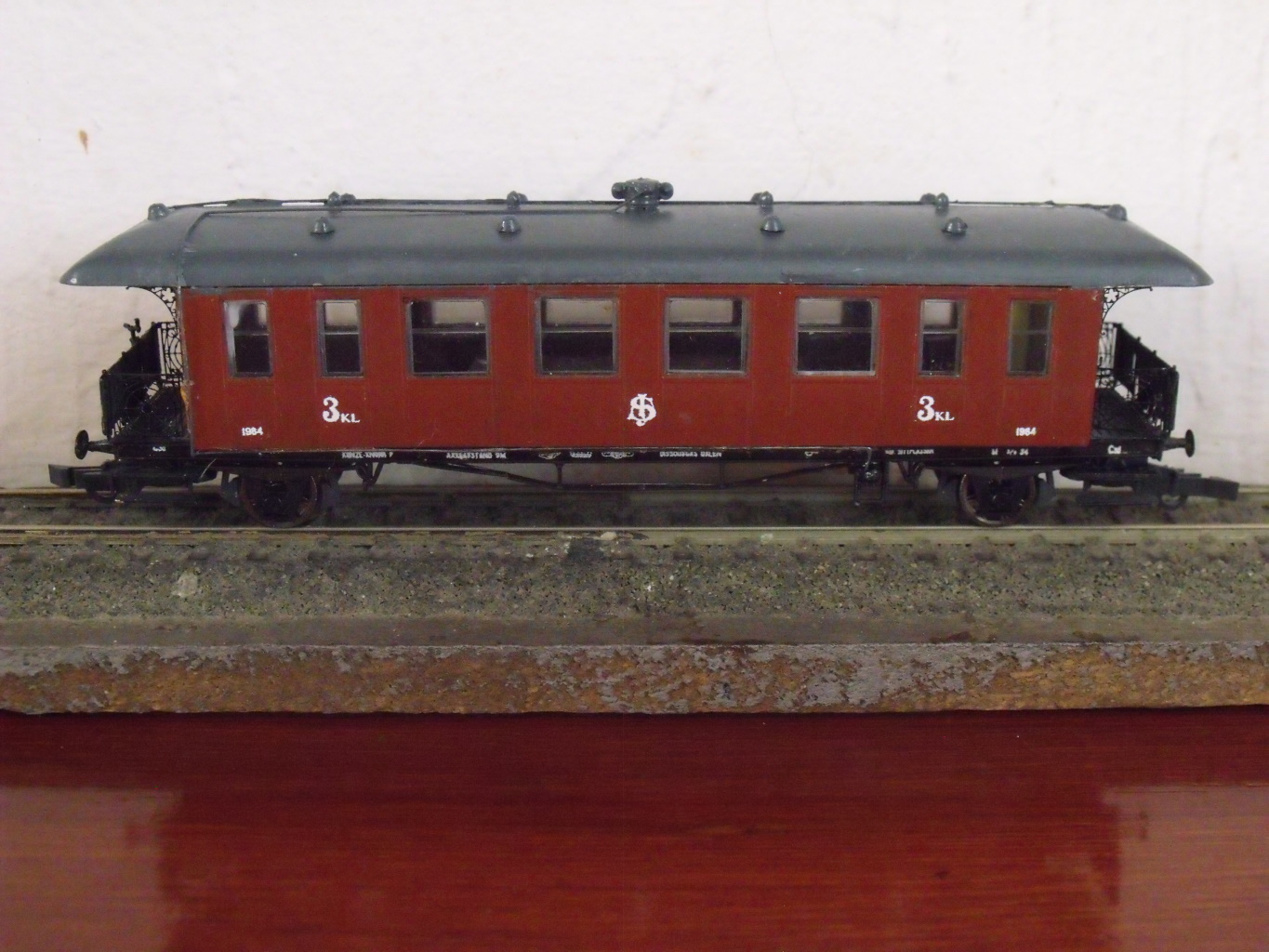


Top Left - C3d 1984, ready to enter service (some paint needs touching up)!
Top Right - C3g 2994, ready to enter service (some paint needs touching up)!
Bottom - CF3 3015, ready to enter service (some paint needs touching up)!
Now that these models have been ‘signed off’, some more have arrived from storage, the Tc-loco (to be fitted with all of its extra detailing such as handrails and so on), T21 diesel (to have its chassis repainted and then all the fallen-off bits glued back on; then an investigation as to how to get it to work again seeing that Heljan doesn’t seem to want to supply a replacement motor for it), and a small Hilding Carlsson goods vehicle type UF6 (which, as a modification from UF2, will be made compatible with our YCo6 generation railbuses). We’ll provide more details about all of these, next time!
Brekina has said on their website, that their new Saab 92 was originally produced exclusively for Märklin, to go onto a wagon, in pairs. Now, it is becoming available in its own right, but better detailed. (This is no offence to Märklin; they needed a basic model in order to make the wagon affordable!) Now, Märklin is advertising a wagon with two Brekina Volvo 66 cars on, but as the Sedan, not the Kombi. Maybe, this means that we can look forward to these without the wagon in the next year or so? The wagon type would not appeal to many modellers (it certainly isn't of Nordic origin), and Märklin models are of course only suitable for three-rail systems.

Brekina's Volvo 66 sedans on a Märklin wagon. [Manufacturer's photo]
Still with cars, we had heard that a new (to us) firm called Minichamps would be producing models of the Saab 900 (1987 version), Volvo 240 and Volvo 740 (both as 1986 versions). Their website hasn’t given much information, but a recently received catalogue from them shews six cars, each in four colours. They are the Saab 900 coupé (3-door), Saab 900 cabriolet, Volvo 240 sedan, Volvo 240 estate, Volvo 740 sedan and Volvo 740 estate. Recent examination of another model by Minichamps suggests that these cars are worth looking out for when they arrive, and we (the FLMJ) could slightly loosen our load of IMU, NEO and Wiking models to make room!
Back to the Saab 92, we have found that BoS has also produced a model of this car in 1:87 scale (H0)!
And finally, just as this month’s news was rounding to a close, pictures emerged of NMJ’s new 1960s catering carriage in four versions, one as B1c-L (original condition, but with ‘post-stamp’ logo), one as RB1-L (same but post-1970), and two as RB1 (with the dining ‘logo’ on the corners). Priced at 895:- SEK (roundly £80), these should be as good as their previous 1960s carriages, and indeed the FLMJ is interested in the RB1-L and one of the RB1. These should be a perfect compliment to the existing 1960s carriages that NMJ produce, and it is quite likely that more liveries will emerge in due course (well, it makes sense, some remain in service today as type R12). But, as with the Y1 railbus, we await delivery!

The RB1 from NMJ. [Manufacturer's photo]
04.07.20 We’re reaching the stage where there is not much more that can be done to the D-loco! It will be dedicated to service before receiving the replacement pantographs or proper number plates, but the remaining jobs to do before then are fewer in number. Handrails have been made and fitted to all of the doors. Presently, they are silver in colour, but a later job is to repaint them black. The handrails around the cab ends will finish this model. There is a technical job that requires further investigation, that of the faulty lighting. The likely cause is one of two possibilities, faulty diodes or feedback; but we need a proper workshop in which to fully investigate.

The D-loco, now with door handrails, still awaiting (parts for) the cab end handrails.
Work resumed on the SMJ carriages at the beginning of June with the painting of etched parts and then the fitting of the handbrake columns, fall plates and awning brackets to the two ex-OKB models. Unfortunately, after all this time in storage, one of the handbrake columns was damaged, but not beyond repair. The brackets were secured to the walls, but not the rooves; this is a later job for after when the rooves have been painted. (Rather than wait indefinitely, we have now ordered the paints!) A more technical job was the work on the couplings—all of them drooped to varying degrees. The solution was to remove them, insert the NEM extensions into very hot water, bend them slightly, and cool them in cold water. Problem solved. (We needed to do the same to the D-loco couplings (as indeed we did on our standard Jeco models).) In mid-June, the handrails were fitted to the carriage ends, a rather tricky process as they needed to be bent to shape, and the best fitting ones ended up on the CF3 where they poked into a locating hole at the bottom, but were glued to the body at the upper end. As the month drew to a close, the decals were applied to the C3d; a job that took over three hours! Bizarrely, we found number 1984 in small digits on the decal sheet, and this number did apply to a steel body C3d, so we’ve gone back to that originally proposed number for this model.

C3d 1984, almost ready to enter service!
Our two CM Laser models of the B6G carriages arrived out of storage, following failure in service in the last days of the old FLMJ. It seems that the carriages, which we purchased second-hand, each have the same two faults:
There seemed to be one solution to solve both issues, in that the steps could be mounted on the bogies (as seems to be the case with the På Spøret models of the same carriage type) allowing them to turn with the bogies, and their cross members being used to provide the extra strength that the bogies need! Well, that is in essence what we have now done, but it was not as straight forward as that. The NEM coupling mechanisms were still in the way! However, because the steps are made of thin etched brass, we have been able to slide that between the mechanism and the chassis, allowing the bogie to sit beneath the mechanism. This means that if we need to remove the bogies, we first need to remove the wheel-sets and the coupling heads, and having released the bogie from the pivotal screw, to slide the bogie over the end of the NEM mechanism, gently prising the brass away from the plastic! The intention to do the two carriages at the same time was withdrawn so that one could serve as a test model; and it also needed a buffer gluing back on. Gluing the buffer was also quite a challenge because the main material used in these carriages is not plastic, but resin, so the regular poly glue was not as successful as we would have liked! Furthermore, one of the screw-holes for a bogie pivot had worn away, so the screw needed to be glued back in. We also found that one of the carriages was missing part of its NEM mechanism, but with the bogie in place, its absence is unlikely to cause any problems. But, job done, and these carriages can be returned to service—whenever we have a railway to run them on!


Top Left - B6G 3828 with its bogie turned slightly, and the steps now move with the bogie. (The missing handrail has since been replaced!)
Top Right - Photo shewing how the coupling pokes between the bogie and the steps. The white plastic is the earlier bogie strengthener. Note the 'repair' to the lower steps!
Bottom - We've also tidied up the ends of these carriages - CM Laser's instructions actually told us to put the end gates on the wrong way, but photos saved the day!
The newly arrived Märklin RBo2 ‘byffé’ carriage has seen some work also, with the removal of the Fleischmann couplings, and fitting some Roco couplings, glued to extension arms from the bogies (thus not NEM-compliant, but compatible with our other models)! We also ought to fit later-style gangways and extended buffers, and find some glazing for the windows in the gangway doors. It’s number has been modified to 4833. We also tried in vain to find a reference number for the interior fitting for the almost identical carriage, Märklin 4378, so that we could obtain one and adapt it to fit! Finally (for now), we’ve made a new box for it; it did not arrive in an original box.


Left - The RBo2 with Roco coupling.
Right - From underneath; the white coupling can turn on the screw, the fins either side act as springs to encourage the coupling to sit straight.
A few new models are creeping out, despite the global mess, and among them are a few cars, including a few that we didn’t know about until we happened to stumble across them whilst browsing!


Top - Saab 99 made by PCX87 (advertised by Brekina); the style of the almost invisible front indicators suggests that this is an early version (probably with a Triumph engine)!
Bottom - Volvo 66 made by Brekina.


Top - Volvo Sport (P1900) made by BoS
Bottom Left - Volvo 264 TE made by BoS
Bottom Right - Volvo 7900 electric hybrid bus with charging point.
HNoll has advertised the A7 and B7 models, along with a few S1/S4 versions, all due for release in probably November. The R4R and derivatives have been further delayed due to a tooling issue, but HNoll is confident that they will still arrive before the A7/B7 etc.
31.05.20 A few new models arrived in May. One is an old Märklin RBo2 restaurant car (later known of course as the R1R), a 1960s design, which will be used in a rake with NMJ 1960s coaches until NMJ (or somebody else) produces something more reasonable. The Märklin model does shew its age, and of course, it is 1:100 scale length instead of the correct 1:87. But, it gives us a dining carriage, and we have often complained about the lack of dining (and sleeping) carriages for SJ in H0-scale! (We have also changed the wheels, of course!) Of four goods wagons arriving, three are Dekas ‘Hbis’ wagons; very high quality and very nice. The other new wagon is a TGOJ F6 bicycle van made by NMJ, and replaces one that we sold ages ago, but later wished that we hadn’t!


Top - Märklin RBo2, pending new couplings, will see service with NMJ 1960s coaches until something more suitable is produced.
Bottom Left - One of the Hbis wagons that arrived recently - beautifully detailed models.
Bottom Right - The TGOJ Bicycle van from NMJ.
Z48 711 departed the FLMJ in May. This was a freelance diesel shunter based on a German design, and intended for use (at the FLMJ) with track testing before the power cables were wired up, but the Triang Z65 locos often took this duty (and now Rc3 1027 or X10 3148 can do it), so it was seldom used.

The Z48 (freelance) at its new home [this photo: S Davison].
Our workshop models had a little more work done during May; the headlamps on the D-loco were refitted and fit much better now, and new couplings were fitted, now NEM compliant. Also, the SMJ carriages had some adjustments to the steps, couplings and assorted other bits between them. The C3d also had its roof ‘plumbing’ put on! The buffers were fitted to the C3g and CF3 (they are a tight fit, so don’t need gluing), and Roco couplings were inserted to the NEM boxes. Unfortunately (and curiously) they are too low (despite having the same chassis as the C3d), so further investigation is necessary. We had hoped to use the close coupling facility to push the buffers in to the right depth. We also found that the D-loco NEM boxes need adjustment (or the buffers need trimming)! Not much more could be done without paint—so we ordered some matt black and satin black! With this we were able to paint the etched brass parts, and then the end gates and fall plates were fitted to the D-loco, with more work on the carriages to follow in June.


Left - The D-loco making good progress with new end gate and fall plate, also with temporary 'stuck-on' numbers!
Right - C3d carriage with new roof plumbing (before settling properly and painting, the latter a much later job).
Two former FLMJ wagons have been worked upon following structural failure when sold! These are Klein Modellbahn SJ ‘Fas’ wagons labelled for use with SNCB (Belgium), and were a limited edition. They have plastic bodies and a very tightly fitting metal floor (for weight). Unfortunately, the metal has fatigued and actually ripped the plastic bodies! One wagon was easily repaired by filing down the metal (and making a few other minor adjustments) and fitting it all back together. The other wagon’s floor has shattered and is so badly distorted that it will need replacing. The plastic has been found to be very soft, so it’s a poor combination, really (a design fault). They’re quite beautiful wagons, otherwise, and very authentic (the real ones can be seen in an early “Svenska Tåg” film).
We have been looking at dates and anniversaries. Whilst any new railway (FLMJ) cannot be rushed, there is a slight sense of urgency to mark the 30th anniversary of the opening of the KRBJ from which the FLMJ emanated. This would be in 2022. It is hoped that we can run a first train 'somewhere' then, but it is too early to plan. Certainly, the 40th anniversary would be the bigger event, so we’re not losing sleep! But the following few years have anniversaries that we would like to acknowledge if at all possible:
There are further dates to consider, but this is enough to be going on with for now!
We’ve had a peculiar experience recently with a Trader in Sweden whom we won’t name, in the hope that this is a once off! We enquired about purchasing eight wagons without being specific (which ones precisely), and how payment could be made if we did place an order. The payment method was not practicable and only some of the wagons were in stock. (They had received only 30% of their order due to Covid-19 issues, and they had been very popular)! So, we looked elsewhere and found them in stock and payment could be made, and thus ordered elsewhere. The trader in question then advised that the wagons were on their way, so could we arrange payment? We thanked them and advised that we had found them elsewhere, to which the trader responded by declaring that the wagons had been ordered especially for us, and we had in effect cancelled our order for which a fee was payable! The real facts are that we made an enquiry, not an order; we did not specify which wagons we wanted, so how could they have known which ones to order; they told us that 70% of their original order was still to follow (so the order had already been placed), and that the wagons had been very popular (so there was no problem in finding customers for them). They wanted payment by IBAN, which from a Lloyds bank account costs between £20 and £30—quite out of the question. It seems a very strange way to treat a new customer; don’t they want to stay in business? Caveat Emptor!
An unusual model car has arrived for a cameo on the new railway, a Messerschmitt KR200! Anyone familiar with the Swedish comedy character Stig Helmer Olsson will know what sort of cameo we have in mind!

Stig Helmer's car - not quite the same livery, but close enough!
02.05.20 Under so-called UK lockdown, the opportunity to work upon some of the more challenging kits was seized... the SMJ 2-axle carriages. The etched brass parts will need painting later, so where possible, they will be assembled and fitted with a low-tack adhesive for completion at a later date. Some changes have been made with their identities. SJ C3d 2128 (which would not have previously been from the OKB / East Coast Railway) was intended to be number 1984, but this number is not on the decal sheet (neither is 2128, but this is easier to ’manufacture’). Unfortunately although the C3d is a ‘plåt’ model (metal body), the number transfers are for the timber version, so a spare number 2 will replace the 6 in decal number 2168! SJ C3g 2996 (which would have previously been OKB C3 133) was intended to be number 2994, but this number would also need changing whilst the new number is on the sheet. SJ CF3 3017 (which would have previously been OKB CF 235) was originally believed to be type CD4, but it’s correct identity is on the sheet. The C3d and C3g are standard carriages, the C3d as a standard SJ version, and the C3g is as acquired from the OKB. The CF3 is a former OKB carriage with a luggage compartment. The OKB carriages were taken over by SJ in 1933.
Upon opening the package, it was refreshing to be reminded that the C3d was built and just needed decals (and a few adjustments). The C3g and CF3 are some way behind and it was done in this way so that the C3d could be used as a built sample (having taken a lot longer to build because it involved a dry-run first) and then as reference material for the later two. Unfortunately, we also needed the instruction sheets (but these are in storage), but thankfully, SMJ has them on their website as PDF downloadable sheets, both SJ and OKB versions. (Much appreciated, guys; thanks!) Here’s how it went, not in any particular order (unless stated otherwise, the following applies to both C3g and CF3):


Top Left - The SJ C3d; black roof ventilators are new (and will be painted), and a few other modifications have been made.
Top Right - The SJ (ex-OKB) C3g (slightly out of focus, sorry); with end platforms, steps and gates, wheels, NEM coupling socket, and buffer stocks.
Bottom - The SJ (ex-OKB) CF3; like the C3g, but with extra steps for the luggage doors; loose fitted roof so that it and the etched parts can be painted later.
Aside from these carriages, work was done on the träkorg (wooden body) D-lok, which certainly relieved the pressure of the work on the SMJ carriages. Again, there are some parts that will have to wait until later, but here’s how it went:
The end gates with fall plates need painting (they’re etched brass) so they have not been fitted, and there are no handrails, so they will need making from scratch. But, we’re going to need to think of a way of providing the tail light because it is a raised fitting and very different to the inbuilt design used on the steel bodied version of the D-loco, as made by Jeco.

The D-loco; in a much more advanced state than in previous photos. [Photo: A. Allum.]
Moving onto relevant model manufacturer news: Dekas is bringing out a model of the SJ Y2 ”Kustpilen” unit available in either original blue/red livery or current (2020) livery. Delivery is planned for 2nd quarter, 2021; and the FLMJ would be interested in one as it represents the end of the epoch modelled (in the same way that the X2000 does). Dekas has also brought out some ‘Hbis’ wagons (types 712 and 731) at very short notice, and they sold out over one weekend. Hopefully, some more will be made.
30.03.20 As probably expected, new models from China are delayed due to the current global health situation! Once the situation has improved, there may then be investment issues affecting the ability to produce and pay; so the situation is very volatile right now
Another international issue is that of Brexit, and the need to pay customs duty on imported goods, but also to be able to claim back the VAT. During the transition period, this has already got very messy with traders not yet required to deduct the VAT, but Royal Mail (in the UK) is already charging import duty and handling fees!
There has been some exciting news from Nürnberg, this year!


The Volvo 240 estate and 740 sedan, from Minichamps. [Photos: Minichamps website]
Considering the exciting news from NMJ, what else would suit the 1960s range?


Top - The RB1 as a prototype from NMJ, seen at Nürnberg this year. [Photo: Modelljärnvägsmagasinet]
Bottom - R12 in SSRT livery is seen en route from Hagalund to Centralstation (Stockholm).
MJ-Hobby intends to organise a small model railway event during the Halloween weekend in Västberga, instead of the big event at Älvsjö. They will have some activities and displays in their shop and some on the other side of the road; as it was several years ago. This event has always been popular with the customers!
Modelleisenbahn München GmbH (who owns both Fleischmann and Roco) has announced that the production of Fleischmann Profi-glis track has been discontinued forthwith. This is because a few of the tools for production have broken down and repair is not possible and new production is not considered economically justifiable. Thankfully we did not use this track on the FLMJ, and we have none in store.
HNoll has announced that work is underway to develop a model of SJ´s and TGOJ´s Ma locomotive in all versions (400, 700, 800 and 900 series). It is scheduled for 2021, but with the current global situation this cannot be relied upon. The price is not known either! Contrary to earlier news, HNoll has now said that they will not pause operations. It would have negative consequences in the factory in China and would have a negative impact on Hobby traders. They will instead reduce the volumes and thus create demand with a smaller supply of models. This clearly means that customers should pre-book models at hobby shops to ensure delivery of the first stage of restaurant cars. The Blue-X Concept and InterCity Concept products have been discontinued because the product as it was presented cannot be delivered as intended. Conversations with Roco did not result in anything constructive, not even an answer. There is a possibility of developing a model of the Rc locomotive or having a conversation with another manufacturer on the matter!
And finally … returning to the theme of emergency messages by mobile (see the last paragraph in our news update from 03.01.20): It happened on Tuesday 24th March; many mobile owners received a short text implying that it was from the government. It said very little (nothing of any help), and contained a link; exactly what scammers and spammers do; so most people simply deleted it! (The text read: "GOV.UK CORONAVIRUS ALERT. New rules in force now: you must stay at home. More info and exemptions at gov.uk/coronavirus Stay at home. Protect the NHS. Save lives.") The government had to work with the operators to get the message sent because an emergency alert system, trialled seven years ago, was never put into practice. If it had been, the government could have bypassed the operators and sent messages directly to mobiles, as has happened in other countries and is what happened in Sweden with the contaminated water. The report on the trial said it would be possible to send alerts to the public within 15 minutes of making a decision, but in the event, some alerts took 24 hours to reach the mobiles. It was suggested by the BBC that the system was not put into practice because cost was an issue!
02.03.20
HNoll has advised that due to the circumstances prevailing in China, it has been decided to temporarily close the factories. This means delays in the delivery of the Restaurant Carriages but also future models. One cannot predict how long the delay will be!
29.02.20
The D-loco has had its glazing fitted, and was on static display at The French Railways Society “Winter Rendezvous & Exhibition” at Lenham, where the Scandinavian Railways’ Society had a stand! There were no other D-locos there, only a Da-loco, which was in use on the DCC track, so nothing to compare it with! Since that event, the buffers have also been fitted. This required more than just pushing them into place because they were a little wider than the shafts, so some drilling and filing was necessary; but they’re in! The only remaining items that we have and intend to use are the roof insulators, but it is better to wait until we can fit the wire and pantographs at the same time (we have some ‘piano’ wire already in stock). We’re not going to use the headlight blanks, as working lights are more favourable. So, an order is being prepared for hooters/whistles, windscreen wipers, end doors with gates and fall-plates, lamp lenses, handrails, etched plates and number transfers, and pantographs.
HNoll has added a second brown restaurant coach to their proposed range, so the FLMJ will not need to purchase a red one (in order to have two), which would have been slightly too modern!
There seems to be a bizarre situation on the Swedish railways presently, where the Norwegian railway company, Vy (formerly NSB) has won the contract for the Stockholm to Narvik sleeper trains from mid-December. SJ retaliated at this loss by announcing the withdrawal of the Stockholm to Göteborg section for the sleeper trains, and the Jämtland sleeper trains; effectively “throwing their toys out of the pram”! Vy didn’t bid for the Stockholm to Göteborg section because there were already too many trains along that route, but with SJ’s withdrawal, they are going to put in a bid, apparently! Maybe, the Jämtland trains will get a bid, also? SJ, more recently, came to its senses after a petition signed by 23,000 people, and declared that the Jämtland to Göteborg services will remain during high season, but that hasn’t prevented Snälltåget now taking an interest in that route, also!
Having mentioned above, the Da-loco on DCC, it was amusing (in a cynical way) to be able to listen to the sound of the diesel engine ticking over in an electric loco. Long Live Analogue!

The D-loco with glazing and buffers. [Photo: A. Allum.]
05.02.20
In our update on 01.06.19, we welcomed the HNoll brand into production, with the reservation about the boxes not accommodating ‘close coupling’ heads. HNoll has listened (or read), and subsequent boxes have had their inner trays modified to allow for this consideration. Full marks to them for listening and responding to their customers. (Roco, take note!)

The modified inner trays with space for the close-couplings. [Photo: T. Crame]
And another follow-up: in response to our question about emergency texting in the UK, a correspondent has said that technically, the functionality does exist, it is just with the politics of how the system is set up in the UK. So, at the risk of being seen as comedians, here’s how it might work… The emergency is identified, and an internal message is sent for the emergency notice to be issued. Naturally, this will be somewhere within the Civil Service, and the authorisation lies with a manager who is in a meeting. Once the manager has been consulted, form XQZ.v1 needs to be completed, but form XQZ.v1 cannot be found. So the form is ordered, and it arrives two weeks later. In the meantime, half of the population has been poisoned … but, good news for everyone else, the emergency has been lifted. So the request goes out for the follow-up text to go out, which requires form XQW.v1 to be completed … you get the picture…? It won’t happen!
The Lokstallet D-loco body and Jeco D-loco chassis were matched in January, and although a tight fit, they went together very well. We have paused in order to conduct a bit more research regarding the placement of the tail-lamp. The chassis comes with working lights, but the body is designed for no lights. Fitting lenses over the open lamp apertures (instead of the ‘plugs’) should be fairly straight-forward, but the body does not seem to have any provision for the tail lamp, and it would be a shame to waste the working lamp. It will not receive the number 597 (as mentioned last month) because loco number 597 never had a timber body, so 174 is more likely. The book on the D-loco doesn’t seem to indicate pantograph type, so further research will be required there. But the book did indicate which way round the body goes; a look at roof shews that the fittings are different along its length, and this of course has to marry-up in relation to the drive shaft.

The united body and chassis. [Photo: A. Allum.]
Brekina has announced some new model cars which are especially suitable for a Swedish or other Scandinavian layout. The Volvo 66 was developed by Daf, and produced by Volvo when they took over that Dutch firm. The Volvo 343 replaced it. The Saab 92 was Saab's first production car and a model has been available from some time by VV Modelle, and sold exclusively by the Stockholm Model Railway Club. That model is in the original green livery used for the first three years; the Brekina model has later liveries. The Saab 99 was a revolutionary car when introduced, incorporating many features ahead of its time enabling people to take the brand more seriously; the previous model, the 96 was becoming quite dated.
03.01.20
God Förtsättning, 2020!
As 2019 drew to a close, we said ‘good-bye’ to our two Triang shunting locos, based on the Z65 design. The arrival of the more authentic Jeco version rendered these models surplus, and a purchaser was found from within the Scandinavian Railways Society, so at least it is nice to know they’re going to a good home.
The FLMJ has some other models for sale, including:
Enquire for details if interested.


Top - The two Triang Z65 locos and the Lima DB type 332, at Siljansnäs in 2018. The Lima model is still for sale.
Bottom - Jeco Z65 (and similar Z70) on shed at Lövhöjden - just to compare!
From departures to arrivals… a body and some accessories for a ‘D’ electric loco have arrived from Lokstallet in Sweden. This, we hope, will fit (with or without some modifications) to the Jeco spare rolling chassis that we have. The essential difference from the r-t-r Jeco model is that this will be a model of the wooden-body version. Curiously, although we have etched number plates (for loco number 597), we do not have any transfers for the buffer beams, but we can sort that out later. Also, the pantographs will need to be purchased separately, and Entec will be the most likely supplier here. Entec, quite sensibly, advertise their models by the prototype that they represent (pantograph type LLXJE 135, for example) and not by locomotive types that they would have been fitted to, so we will need to dig out from storage our book on the D-loco to find which type we need!
Whilst driving through Sweden in November, an interesting SMS was received from ‘sosalarm’, thus (translated here): “Important communication to the public in Hallsberg and Kumla municipality in Örebro county. The municipal drinking water has been shown to be contaminated by bacteria. The municipal management encourages everyone to boil the water before consuming. Sampling begins immediately. For more information listen to Sweden's Radio P4 Örebro.” Then on the return journey through that area, “Hallsberg and Kumla Municipality in Örebro County announce that the danger of unfit water is over. The requirement to boil the water is lifted and you can now drink the water just as usual.” I am not registered with any alarm system so I was quite surprised to receive these texts. But it seems that the situation was so serious that EVERY mobile within the region had to receive them. Does this facility exist within the UK?


Left - The body for the D-lok.
Right - A Jeco D-lok with the later metal body, again, to compare; our wooden body version will use the same rolling chassis.
12.12.19
Jeco’s new X16/X17 railbus has arrived into store without warning! It had been hinted at nearly ten years ago and then no more was heard of it. Then, in a newsletter from MJ-Hobby on November 1st, both models (X16 and X17) had become available in stock for the princely sum of SEK 3495:- each. Catching modellers out by surprise is not a particularly wise move as people’s funds could be too limited (especially in the run-up to Xmas), and nobody really had the chance to allow for it. This situation (thinking about allocating funds for it) will preclude any arriving into stock for the FLMJ or whatever replaces it (we’ll continue to say “FLMJ” until we know differently)! (The model is of course, very similar to the Y6 series of diesel railbuses. Sadly it seems the model is too much so; it doesn’t have the correct (different) window layout for the electric version!)
Still with Jeco, the E2 steam locomotive (a collaboration with Liliput) has arrived, and so have some of the ‘older’ style Ma-locos, the green TGOJ ones. The older style means original large headlamps and original door positions; there may be other subtle differences, also. The images used in advertising do shew different bodyside windows for the SJ and TGOJ versions, which is correct. Sadly, the orange TGOJ one that is wanted for the FLMJ had sold out on pre-order, so we won’t be getting one. Whilst upsetting, this is not a major loss; we would have preferred the orange livery with the later lights—as seen during Adrian’s first visit to Sweden in 1990! The brown SJ version, which is wanted by a friend of the FLMJ has been delayed due to a fault in detail where the so called ‘A’-end markers were fitted at both ends. This needs to be corrected, of course.
Two E2 models (one of each, 904 and 1333) arrived at the home of an FLMJ member, one for the FLMJ, but being retained until the FLMJ can pay for it! The urgency of the purchase is due to the “limited edition” nature of the model, and we don’t want to miss out! We are grateful for this kind offer. Both models were tested and the FLMJ one had a fault with the lighting, which has been traced to the DCC “Blanking Chip” which the supplier has now replaced. (Although it is a ‘blanking’ chip for use when not using DCC, they are not ‘standard’, different locos use different chips.) But, it runs beautifully!
Construction of the new FLMJ is unforeseeable at the moment. It could be another year to 18 months, for some of the most incredible reasons, which sadly, we cannot publish! Not yet, anyway. Consideration has been renewed in the Byxelkrok project (as hinted last month).
A second road-trip to Sweden has been completed (no photos this time, sorry), to help the emigrating friend move all their belongings. This needed to be done urgently because from December 1st a new Swedish law requires all visiting vehicles to have Winter Tyres during the period up to the end of March—this would be a problem with a British hire vehicle, so the journey was urgent. At least Adrian now has an idea of costs when his turn comes.


Top - Outline of the E2 locomotive (from svenska-lok.se).
Bottom - The X17 - note irregular window layout (from jarnvag.net).
28.10.19
Adrian spent much of October in Sweden, helping a friend migrate to there! During his free time, he got some better photos of 1980s coaches to go with our new feature on them; spent some time at MJ-hobby (but not a lot of money); and had a look around the stations at Virserum and Hultsfred, both on the former VHVJ from Växjö to Västervik. Växjö town council has made it clear that they wish for the VHVJ to remain closed. But the section from Västervik to Hultsfred is open as a heritage railway. The section from Hultsfred to Åseda is available for dressin hire (in parts due to safety reasons), but one third of that section, Åseda to Virserum sees a train service two or three days a year! The line is 891mm gauge (three Swedish feet), and the open section is well worth a visit.


Top Left - A delightfully restored Pressbyrån kiosk at Virserum station.
Top Right - Part of the former VHVJ, seen here between Virserum and Målila; overgrown but serviceable.
Bottom Left - Hultsfred with the narrow gauge VHVJ disappearing off into the background, and the standard gauge tracks in the foreground.
Bottom Right - Td 378 (formerly T44 378) with a short train at Hultsfred.
In helping the friend migrate, the journey was by car. DFDS has no sailings between the UK and Scandinavia, which apart from the inconvenience is not much of a loss; the customer service was always terrible, and this may explain why they have no customers now! The most direct route is with Stena Line from Harwich to Hoek-van-Holland. They offer a night sailing (about 7 hours) and a day sailing; the latter is about 1/3rd the cost of the former! This means an overnight stop in the Netherlands is likely, but here’s the catch; roadside Motels seem to be non-existent there. The only accommodation that could be found (with the help of online services) was hidden away and very difficult to find. Following route E25/E30, (the latter also the Netherlands route A1,) into Germany to Osnabrück, and then the route E37 (German route 1) to Puttgarten, the ferry to Rødby (Denmark) and then up to the Öresund Bridge into Sweden, seems the most direct route. In the 375km along the E37, eleven sets of roadworks were passed (very frustrating), and before that, arrival into the Netherlands was on the worst possible day; October 1st, the day of the biggest ever protest with tractors blocking all major routes throughout the country, and we averaged 31mph during 2½ hours!
A useful tip if you are thinking of taking a vehicle into Scandinavia; the ferry service between Puttgarten (Germany) and Rødby (Denmark) takes 45 minutes and is a half-hourly service. If you book it in advance it is also quite cheap. If you don’t book it in advance, it is cheaper to do the extra mileage (and pay the Størebælt Toll) to go via route E45/E20 and through Odense! It will cost you an extra hour, also! (For a car; approximately £30 Vs £90 on the ferry; the Størebælt is approximately £35!)

One for the "Funny File", we think. On the ferry to Rødby, we were given this voucher for a packet of cigarettes (usually containing 20) which must all be smoked during the 45 minutes crossing! Really?
One wagon and four buildings were purchased at MJ-Hobby. The wagon is a Roco one and is in their adopted Fleischmann box; naturally it was damaged by the time it arrived home! The four buildings are a cottage, bus stop shelter, Pressbyrån kiosk, and warm sausage kiosk (and this is being typed with Owe Thörnqvist’s “Varm Korv Boogie” (warm sausage boogie) playing in the background)! Whilst these will have a home on the eventual new layout, they could also be found a home on a temporary little layout (the Byxelkrok plan), being built to administer the “Chaos Theory” — if this gets built, it will only speed up the need to break it up for the planned emigration!


Left - In addition to local train operators, some longer distance trains are operated by private companies; Snälltåget being one of them.
Right - The older pre-C20 trains will soon disappear from the SL network, with the arrival of the new C30 trains. This body design (with modifications) dates from the opening of the Stockholm T-bana in 1950.
30.09.19 AJF members are usually given a ‘club membership card’ every year, but with the FLMJ closed, and access to a reliable printer sporadic, the cards were not produced this year. Each year is different with a small image of a train on, and for 2019, the Tc-loco was the selected train. 2019 marks 50 years since the Tc was introduced, and with a model in the FLMJ’s stock, it seemed appropriate. Between 1969 and 1971, Nohab manufactured 10 bogie locos type Tb and 20 two-axle locomotives type Tc for SJ. The locomotive was built as a combined goods train and snow removal locomotive. The Tc locomotive is weaker than Tb and is diesel hydraulic instead of diesel electric. The engine is from Deutz. The cab is located at one end and has large windows that give good visibility to the front and sides. Between the wheels is a lifting plate that allows the locomotive to be turned if needed so that the cab can always be forward. The front and sides have large ploughs that can be removed when they are not needed. Two Tc locomotives can be run in multiple. SJ used the locomotives in goods trains and railway work in the summer, and for snow removal in the winter. In 1984, the locomotives were transferred to the service vehicle pool and they were then used mainly for railway work trains. They became Qaz, but many of them retained the original marking. After the Swedish Rail Administration (Banverket) was established in 1988, the locomotives were transferred there and they were used only for track work and snow removal. They became QTC, but this was later changed to DLL (diesel line loco). Most were also repainted in yellow. At delivery, the locomotives were orange with grey frame and roof. In 1994, Banverket sold a locomotive to BK Tåg who painted it in its blue / white colour scheme. This locomotive was later sold to DVVJ, which in turn sold it to Strukton Rail after a couple of years. Later, Strukton bought another Tc locomotive. During the early 2000s, the use of the Tc locomotives decreased and many of them were scrapped. Today, three locomotives remain in traffic, the two locomotives at Strukton Rail, and one locomotive at Infranord, the company that was created when Banverket Production was incorporated in 2010. (Information translated from järnväg.net.)


Top - The image of the Tc-loco that was to have appeared on the 2019 membership card (it does appear in the old-fashioned letterhead for 2019)!
Bottom - Tc 306 on the FLMJ. Our model does not have the front plough so it often propels a plough tender - and in this view pulls a track cleaning wagon, also.
If you have wanted a Jeco Y6 (series) railbus, but missed out when they were produced in 2006, then you will be pleased to know that four more have been produced, numbers 773, 1062, 1185, and 1242; priced at (SEK) 2795:- for the DC analogue version.

Y6 764, a Jeco model, near the Locoshed; Jeco has re-released this model, but with four new running numbers.
We have recently added a feature about the 1980s coaches to this website. It is rather short of good quality photographs, but we hope to sort that in due course. In the meantime, we would be delighted to receive some that we can use…!
And still with 1980s coaches, it has been noticed by many modellers that the new HNoll models are not very free-running; this has nothing to do with the brakes! If you have any of these models with this problem, turn the model upside down and you will see small ‘ears’ with holes in them on the bogies, these are in the way of the wheels. We have been advised, just cut them away, they are not supposed to be there.

Bogie detail from a HNoll coach. The 'D' eyelets circled in yellow are the bits we have been advised to remove. The brake disks (circled in red) are unnecessary on the model, but nice to notice when turning the model over! [This photo: P. Spiegelhalter.]
05.09.19 HNoll carriages are slowly emerging, but at 995:- SEK, they’re going to be difficult to obtain whilst out of work! Adrian juggled his finances to buy the WL4 and WL6 models, but this month, the BC4 models appeared. Thankfully, a late birthday present (for the last three years) has taken care of them! Now, the R4/RB11/S12 models have been announced as likely to arrive February 2020. These have much more detailing on, so without surprise, these are a little more expensive, at 1195:- SEK! Restaurant cars are virtually non-existent in H0-scale for SJ! The FLMJ is only interested in the R4 (the RB11 and S12 are too modern). Only one brown one has been advertised (and is with the InterCity chevrons), so the solitary all-over red version might make a suitable ‘second’—if funds permit, of course!
Another financial worry is that of the proposed NMJ models of the Y1 railbus. They’ve been advertised for a long time (pre-production samples have been displayed since 2017), but it seems that they could be soon. In a message from a friend on holiday in Sweden, having visited a model railway outlet, we are told that “NMJ has finally confirmed (that) production of the Y1 is going ahead.”
Jeco is advertising release dates for their Ma-loco (older style including TGOJ versions) and E2-steam loco; both are due before the end of the year.
Earlier in the year, Adrian had the delightful opportunity to work on the Hornby Dublo railway that had been built by his late friend, Roy Bell MBE. This railway is now the subject of an article in the latest edition of the Swedish railway modelling magazine, “Modelljärnvägsmagasinet”; worth a look if you can read Swedish.
Back to more homely issues, and especially a home for the Railway. The desired option of a barn for the new Railway (so that it is under cover) seems to exist only in out of the way places, and not particularly close to good job markets! Three houses with ample room indoors for the Railway are currently under investigation, and in a bizarre similarity to the FLMJ, they are located in the North, Central and South areas of Sweden - well, not that far north, but in Norrland, Svealand and Götaland! Recreating the FLMJ to a similar layout plan (though not necessarily track plan) is going to be a struggle, and we have to concede that something completely new might have to emerge instead (in which case we will give the Railway a new identity).

HNoll BC4R coaches - but will they see service upon the FLMJ?
29.07.19 Well, we got this far into 2019 before reaching a no-news point. Having updated the homepage picture to an image from 2006, what happened in 2006? AJF members will remember that this was the year of our most recent group trip to Sweden! It was a trip where we hired a car to get to one of the heritage railways, and were stopped on the way by a moose just standing in the road. To move it on, the driver got out so that he could be seen, and moose are usually shy of people, and indeed it ran off! We also spent two days on a railbus meandering up the Inlandsbanan from Mora to Östersund, then Östersund to Gällivare, where we travelled 1km downwards (literally) into the nearby iron ore mine. Twice on the trip Adrian managed to get the group lost: he misunderstood which hotel in Gävle he had reserved, so they had quite a tour around the town before finding the one where he had booked; and the hobby shop MJ-Hobby had recently moved, and it was quite a struggle finding it! But grumbles aside, the group all seemed to enjoy the trip and, ever since, we have been talking about the next one…!
2006 was also the year that the Jeco YCo6 railbus came into production. This model was the first of a series of models built to usual European standards, comparable with the models of Roco! (In 2016, the FLMJ ran a few special trains with Jeco models to celebrate the ten year anniversary.) The Y7 version was purchased during the Swedish trip that year, but three more railbuses and three assorted trailers have arrived since, two in the lamented Säröbanan livery. The Säröbanan (or GSJ: Göteborg Särö Järnväg) models gave inspiration for a new portable model railway based on the GSJ, but modelling the Göteborg end where the trains shared track mileage with the new tramway. It was an ambitious plan, but quite workable; but lack of time, space and money were the usual barriers; and although the one Göteborg tram was sold a few years ago, the GSJ YCo6 and trailer remain in storage with all the other models!
2006 was also special in that it was the 150th anniversary of the Swedish railways. The AJF trip to Sweden did not time very well with the celebrations (but that made the trip easier to organise), but for enthusiasts who were there it was quite an experience; one of the most often mentioned activities was a special passenger train hauled by one of the large Iron Ore Dm3 locomotives (at about 50km/h)! Adrian still has a souvenir T-shirt from the anniversary, but it is well worn and not likely to be wearable for much longer!
So, what of the new homepage picture? We actually have four of the ballast wagons, but we want more. Originally, Roco produced just the one pair; we bought transfers to renumber four wagons. Thus, we currently have one original set and one renumbered set. We would like a third set (to use the remaining two numbers on, and a fourth where Roco reissued the pack with the same catalogue number but with differently numbered wagons in. If they had issued a new catalogue number, they would have been bought sooner—we do try to avoid duplicates. More recently, they have issued a pack of four wagons (this time with a different catalogue number)! We would like these also—a 12-wagon train would look good!
11.07.19 We start with some manufacturer news, translated from two websites:
Statement from Per Lindgren (Perlmodell)...
"A bit into 2019 and my illness has resulted in me not being able to work any more. It's the heart! I have now decided to close the business. Michael Thörning takes over and informs about this on his website."
Statement from Michael Thörning, who runs SV&LV...
"Per Lindgren and I have agreed that I will take over Perlmodell, and will continue with Permodell's stuff in Skultorps Vagn & LokVerkstad. It may take some time for me to sort out everything with Perlmodell, but I will work on this and try to make it as fast and smooth as possible for everyone's best. I thank Per Lindgren for the trust and at the same time wish him good health and now more time for his dog who today is his warmest heart."
The “Editions Atlas” ‘Rc3 1027’ arrived in June, and it was on display with the Scandinavian Railways Society’s stand at the GRS Model Railway Exhibition at Didcot a week later. It is a nicely detailed static model, very little to fault with it in terms of authenticity, but lots of detail needed gluing back on following delivery, especially bogie sides and steps. Curiously, to make the ribbed sides more noticeable, they have been painted with thin white lines, which are really unnecessary, but all livery details seem to be correctly applied, except that they have got their ‘A’ and ‘B’ ends confused! The pantographs are solid mouldings, so one is permanently raised (and not spring-loaded), the other permanently lowered. The bogies inside the dummy frames have that “could be retrofitted with Tenshodo Spuds” look, but the less said about that, the better! The wheels on the dummy bogies are RP25-ish, but they are easily accessed if NEM 311 wheels are preferred. Once retro-fitted with NEM 362 couplings (as well as exchanging wheels and pantographs), this will be a useful model for double-heading or push-pull trains. (Somewhere in the archives from 1994, there is a photo of an Rc-loco in the orange livery, but modified to denote radio control - maybe that is a future option for this model at the FLMJ.)
On the theme of ‘Rc’ series locos, this year marks 35 years since Roco’s model of the Rc5 was first introduced. As expected, it has stood the test of time very well, with many still in use upon many railways around the world. Although it has been retooled at least twice, the original versions are just as good (for Analogue users) as they’ve ever been. With the FLMJ currently dismantled, we’ll consider marking the 40th anniversary instead!
The motor from T21 64 (our model of...) has been returned from Sweden (as agreed) so that we can search for a replacement enabling the repairs to continue. Obviously, in view of the problems with this motor, we’re not looking to replace it with an identical Heljan product, but we hope to find something that will fit! (We think the original was made by Chinatrain Motors, whose website address now points to a ceramic tile manufacturer!)

Photo: The motor from the T21 model. The flywheel is 5mm wide by 11.5mm diameter; The main body is 30mm long by 12mm diameter; the gear is 6mm long by 5mm diameter. The shaft is 1.5mm wide and the gap between the flywheel and motor is 4.5mm, between the motor and gear is 2.5mm (there is some minor lateral movement of about 0.5mm). The rubber bands are to reduce vibration and can be recycled. Useful tips for finding a replacement would be appreciated, please. Thank you.
The Criminal Cases Review Commission has acknowledged the complaint about inappropriate behaviour by the prosecutors (and others) in the trial against Adrian, and it is possible that he will get the chance to clear his name. (An accusation had been made against him which the Police investigated, and they found evidence that the accusation was false; but they withheld that evidence from the Trial, hoping (and succeeding) to get a conviction anyway (this purpose was actually recorded in their notes)! To add insult to injury, Adrian’s Barrister was sympathetic to the Prosecution. And to add further insult, the Police are now taunting Adrian because he now has a ‘record’ - even though it’s their fault - and sadly this has led to a delay in moving the FLMJ to Sweden!)
Thank you to well-wishers for Adrian’s well-being. Much of his health has been restored since the trauma began 2½ years ago (back up to ±70kg). The emotional scars will take a long time to heal, but a new FLMJ will assist with that, greatly.


The FLMJ's WL4 and WL6 seen from both sides; beautiful models.
01.06.19 Jeco / MJ-Hobby has announced some new models, all of which are of interest! First and foremost, is the class E2 steam locomotive. This is a 1’D+3 (or 2-8-0 with three axle tender, in British terms) development of the class E locomotive; in fact many of the E were converted to E2. The models proposed are of numbers 904 and 1333, both preserved. These are being produced in conjunction with Liliput from Austria again (as were the E-locos). Delivery is expected later in the year (late November), notwithstanding any production issues that arise in the meantime.
But it is not just the locomotives that are of interest. There are three model buildings proposed also; a single-track locoshed, a larger goods shed (larger than their previous one), and a smaller cottage (smaller than the one offered in red or yellow versions). Delivery dates are uncertain. Additionally, but of less interest to the FLMJ, the Jeco bus for left-hand traffic is to get a re-run, but priced at over £100 each, it is for a limited market!
The first of the Hnoll coaches have arrived into the shops; none in SJ brown. Early impressions from a friend are positive, but that the boxes have not been designed so that the coaches can be put away with ‘close-couplings’ fitted into the NEM boxes, and some polystyrene will need cutting away! The models so far are of types BC4 (couchette coach), WL4 (sleeper coach with 1-2 beds and wash-room per compartment), and WL6 (sleeper coach with three beds per compartment). Of these only the BC4 was ever in the brown livery, the others being introduced to SJ after the new livery had been started. As 1990s coaches, their bodysides are slightly different to the 1980s design. With a lack of sleeper coaches for the FLMJ one WL4 and WL6 each in the original blue livery have arrived into FLMJ storage, but we’ll wait for the brown BC4 (of which we’d like two)!
‘Editions Atlas’ was a firm who made static model locomotives (among other things). One of their NSB (Norwegian) El.12 locomotives visited the FLMJ in July 2017, but we have recently discovered that they made a model of Rc3 1027. At a quick glance, this might seem to be a wrong number. 1027 was the first Rc2 (1026 was the last Rc1), but in recent times it has been converted to Rc3 for the higher speed potential. The model is available in SJ blue with radio control livery. Despite being too modern for the FLMJ, one has been ordered (for less than £20 including P+P) to be used in its unmotorised state for testing purposes during track laying along the eventual new FLMJ. After then, maybe a new (old) livery and a motor (or to leave without a motor for push-pull purposes)?
The FLMJ’s Director General moved into a ‘bedsit’ in May; far from ideal, but a stepping stone on the way to Sweden, hopefully. There is no postal address at the bedsit, so Adrian remains contactable by digital media, only!


Top Left - Rc3 1027 as a static model, from Editions Atlas (not the US train firm, Atlas). [Photo from eBay seller.]
Top Right - End detail on Hnoll WL4 5599. [Photo: T. Crame.]
Bottom - The E2 locomotive.
01.05.19 The Scandinavian Railways Society held their Annual General Meeting at the Nene Valley Railway, and Adrian was confirmed as the new editor of the Society’s newsletter, “Skandiapilen”, a post which he has held before. The Society’s chairman, Tom Crame had seen Adrian’s work with “FLMJ-Nytt” and was suitably impressed. The outgoing editor had served for roundly ten years, and although he desired a rest from this role, his own domestic circumstances were such that it became urgent to move on. Known personally to Adrian, he had been a guest at the FLMJ.
After the SRS AGM, the delegates enjoyed a ride in the Swedish railbus Y6 1212, travelling along the rarely traversed Fletton branch, in order to stay out of the way of the revenue steam train operating that day. From the train, a similar unit was glimpsed, which needed further investigation, so going back by car (on the way home), we found a matching trailer car (no engine, but driving controls at one end) UBF6Z 1987. We were told that this should be in service by September.


Left - SJ Y6 1212 at Fletton on the Nene Valley Railway, with SRS members taking photos!
Right - SJ UBF6Z 1987 at Overton, being restored to operating condition.
We have news from the Swedish railways, following an Easter visit. Please forgive the cynicism, but the first thing of note was the brand new Mälartåg units at Tomteboda, covered in graffiti! A sad start to their use in Sweden. But the trains are being let off lightly; it is the station escalators that are making the headlines, with an injury-inducing accident several months ago, many are now out of order, deemed unfit for service, or closed for repairs. Adrian had the dubious delight of climbing out of Kungsträdgården station - he didn’t count the steps, but end to end usually takes just under 1½ minutes! It was nice to see (and ride on) older T-bana trains on the Red and Blue lines; nothing wrong with the new, but more nostalgic with these old units.


Left - This was as near as one can get (legally) to the vandalised Mälartåg units, seen here at Tomteboda.
Right - An older (and therefore, more interesting) T-bana train at Kungsträdgården.
With the FLMJ in storage, it might seem a bit odd to be buying models right now. But, if new models are not bought when the opportunity arises, they might sell out, never to reappear. This is especially true when the models are of rare prototypes (and the Swedish railway scene qualifies as such)! Limited production runs of interesting cars for the station car parks also fit this category. So, the recent Brekina models of the Daf 600, Ford Granada Turnier, and Jeep Gladiator Camper (you can never have too many campers on a Swedish diorama) were purchased during the trip to Sweden. Also, older Volvo 264 and 760 models were purchased, in different colours to existing models. Also, various spare parts were purchased, particularly for the Jeco Hg-loco models, but also some round buffers for the Rc2 1124 (as photographed in 1990); and a kit of "Villekula" cottage - Pippi Longstocking’s house - for a cameo scene!
Hnoll has released the first of their new 1980s carriages, but in order to raise funds cautiously, they’ve only released the black livery first. Why; when experience shews that the ‘heritage’ liveries sell faster?
Adrian’s job interviews in Sweden have started, but more will be sought...


Left - Tram 373 was to be moved from Malmköping to AGA-Lidingö, but it was 10cm too high on the low-loader - so the top part of the pantograph was removed!
Right - Nothing to do with railways, but here is the beautiful Haga Park with the Copper tents in the background - the park is designed to look "English". Marks out of ten...?
04.04.19 With the prospect of the FLMJ being rebuilt in Sweden, what will happen to this website? It is planned that no significant changes will be made. Much of the information that we have provided is available in Swedish on other websites, so its presentation here in English is a useful resource for our many visitors. And we hope to add to it. Perhaps the only likely change is that a second news archive will be created, mainly for the benefit of Swedish readers in that it will ‘repeat’ the main news section—in Swedish.
There is a rather interesting website for Swedish homes for sale. Many are pictured inside and out, and quite often some appear that are especially suitable for the FLMJ. This could be in the shape of a garden shed the size of a farmyard barn, or a former shop (large open plan downstairs) with living accommodation above. Prices are attractive and in some cases affordable. So called ‘executive auctions’ are pricey and not suitably photographed, so there’s no interest there.
The T21 diesel has been returned, but will soon be on its way to a Swedish workshop with an engineer (modeller) who has experience of the same problem with this model, and has offered to carry out the same work for the FLMJ. It is imagined that this loco will be one of the first to test any new layout, with works trains and suchlike. The Tc-loco would also be used here but it lacks pulling power!
Ten years ago, Ub-loco 717 derailed over points at the entrance to Månstorp station, and after a lengthy investigation (with all stock derailing here), it was found that the track had re-gauged itself—the sleepers were certainly an unusual colour, possibly UV-damage, although Peco boast that their track is suitable in an outdoors environment. This was the first Peco point to do this; no others were as badly affected, and many stayed true to gauge, but maybe now is the time to consider an alternative brand of track for the new railway?
We have mentioned a three-rail Dublo railway that the Director General has been working on, mainly to bring it back into working condition. New diagrams have been made for the layouts (the original is so old that the paper that it has been drawn on is crumbling) and new lever ‘pull-plates’ have been created. But, cleaning the old (pre nickel-silver) rail is a major challenge. Learning how to use the Tyers signalling equipment has also been a challenge. But, it is certainly keeping the flame alive; and a longing for the new FLMJ.
Question: If an employer has a policy that says in a circumstance an employee should be dismissed, what is the point of searching for mitigating factors—especially if that policy is going to be adhered to without further consideration? That was the situation faced by the Director General (following on from the main trouble) and it made a farce of the whole Employment Tribunal process. Of course, the fact that the judge was a civil servant and the employer was the Civil Service bore no influence on the outcome in the employer’s favour! Time to move on.

A goods train on the three-rail Hornby Dublo railway that is being worked upon.
01.03.19 The Scandinavian Railways Society had a stand at the Model Railway Exhibition at Lenham. Although this event was hosted by the French Railways Society, it could have been useful for finding a few model cars to grace the Railway's station car park areas, etc. But the one trader with such models decided to shut shop two hours before the event closed, so there was no chance to make any purchases!
Whilst all the upheaval is ongoing, we have been fortunate in that many proposed new models (which the FLMJ would benefit with having) have not yet made it into production! It is rare that a modeller welcomes such a delay! The key areas of interest are the 'Y1' railbus from NMJ and the 1980s series carriages from Hnoll. (The orange TGOJ-liveried Ma-loco from Jeco is also of interest, but TGOJ-style ore wagons r-t-r would be a welcome addition!)
The home around which the FLMJ was situated has now been sold, and it is fitting to move on in more ways than one. It is time to focus on the new; the railway that will replace the old. It is of course too early, to know how this is all going to work out, but we can focus on plans and preparations.
Whilst 'sofa-surfing', the Director General has had the dubious delight of working on a Dublo three-rail railway! The railway is fully signalled, partially interlocked, and operation is regulated by Absolute Block regulations, using Triang equipment in one area and Tyers single wire two-position equipment in the other! (The FLMJ's formerly privately owned three position block instruments were donated quite some time ago, as a 'wedding present' to a suitably motivated couple!)
A Civil case has now been 'hinted at' against the Director General, but the outcome of the Crown Appeal will need to be made first, so nothing will happen in a hurry. (In the Crown case, the accuser is a witness with no recourse to fiscal gain; in the Civil case, the accuser is the claimant and has that recourse. Already it has been seen that some of the accuser's claims are frivolous and easily disproven!) The Crown case argues 'proof beyond doubt' (which doesn't work when the defendant's lawyers withhold evidence from the Jury); but the Civil case argues 'balance of probability'. There is much that could be said here about that, but we ought not to!

Locos on shed, December 2007 at Lövhöjden before the locoshed was moved to the Up end of the station.
07.02.19 Adnalms Järnvägsförening (previously Adnalms Järnvägsklubb,) was the name given to the group of friends who maintained and operated the FLMJ. The FLMJ title didn't feature in the name because the friends were also interested in the maintenance and operation of the smaller exhibition layouts, Köpingsvik, Steninge and the awaited Rönnöfors. The name changed to reflect that we were a group of friends, rather than a formal club, so from 'club' to 'association'. We will continue as AJF, but if/when things start happening in Sweden, then the Swedish based activities will be back under the AJK name. AJF will then continue to exist for as long as the friends want it to, as something for the now more remote friends.
For a wider interest, we still encourage membership of the Scandinavian Railways Society. The FLMJ's Director General has been nominated to take over as Editor of their newsletter, “Skandiapilen” (a post which he has held before, but which hasn't been confirmed, yet), and the newsletter is the main core of the group, so a membership fee is payable. See www.scanrailsoc.org.uk for more details.
Whilst the FLMJ is all boxed up, modelling time is being wasted. However, the T21 diesel loco should be on route to the Director General's lodgings, and getting that back into running order will take a lot of time—such as is available right now.
Regarding the cause of the matter; the Criminal Cases Review Commission has looked at the case against the Director General, and have indicated that there is a Case for appeal. Fuller details of the failings in the Trial (especially the Counsel for the Defence withholding evidence that would have made a conviction unsafe) have been submitted along with a long list of supporting documents. Presently, there is no representative involved, which given the failings of the previous lawyers, is not surprising! But one needs to be found—one that will listen and then act accordingly.
The Director General hopes to get to a few model railway exhibitions this spring, only where it is safe for him to do so, so no advance notice until the conviction has been quashed. Apart from work on non-public railways, all miniature railway activity has been suspended.

A double-headed train in the snow near Kopparberg, on route from Månstorp to Lövhöjden, in 2009.
06.01.19 The FLMJ closed at the end of the 2018 Summer timetable. All of the trains and buildings were put into safe storage soon after, as well as various other scenic effects, materials and tools. The home was vacated early November. Thus ended more than 25 years of Railway history. But given the circumstances leading to this, we are determined not to be beaten completely, and with suitable recovery and some help where it will be needed, the FLMJ will open again; somewhere else (and probably indoors).
There is a sad irony that the FLMJ was officially closed on the 100th anniversary of Sweden's worst ever railway accident (at Getå, October 1st, 1918) claiming the lives of ±42 people. There had been a landslide pulling the ground out from under the railway line; and here we have a situation where the rug has been pulled out from under our feet. But on that note, it is pleasing to recall the fact that the locomotive involved in that accident (F-class number 1200) was rebuilt and returned to service, and has been preserved in full working order. There is no reason why this cannot be true for the FLMJ also.
This monthly update is also available as a temporary newsletter, available on demand, intended to keep all Friends of the FLMJ in touch. Initially, we expect news to be slight; but as recovery continues, things should pick up a bit. So, what are the options? It would be foolish to consider anything in great detail at this stage, but it is helpful to have some ideas about what might be possible in the right circumstances.
If neither of these options is possible, then there will need to be a review of interests. One possibility is rebuilding Lövhöjden to a new track plan to allow more operational interest of just this one station area. But why still call it Lövhöjden? This would be to keep the concept of the FLMJ alive, as well as the operational timetable. Space permitting, the enlarged plan would be used if the FLMJ was to be rebuilt (in Sweden), along with Månstorp being given its pre-rationalised layout! But this is just the Railway interest, of course; there are more important things (yes, seriously,) that need dealing with first!

Ue 592 seen near Gärde in 2017; this loco was destined for shunting at Fjällnäs, but that station has still to materialise! Hopefully, a new FLMJ will enable that to happen.
11.09.18 The FLMJ's late-summer Open Weekend was held early September, and back to our usual format ... rain! Well, OK, to be honest, it was just a little towards the end of the Saturday, but it was notably cooler than earlier events this year, and very pleasant. As some of the SRS members hadn't been able to attend the previous event, we permitted any Scandinavian trains to operate on the Railway again this time, and all four countries were indeed, represented. We had a ten-minute-stop on the Sunday due to infrastructure repairs being required, and the evening sleeper train was compromised due to two vehicles (the AB8K seating coach and the F6K baggage coach) needing to be taken out of service. Recent hedge trimming has provided a lot of suitable timber for cargo for the 'Rps' and 'Sgs' wagons, and these were cut to length (69mm - or a 1:87 scale 6m) so that three piles could be placed on each one. On the Sunday, more clippings were collected in 'Oms' wagons, which are slightly too short for two piles, so two trips were necessary; and the 'G' steam loco had the honour!


Top Left - Green Cargo Rc4 1309 and Rc4 1318 departing Lövhöjden with a goods train.
Top Right - The station rain-cover was brought into use on the Saturday
Middle Left - VR (Finnish) Sr2 3207 brings a goods train past Kopparberg. The two end wagons are used as barrier vehicles for when visiting locos have different couplings to those normally used at the FLMJ.
Middle Right - G 1414 with a train load of timber, passing under the road bridge near the church.
Bottom Left - Rc1 1024 at Lövhöjden, seen from a more scenic point of view
Bottom Right - A DSB train near Kopparberg. [Photo: P. Bridge]
In the days leading up to the open weekend, several jobs were completed. One was to provide a 'home' signal repeater at Ålunden, the second green is for entry to tracks 3 or 4! Also, the up end of Lövhöjden was relaid again because we were not happy with the recent changes here.


Top Left - The two signal repeaters side-by-side.
Top Right - Much better geometry through the up end of Lövhöjden station.
Middle Left - As the Friday drew to a close (final preparations), it started to get dark, so buildings needed to be lit up!
Middle Right - T43 217 with a train of Fb-u wagons approaches Lövhöjden.
Bottom Left - A most unusual train, VX 999 is not authentic, but we allowed it to run; and the wagon is a spirit level!
Bottom Right - NSB (Norwegian) El.11 2098 with a CIWL and NSB sleeper train passing Kopparberg.
The steam train in action, with its timber train.
11.08.18 Another July event was our International Weekend. This started off as our 'British Weekend' when we allowed our members and closest friends to run their 00-scale British trains in the garden environment. Then we included other H0-scale models (from Europe and USA, etc) and whilst it became known as the non-SJ event, we prefer "International Weekend" as a title!
British and Dutch were the main visitors, but the one British H0-scale train (Fleischmann's "Warship" diesel) failed in service and needs a good looking over! We tried a new 'cab-ride' video in this environment, but a 6-minute clip on Go-pro is over 1 GB and would take hours to upload. So, we're working on that for another time!


Top Left - Before it failed - here is the British (H0-scale) 'Warship' diesel loco with train at Månstorp. Note the new platform alongside the main line, here.
Top Right - At the same location, a Swedish diesel loco brings a train comprising German and Norwegian coaches!
Bottom Left - Another British train; this time in 00-scale.
Bottom Right - This could be a scene from the Netherlands, but it is in fact Lövhöjden!
Since the event, we have been measuring speed with a Tacho-Wagon, so that we can run the trains at more authentic speeds. A master spreadsheet (giving also the date of the test) is kept at the Railway, and each loco has a 'certificate' with report card giving details of the various speeds at the various controller settings. We recorded the average speed for a trip around the circuit, voltage drop (and therefore, lower speed) is only slight near where the line passes Jonshamn. Also, by recording light locos, drivers will be permitted to go a little faster than documented when pulling a load. All for authenticity, of course...!


Left - We have also been lighting up parts of the layout.
Right - Here is the 'certificate' for Rc3 1063. There is no speed recorded at the 'Max' position because at 90 we recorded 173km/h and the Rc3 is limited to 160km/h. This loco was very balanced in each direction; at mark 80 there was 6km/h difference. We record the higher speed to be fail-safe.
F 701 with the TachoWagon on its way past the locoshed area. Yes, the unit is held together with tape!
04.08.18 Apologies for the recent delays in news updates. AJF member Andrea (who is our webmaster Daniel's fiancée) was knocked off her bike by an inattentive driver in early July, sustaining serious leg injuries, and Daniel has been spending almost all of his time supporting her.
We wish Andrea a speedy and full recovery, and hope to see them both back at the FLMJ soon!
The FLMJ was open for invited guests mid-July, for the celebration of our 25th anniversary! It was also the 25th anniversary of the Scandinavian Railways Society, so we invited their members to join us, and we permitted any Scandinavian trains onto the Railway. It is nice to record that rain did not stop play; but the over-bearing heat did slow everyone down and better shade is probably needed! We had a few track issues caused by the inferior quality materials used as baseboards, and we had to be quite ingenious to find suitable repairs in order to keep it all running - we did have to stop for about ten minutes. Recent scenic work was praised by all guests, and there was some overlooking of the improved electrical installation due to that distraction!


Top Left - A special cake was made for the FLMJ's 25th anniversary.
Top Right - Rc6 1338 brings an InterRegio train past the locoshed area.
Middle Left - The ex-FLMJ Y1 is still an ongoing project, but it made a couple of trips round - the body will be secured, eventually!
Middle Right - A visiting Ga-loco with a goods train near Lokstallet.
Bottom Left - A Finnish loco with a Swedish ore train!
Bottom Right - Ma 831 passes under the new road bridge in the equally new cutting - this area is a currently ongoing scenery project.
As usual, Sunday was the quieter day, but still the regular timetabled service was run plus a few extra visiting trains (two of the three timetabled InterCity trains were run with visiting stock). 1990's blue seemed to be a theme with the visiting stock, and although this is a little later than the FLMJ's usual epoch, it was very nice to see running round the Railway. The visiting goods train (on the Sunday) did find its way to Jonshamn, but very little shunting actually took place there. Maybe, when it is not so hot we can create so called "shunting puzzles" for here and at Industriområdet!


Top Left - Da 940 with a train of vans, awaiting departure from Lövhöjden. The works vehicle on the adjacent track (and the workers' vehicles on the ends of the platforms) give away the fact that we had to do some track improvements on the Sunday morning!
Top Right - The (mostly) Norwegian sleeper train was in service on the Sunday; here it is seen stabled between morning arrival and evening departure.
Bottom Left - TMX 1014 (a former FLMJ model) brings an excursion past the locoshed area on route to Siljansnäs and Månstorp.
Bottom Right - Not so many years ago this could have been a typical FLMJ scene, but the blue livery has virtually disappeared now; these are two visiting trains.
TMX 1014 (a former FLMJ-model) brings a train over the viaduct towards Ålunden.
Da 940 departs Lövhöjden with a goods train.
Da 940 arrives Lövhöjden with a tanker train.
Rc4 1164 brings a short goods train past the locoshed area.
24.06.18 The FLMJ 'session' in June was primarily for running trains. Our workshop had made subtle modifications to a Y6 railbus and trailers owned by one of the Friends, so these were used on the time-tabled local service. A Da-loco with B6 coaches worked the Inter Regio service, and the X2000 was on all InterCity services. The Iron Ore train was run, 'Mas' 3-axle wagons for the first return working, and then 'Uad' bogie wagons for the second (because some of the 'Mas' wagons were struggling to stay on the track)! Another goods train comprised 'Fb-u' and 'Tbis' wagons (including three new ones from Roco). An enthusiasts' Special comprising our blue SJ coaches and one DB coach was hauled by TGOJ Hg 201!


Top Left - Rc1 1024 with goods train at Lövhöjden.
Top Right - The newly installed (recycled) point 113 at Lövhöjden. The visible blob of red paint on the extended tie-bar indicates that the point is in the 'reverse' position (yellow when 'normal').
Bottom Left - Spot the reason why one of our station monitors is not working...!
Bottom Right - Dm 836+837 with the Ore train near Kopparberg.
Some work did take place also; repairs to the delaminated baseboard at Lövhöjden and replacement of point 113 nearby. Due to the weakened infrastructure where the baseboards have been modified, one point motor had to be moved to the other side of the track, and the signalbox is now much closer to the locoshed area.


Top Left - A new house at Lövhöjden. Note how the point motor cover has been painted similarly to act as the garden shed!
Top Right - Newly planted trees (!) in front of the combined Post Office / Hotel. More scenic work here follows...
Bottom Left - Another new house (actually a very old one that has been refurbished and given a home. Since this picture was taken, a garden and lawn has been painted down around it.
Bottom Right - Two packs of two Heljan houses were recovered during a tidy up; now built, but still pending a home.
The extended local train on route from Siljansnäs to Lövhöjden - passes the signalbox in its new location!
2.06.18 The FLMJ was open for invited guests late May, and we included the Bank Holiday Monday. We ran a few special trains in honour of the 60th anniversary of the Swedish Railway Club (SJK). The weather forecast was gloomy (as usual), but the weather itself was surprisingly supportive of the event and it stayed dry (well, just a few drops as we packed away on the Saturday). In addition to an assortment of trains from the FLMJ, we had a few others; Hg2, Ra, E locos all being run-in by a club member; various TRAXX locos with trains from another; and a Norwegian EMU from one guest and Ra-loco with train from another. We were also able to sell off most of our old models, with very little remaining.


Top Left - A HectorRail TRAXX loco with Cement train passing Siljansnäs.
Top Right - NSB EMU alongside a Y7 railbus at Lövhöjden.
Middle Left - A Jeco Ra-loco, running-in with mixed Epoch coaches.
Middle Right - E 1189 with one of the special trains to mark the 60th anniversary of SJK.
Bottom - T43 212 with a goods train on the Monday.
E 1189 with the SJK special train on the Saturday.
G 1414 with the SJK special train in the Sunday.
14.05.18 - May's Maintenance weekend has been cancelled due to other commitments, but with an open weekend coming up soon, all sorts of work has been taking place; so here is an update.
Presently, it takes about one hour to set up the Railway when we want to run it, plus whatever time is needed to clean the track! This should now be slightly reduced due to recent work at Ålunden, where some of the cables that passed through the access hatch when open, have been re-routed through a hole in the wall (properly bunged up and insulated), and are permanently connected. A better catch to hold the access hatch open has been fitted, and all of the remaining cabling on the bridge section has been fitted. For the point motors and detectors, it will be normal for the cables to be left connected (there is enough slack), but they can be disconnected if needed (to remove the bridge section completely, for maintenance, for example). Around the same time, the point motors were connected to a power supply, and (after replacing two) they all work fine.


Left - A simple hole in the shed wall saves a lot of time when setting up the railway.
Right - Note the new means of holding open the access hatch; now that it is not horizontal (like a canopy), it doesn't collect rainwater!
About the point motors and cabling; a relay rack has been built for Ålunden, using various left-overs from other projects. There are five controlled points, there will be two signals, and if we can get a reliable means of detection one block section. For this we have 15 relays - so that points cannot be changed under trains or if a signal is clear, and only the correct signal will clear according to conditions; but also some relays feed panel indicators, which in imitation of the installation visited in 1994 at Falköping, will be white for 'free to use', blue for 'locked', and red for 'out of sync'. However, we are compromising on the points here (being only a fiddle yard), and the red indicator will not apply. An example of the use of a red indicator is if a lever is set one way, but the apparatus is set the other - using centre-bias switches, use of a red indicator would be futile! There will not actually be a home signal (as its location would be out of sight), but the switch will lock the points and determine the aspect on the fore-signal which will be seen outside. The starter signal will simply be an indicator for the driver's benefit, and not mounted on the railway; but it must be 'clear' before a train can proceed, and it will be interlocked with various conditions. (We haven't determined yet how many relays the installation at Lövhöjden will need, but it will control 15 points, 12 signals, and one 'lock'; so considerably more than 15!)


Left - The Ålunden bridge section on the fiddle-yard track where it is stored when not in use. Semi-permanent cables attached at the back, socket for track wires is at the front.
Right - The relay rack at Ålunden; note that only enough relays are installed at the moment to work the point locking and starter signal.
The small control panel at Siljansnäs has been replaced with a new larger one with the indicators included (instead of on an adjacent panel) and two extra switches to control the point motors from the running line. (Motorising the points within the Industriområdet and Jonshamn areas will be a much later job.) This was all connected up at the beginning of May and it means that we now have full use of these areas. Without getting too technical; the line through the station can be switched to local plug-in controller if desired (and the Lövhöjden panel has relinquished control). Each of the industrial areas can be switched to local controller or to whichever controller the through line has been connected to (or off). An extra switch will hold the signals (normally controlled from a CTC) at red, and this switch needs to be operated in order to release the point controls. A similar panel is now under construction to replace the temporary installation at the locoshed, and this will also include a local controller and point controls.
Blocks for siting the buildings were glued into place at Månstorp and Siljansnäs, and road markings painted down. Månstorp is not complete in this latter respect, but we are considering a number of options for here that don't jeopardise the security of the area, so the route of the road couldn't be confirmed. We didn't do the same at Industriområdet due to the faint possibility of replacing the baseboards! We do have an issue with them delaminating; but of greater interest is that the idiots at Calor have been forced, it seems, to remove that unused gas tank that has been in the way of what had been planned for here. (When Calor took away the tank that was no longer needed (at the rates they charge, electric heating etc is cheaper), they dumped another one in its place. Eventually, it was moved to the extreme corner of the plot and the fence was brought in so that it was outside the fence - not such an eyesore in the garden. Calor, instead of taking the hint and taking it away, filled it with gas to stop anyone else taking it away. That is foul of the fire and safety regulations and they have had their knuckles rapped!)


Left - The new control panel at Siljansnäs, with socket for local hand-held controller.
Right - Månstorp with road layout painted down (but we have revised it since)!
The temporary controller used at Lövhöjden has a plug and socket arrangement for the outputs, which saves time searching for a suitable screwdriver (yes, seriously) and then doing it all up, remembering which cable goes where. A little amount of re-routing cables for the CCTV was also done but a longer-term need is their replacement as they are beginning to play-up!


Left - A simple electrical coupling at the Lövhöjden control panel for the train controller, saves a lot of time and effort.
Right - To protect the track from accidental damage, these girder sections have been added where people can cross the layout, near Siljansnäs! (They're painted in Pågåtåg Mauve as used on our former KRBJ many years ago!)
The control panel for the locoshed area (Lokstallet) has been replaced; the former 'Eckon' levers were a nice idea, but not at all suitable, so conventional switches have been used instead, but they do operate in the same way, five track section switches, moved up for the five sections through track 'A', and down for the three sections through track 'B' and one through track 'C' (and one with no down position). Obviously, all centre-off! Added to the new panel are switches for the two point motors (for later installation) and a master control switch to select control from the main controller at the station, or local controller; this latter item built into the panel (and not on a lead).
The 'end sections' within Ålunden are in the process of being connected to the switch panel. These are sub-sections and when switched on, only allow a train to depart; but if the switch is held (spring resistance) the other way, then a train can arrive. This little feature (with diodes) protects trains (in most scenarios) from crashing into the end wall if the fiddle yard operator gets distracted! Unfortunately, this job scheduled for one afternoon, has so far taken one and two half-days; due to a number of factors including discovering that we had inadvertently fitted 'electrofrog' points on the long goods track!


Left - The new locoshed control panel. (The two empty holes are for indicators.)
Right - Track 4 (aka AH2) at Ålunden now splits into three tracks, and this rotary switch selects which track is to be connected to the power supply.
Cosmetic work has also taken place. The paint used for the roads has been a disaster, so in preparation for a better solution, we have changed some of the routes and hope to do the job properly later in the year. Nevertheless, we have also painted some grass down near the locoshed area, fitted a new 'private' level crossing to this area (in readiness for the existing one to be closed when the line to Gärde is laid), and found space for a new house! The one that we have used is very old (dates from KRBJ days) and the car that we have parked alongside it is the one that was alongside all those years ago! More about cars, two of our three Kniga Modelle kits, the Volvo 164 are now ready for display on the layout, the third needs more painting. And finally, we were given, many years ago a horrible plastic American-looking snow-plough, and it got put away and forgotten about. We have now painted it, weighted it, and because it would be a major job to change the Kadee coupling it will be propelled by a Dm-loco if needed!


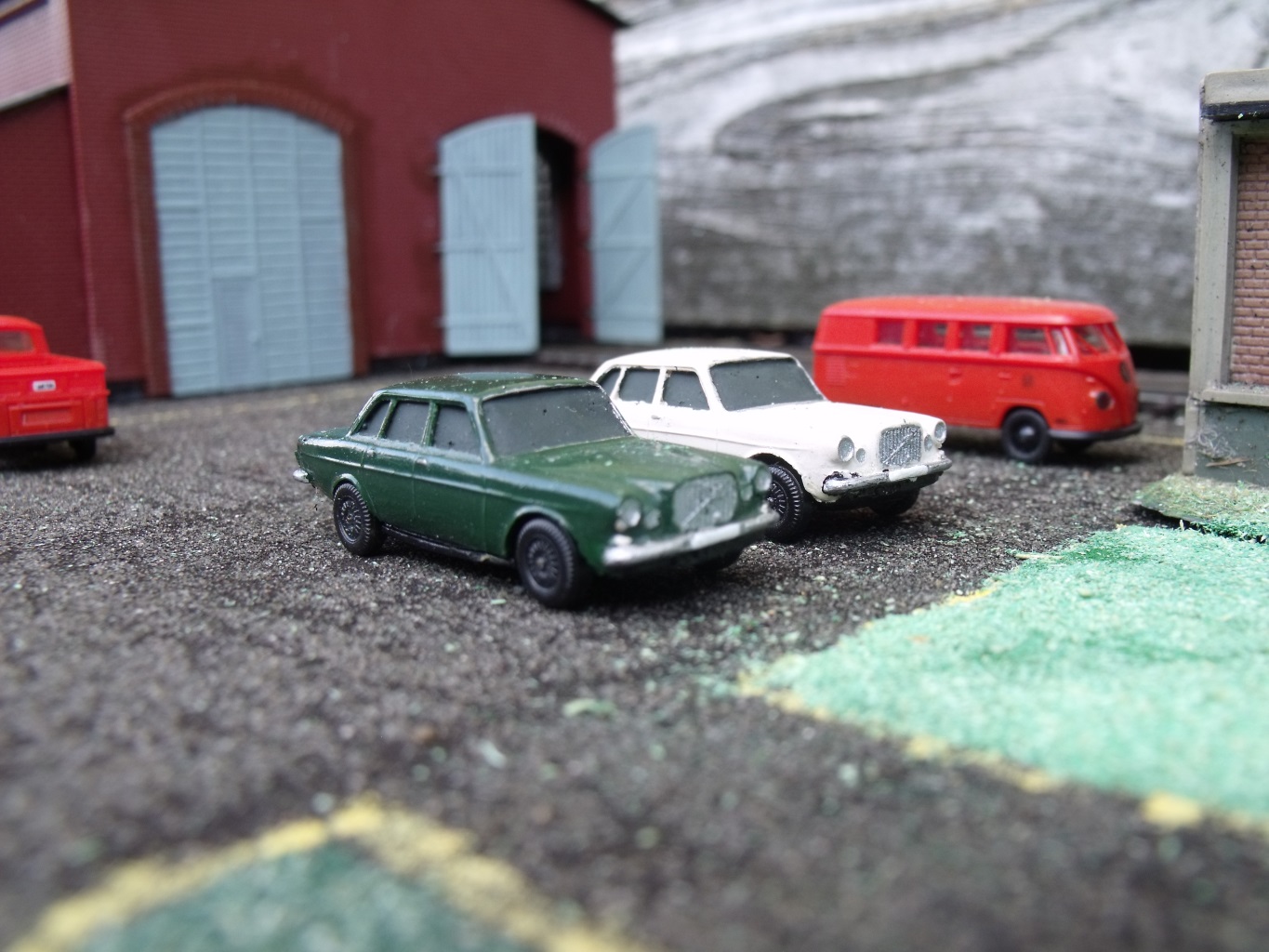

Top Left - A start on repairing the damaged roads!
Top Right - There is now a lawn in front of the Railway's head office near the locoshed. Note also, the new level crossing in the foreground.
Middle Left - An old house with a new home! The tree is actually a grape stalk, pending foliage!
Middle Right - The Volvo 164 as a model by Kniga Modelle. We did consider glazing the windows (would take much more time and effort), as there is a full interior!
Bottom - The snow-plough; the less said the better!
A journey from Ålunden, through Månstorp, Lövhöjden, Siljansnäs, Månstorp again, before reaching Lövhöjden again
The same journey (different day) in reverse!
[Videos: A. Allum.]
15.04.18 - April's Maintenance weekend was delightfully with good weather - on the Saturday! The morning saw a thorough track inspection, and several track bonds replaced or repaired. Then, after some deliberation over the last few months, the decision was taken to remodel the up end of Lövhöjden station. The point between the proposed Norra Stambanan to Gärde and Fjällnäs and the existing Siljansbanan to Siljansnäs, Industriområdet and Jonshamn is too far away from the station. So, the junction area where the line to the locoshed diverges was rebuilt to accommodate three new points, two to replace the locoshed access, and one for the main divergence. The far-out point was not removed, however; this will be done at a later date. In the afternoon, a few trains were run, including a chance (at last) to run-in the new E-loco 1189 (and it doubled with the G-loco 1414 for most of the afternoon). Ma 831 also worked (patiently) with the Lux-Modellbau track cleaner, with middling results (from the track cleaner, that is; the loco performed admirably)! On the Sunday, we did manage to complete the soldering of cables onto the new points, and run a few trains, but by mid afternoon, the weather turned and it rained! But, this was not before we had given consideration to the installation of trap points from the goods lines at Lövhöjden.


Top Left - A track bond needing repair - on a garden railway we cannot rely on the rail-joiners (fishplates) to maintain good electrical contact!
Top Right - The Up end of Lövhöjden station with its new track layout. The track with the work vehicle will be the Siljansbanan, but it presently leads to the existing point where that line was to have diverged from the northern mainline. The track to the left is to the locoshed, and the missing track (right) will be the new northern mainline.
Bottom Left - E 1189 and G 1414 with a train passing the FLMJ's head-office - typical of Swedish heritage steam trains, the second loco is running tender-first!
Bottom Right - Ma 831 and the troublesome track-cleaner!
In other news; during the 'shuffling' of model buildings in the snow (for getting some of the wintry photos), the model of Mariefred station got dropped and broke into almost as many pieces as when it was in its box! Fortunately, only the base was actually broken and easily glued back together; the rest of the parts had simply come away where glued on, even the more intricate parts were undamaged. All back together now, and a lucky 'escape'! We have also fitted two LEDs inside as part of our project to light up the buildings - unfortunately our matt-black paint on the inside was too thin and some of the light shines through the plastic, still! A few other buildings have also been fitted but we have been more thorough with the matt-black!


Left - Sunday's trains; two Hg2 locos at the head of a long goods train, the InterCity train, and in the far distance the local railbus.
Right - The former 'Mariefred' station building lit up after repairs - when it is darker, some of the light dies shine through the plastic!
X10 3148 now rolls freely (well, still a bit of friction) on its new metal wheels, and has been fitted with NEM coupling mechanisms between the coaches. A later job is to devise a coupling for the outer ends so that it can run with X10 3149 - once that has had its power output repaired/replaced, and then doubled (two Tenshodo motor bogies instead of one)! The two duplicate ballast wagons now have proper number transfers on so that they are clearly different from the original two, and to make them even more noticeable, they have SJ logos over their original BV ones! We have two more sets of numbers (and SJ logos of the same type), so we are looking for a third set of Roco ballast wagons (cat. 44127) to give us a 6-wagon ballast train!


Left - X10 3148 rolls freely and is coupled within the unit.
Right - Ballast wagons in a train at Lövhöjden; the two nearest the camera were duplicates of the other two!
E 1189 & G 1414 with a 1930s Heritage train passing the locoshed at Lövhöjden.
Hg2 660 & Hg2 787 bring a long goods train into Lövhöjden.
14.03.18 - In early March, with the usual poor weather outside, two Friends worked inside, mostly on one of the CM Laser B6G coaches (having completed the essential modifications to the other), and a heavy card kit for a small building that will be used outside, suitably lacquered to see how it copes with the weather! The card kit was completed on the Sunday (and even has an LED inside - but difficult to photograph lit up whilst it does not have a proper electrical connection), but the B6G will take a little longer - and need some extra repairs! On the Sunday some of the garden paving slabs were relaid (changed to newer slabs and arranged differently) because they had become quite uneven!


Top Left - Close up of the end of B6G 3405, with handrails, door handles, gangway sides and more! B6G 3828 will soon be like this, also.
Top Right - The card hut, seen near Månstorp, just after completion, but not yet lacquered!
Bottom - The new paving slabs alongside the Kopparberg area in the garden.
In other news, Tc 306 was run-in on Sunday 25th February on the Skandi-Demo test track used by the Scandinavian Railways Society at the Euro-Track model railway exhibition. This loco has been on the register for many years, but has had many problems. Following a lot of recent work, it was worth another test, with much more satisfactory results. The finer details such as handrails will now be fitted to this model soon. Hector-Rail 142 002-5 departed the FLMJ on the same day, this being one of the few remaining Epoch-V locos that was no longer in traffic.
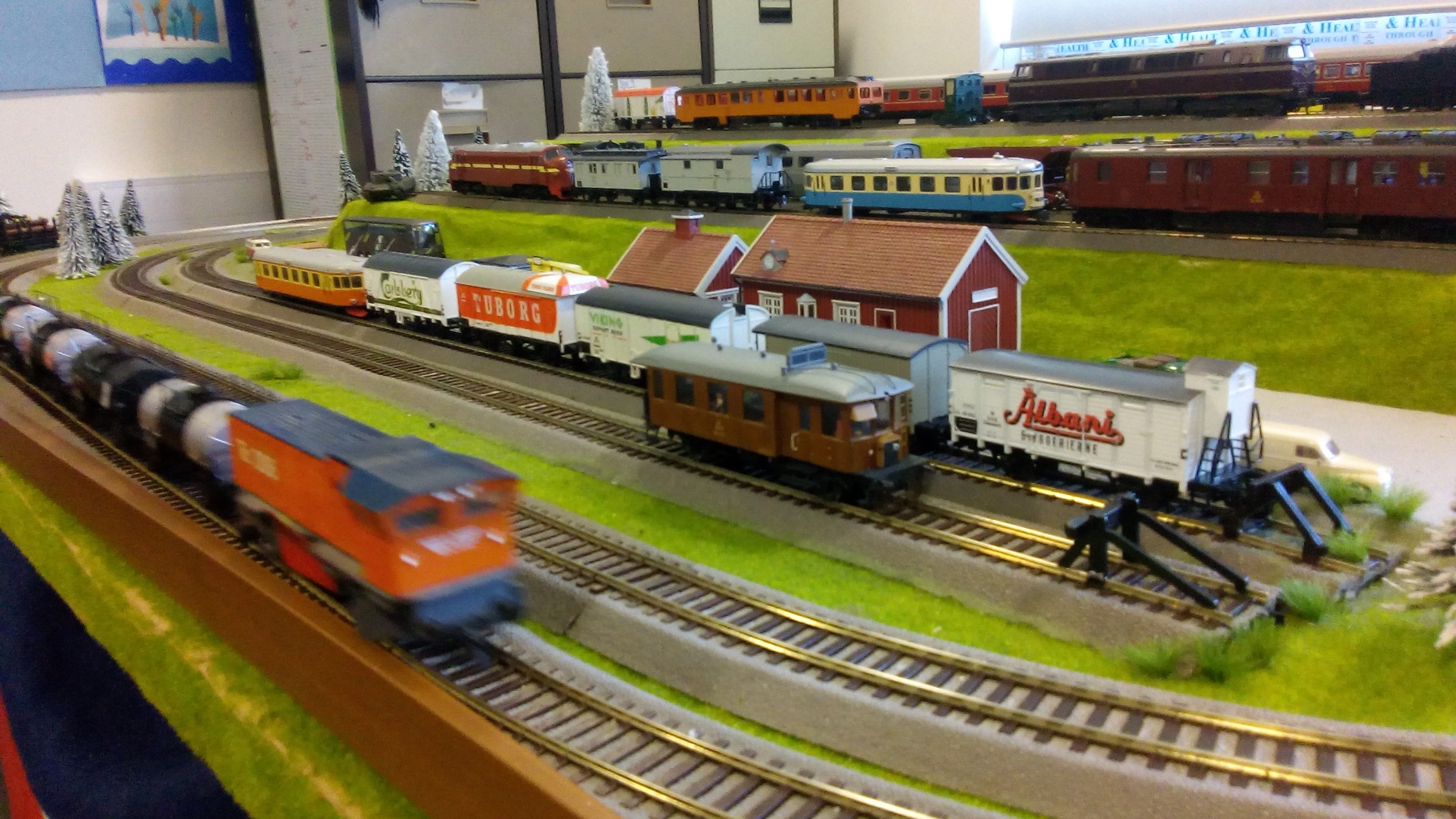

Left - Tc 306 at speed on a demo-layout! (Note the FLMJ's Säröbanan YCo6 on static display in the background, and also the Y1 that we sold not so very long ago!)
Right - Our Hector-Rail loco on a demo-layout only hours before it was sold.
We have also had a lot of snow, and given that a lot of this came down during the day, we were able to get some photos with just the right amount down!


Left - Tc 306 propelling snow plough Qt 6410 through the snow near Kopparberg.
Right - X10 3149 in the snow at Lövhöjden.
16.02.18 - Typically, February's FLMJ Saturday session was mostly rained off! Indoors work saw a member's model being serviced to bring it back into working order (a Brawa model, generally very expensive, but here of very poor running quality), and a start made on a card kit building, as an experiment, when varnished, for outdoor use. Watch this space. Steam loco F1207 had its couplings straightened up also.


Left - The body of the member's model is seen in the foreground; the chassis in the upper background, on its side whilst re-attached components are glued back on!
Right - F 1207 with, to the very left of the picture, a clamp on the coupling head to straighten it.
On the Sunday, attention was turned to the delayed construction of BC1 4353. The missing parts for this model arrived early in 2017, but time needed to be found to get on with the model. A further delay was necessary whilst the model was balanced on end to allow the glue to dry - a buffer had broken off, and this seemed the easiest way to repair it! As soon as the roof was fitted, the model was balanced as shewn in the photo to straighten up some very slight bowing that was apparent in the body (not an unknown problem with UGJ models)!

BC1 4353 in the final stages of construction - at last! Testing and snagging will follow in due course.
In other news, one of the Pola houses has had an LED fitted inside as part of a new project to get buildings lit up! The other Månstorp kits will follow soon (the dairy shop and the station), and then we'll move on to other areas.


Left - A card building kit, under construction; laser cut, it goes together quite well.
Right - The cottage from Månstorp, seen on the kitchen table with the interior lit up!
07.02.18 - The first session for 2018 was two weeks later than usual due to personal commitments. So the rain delayed as well! It was intended that two new 'E' class steam locos would be run-in, but it was too damp. Instead, a home CCTV was installed, which will also have uses with the Railway - at a later date!


Left - E 1189 alongside the signalbox at Lövhöjden.
Right - Night-images with the CCTV.
In other news, the T21 is now at another workshop being looked at. It seems that the motor is flooded with oil (how on earth did that get there?)! So, if it can be dried out (paraffin perhaps) or the motor replaced, then the loco could re-enter service. Christmas and New-Year, for the Director General was spent in Sweden; where there was virtually no snow in Stockholm, but 85cm depth in Tandådalen! It was a 'cultural' visit (to be with friends and in the Swedish atmosphere) rather than a railway visit, but a day was spent at Centralstation at Stockholm, taking photographs. And, a few more from a bit farther out!


Top Left - The last time that the T21 ran was in April, it failed in service on the 18th shortly after this photo was taken.
Top Right - Stockholm (Sollentuna) on Christmas Eve with virtually no snow.
Bottom Left - Making tracks at Tandådalen (Sälen), but not railway tracks!
Bottom Right - A HectorRail loco brings the Blue Train into Centralstation. Note that the leading carriage is ex-Norwegian - there are quite a few of these operating in Sweden, now.
And finally, compare these last two pictures: Göringen station in Dalarna, and the building that we have used at Siljansnäs (representing Dalarna)! The model also has a goods facility which is why it is of a slightly bigger prototype, but in essence they are the same design (as drawn by SJ's chief architect at the time, Folke Zettervall).


Left - Göringen and ...
Right - ... Siljansnäs
11.12.17 - The FLMJ was open to invited guests in December, despite the temperature staying below 5°C. The temperature did cause some track joins to open up alarmingly, and one actually came undone (but was quickly repaired). A newly acquired Du-loco (owned by one of the FLMJ's Friends) was run-in and several other trains were run also. Slight seasonal (and mostly Swedish) refreshments were enjoyed, and we managed to have it all packed away before it got too dark!


Top Left - A new visiting Du-loco on shed at Lövhöjden, pending running-in.
Top Right - A visiting Z65 with insulated vans.
Bottom Left - A visiting Dm+Dm loco with tanker train; Dm+Dm locos which did not acquire the Dm3 centre unit were moved south to work on non-iron-ore goods trains!
Bottom Right - Some visiting HO scale figures took advantage of the cold weather... yes that is a real sheet of ice! [Photo: A. Keeping]
In other news, the bridge section carrying the railway through the hole-in-the-wall at Ålunden was modified recently, with the track realigned and point motors fitted. The track alignment had been poor and too much compensation was necessary in the fiddle yard tracks. Now, tracks 2 & 3 are parallel as they leave the bridge, and tracks 1 & 4 have 12° curves to bring them parallel. Also, the track slightly overhangs the bridge section now, so that we do not need so much loose track on the adjoining pieces. The point motors were fitted to secure the point positions, but we hope to have them working before too long.
The second 'Ibcos' van has been brought into service, but we might need to limit it to shorter trains because we probably shouldn't put too much load on the repaired coupling!


Left - The Ålunden bridge section with realigned tracks; seen here on the work-table.
Right - The second 'Ibcos' van in a train on a test track, flanked by other types of insulated van.
13.11.17 - There is good news and bad news on the locomotive front from the FLMJ's main November session. Both of the Ma-locos have had 'bypass' wires soldered on so that the connection between wheels (pick-ups) and motor no longer depend on the problematic DCC base, and thus better performance can be ensured (initial testing is good, but we'll have to wait until December before they get a full running in)! The Heljan T21 64, however, is beyond viable repair and has been condemned and withdrawn from the register. It is the actual motor that has failed and we can see no way of getting it out, nor obtaining a replacement (power leads directly onto the motor yielded no movement, but the lights did come on). But many 'add-on' parts fell out during the investigation, and this has been an ongoing problem with this loco. Roco did hint at the production of the T21 model a few years ago; we hope that they do; we'd have two (different running numbers) to replace our one Heljan model!


Left - Ma 879 with two new cables soldered on (blue and yellow) to provide a direct link between the pick-ups from the wheels and the motor. Ma 831 has also had the same modification.
Right - T21 64 in a rather sorry state. It has been mostly reassembled, but remains out of service indefinitely!
Hobby-Trade wagons also got looked at, and both 'Hbis' vans are now in service. On each wagon the NEM coupling pocket poked out too much at one end by 3.5mm, so they needed cutting back and then the inner end extended by the same amount. Having made the cut, the couplings were such a tight fit that the inner extensions have not been made or fitted; we'll see how well they run before signing this job off. Both 'Ibcos' vans were also NEM failures, but this time they were slightly too far in at each end. Therefore, the inner ends were trimmed at the sides so that the couplings could be slightly farther out, and a spacer fitted (glued) at the outer end to stop the coupling going in too far. Unfortunately, this fix was identified after we had tried a different method and badly damaged one of the couplings! So, only one of these wagons has entered service, the other requires more work - a fix has been identified, but we need to be very careful and not rush it!


Top Left - One of the 'Hbis' vans; note how the coupling looks loose, but it is very tight.
Top Right - The two 'Hbis' vans coupled together - at this end there was previously an 8mm gap between buffers; now there is only 1mm.
Bottom Left - Close-up view of one of the 'Ibcos' vans; note the white spacer between the coupling and the NEM box, and the cut-out at the inner end.
Bottom Right - The 'Ibcos' van coupled to a 'Hbikks' van used as a measuring tool. Previously these wagons could not be coupled together with Roco NEM-compliant couplings.
In other news:
More switches and indicators were fitted at Siljansnäs for use with the shunting arrangements in both industrial areas. Each area, Industriområdet and Jonshamn has a master switch to select local controller, off, or main through controller (usually from the Lövhöjden panel). There is a section switch for the Siljansnäs station area which will work with relays so that either the local controller or the panel controller is switched in, but unlike our usual block arrangements, one won't be able to take control from the other unless switched off. A fourth switch for much later installation is a signal lock, so that when shunting is taking place in the Siljansnäs area, then the appropriate signals can be prevented from clearing. We have also fitted a socket for a hand-held controller (the local controller) for later installation, and the usual red/green marker lights for the block section. This work was done on a Friday during annual leave, so the Friday timetabled train service was run also!


Left - The new control panel, indicators and controller socket near Siljansnäs.
Right - Ra 988 with an InterCity train alongside Hg2 660 with a Postal train, at Lövhöjden; typical for a weekday service!
15.10.17 - In early October, the two points (motors) at Månstorp were connected to a power supply and switches at Lövhöjden, but the originally intended switches were too unreliable and therefore replaced by standard toggle switches. The panel includes a third switch for the point where the Siljansbanan diverges from the Norra Stambanan, but this won't be needed until mid-2018 at the soonest. The trap point at Månstorp worked faultlessly straight away, but the point between the Siljansbanan and the Södra Stambanan wouldn't work reliably in one of the directions until modifications were made, but it will need monitoring. On the Sunday, after a visit to a local model railway exhibition, work continued on the repeaters for the motorised points, so that the Lövhöjden operator can know which way the points are set. This equipment is only temporary until the full signalling system goes in.


Left - Controls and indicators at Lövhöjden. The indicators relate to both points at Månstorp; they have to both be in their corresponding positions for the appropriate indicator to light up! The third switch (extreme right) is for the solitary point where the Siljansbanan diverges from the northern mainline near the locoshed.
Right - The tie bar was sticking to the roofing felt, so insulating tape made a nice smooth surface for the mechanism to work correctly!
In other news, Hg 787 has returned to service with a new set of drive gears. As sold, Jeco models have nylon gears pressed onto the axles, but in some cases they are known to break. The replacements are metal and much harder wearing. Replacements have also been fitted to the new X2000 because the noises it was making suggested the same problem. Rc1 1024 and Rc3 1063 (rebranded from Rc2 1054 and Rc2 1103 respectively) have had their numbers completed (we didn't do the buffer-beams immediately) and thus these locomotives are back in full service. T44 208 now has a better shade of orange on the cab-sides, and is in full service; but buffer-beam numbers are still pending! On a negative note, T21 64 (a Heljan model) has failed miserably and is presently in pieces on the work-table for evaluation. The lights come on when powered up, but there is no movement at all. The are no dis-assembly instructions with the model and it is not coming apart (so that we can get at the motor) very well. (Roco had hinted a few years ago that they would produce the T21; if they do then we'll gladly replace our Heljan one; it has been problematic ever since we got it!)


Top Left - A broken nylon gear, explaining why Hg 787 wouldn't work properly!
Top Right - Replacement gears on the axles.
Bottom - And out on test with FV1 (F5) 25923 at Lövhöjden.
04.09.17 - The FLMJ was open for invited guests at the beginning of September. Despite being a railway, we chose to acknowledge the 50th anniversary of Swedish road traffic changing sides, which occurred at 5am on Sunday 3rd September, 1967. There are plenty of online sources telling the story of "Dagen-H", so we won't go into great detail here. A late-60s car rally was planned for the open area near Kopparberg on the FLMJ, but the weather had other plans!


Left - TGOJ Hg locos 201 & 202 with a goods train passing Månstorp.
Right - T43 212 with an empty train of timber-carrying wagons, about to pass Kopparberg.
The timetabled passenger service was provided on the Saturday, along with some goods trains. One of these comprised our six new bogie timber wagons (types 'Rps' and 'Sgs') and for a while an 'Eaos' as well. The other, headed by two TGOJ 'Hg' locos comprised a collection of 'Om', 'Os', 'Kbps' stake wagons and a few vans, including all of our TGOJ wagons! A new Z65 diesel loco made a trip to Industriområdet with a van, but only for the purpose of getting a photo. This loco will retain standard H0 (hook & loop) couplings for assisting guests' wagons to and from the Siljansbanan which will not be overhead-electrified, and will probably replace the Märklin V5 for this duty. The V5 (which has been converted to two-rail operation) cannot be retrofitted with NEM couplings, so its future here is questionable. We didn't set up the car rally for the Saturday, but there were plenty of campers nearby, and a line up of 1960s police-cars!
T43 212, passing Månstorp with a train of NMJ 'Rps' and 'Sgs' wagons.
Sunday started off dry, but the forecast was not good. Sure enough, by late morning, train services were stopped; and the weather did not improve until mid-evening. A Du-loco did manage a few trips with the Inter-Regio train, and the F-loco did one return trip with an InterCity set. But although set up, the second InterCity train (with the 'Ra' at the front) and the goods train did not run. The car rally was also rained off!


Top Left - Locos on standby - well actually the 'Ue' electric loco was brought out just for the photo!
Top Right - The new Z65 536 with wagon at Industriområdet.
Bottom Left - Not forgetting passenger trains, Y6 764 provided the local service along the Siljansbanan on the Sunday (Y7 1136 on the Saturday).
Bottom Right - Trains lined up for their next turn: from left, the Ra-loco did not run due to the weather, the Du-loco provided a few turns on the Inter-Regio service, the F-loco did one return trip with an InterCity train, and the Hg2-loco did not run due to the weather!
TGOJ Hg locos bring a goods train through Siljansnäs.
07.08.17 - At the beginning of August, the old Gärde baseboard was dismantled and taken to the local Waste Recycling Centre. The track had been removed along with the minimal cabling that had been in use, this area having not received its full control system. Having got these boards out of the way, the vegetation behind was blitzed, and a second trip to the Waste Recycling Centre was necessary (and if there had been time, there would have been a third just for the 'green' waste)! Whilst clearing up the vegetation, advantage was taken of the many blackberries growing there, but we also found some interesting wildlife including slow-worms and a frog!


Top Left - Ra 988 with a local train at Gärde - in this view the vegetation is not as overpowering as at the beginning of August!
Top Right - Baseboards removed, vegetation removed, but the path alongside the fence is still buried
Bottom Left - It's been a long time since we've been able to see behind this shed.
Bottom Right - More green waste ready to go.
[Photos: A. Allum.]
Some photos were also taken to promote an upcoming event, an open weekend where we will also acknowledge the 50th anniversary of Swedish road traffic changing from driving on the left to driving on the right (September 1967). Compare the official photo to our mock-up!


Left - Swedish traffic changing sides - on the FLMJ. [Photo: A. Allum.]
Right - Swedish traffic changing sides - in Sweden.
29.07.17 - Rc-50
We decided that we would mark the 50th anniversary of the introduction of Sweden's most iconic locomotive, the Rc-series, introduced in 1967. The Open Weekend for this event was planned for July 22nd & 23rd, but the weather had other ideas! We did manage to run a few trains on the Saturday before the downpour, but sadly none of them had an Rc at the front! Most journeys were in fact made by a Norwegian "Flåmsbana" train. A postal delivery of track in the morning enabled us to lose-lay the track at Jonshamn in the almost-dry evening. On the Sunday, the weather was much better (though we did have light rain for about 90 minutes). Four Rc-locos were on the layout, along with various others. During the day, the track at Jonshamn was fitted and an experimental layout of buildings (and containers) was considered. Another experimental idea is a staff 'halt' alongside the locoshed, but we're not sure...!


Left - Flåmsbana train at Siljansnäs.
Right - Paddling pools usually have water on the inside, but this one was used to keep the (rain)water on the outside! (The control panel is underneath!)
[Photos: A. Allum.]

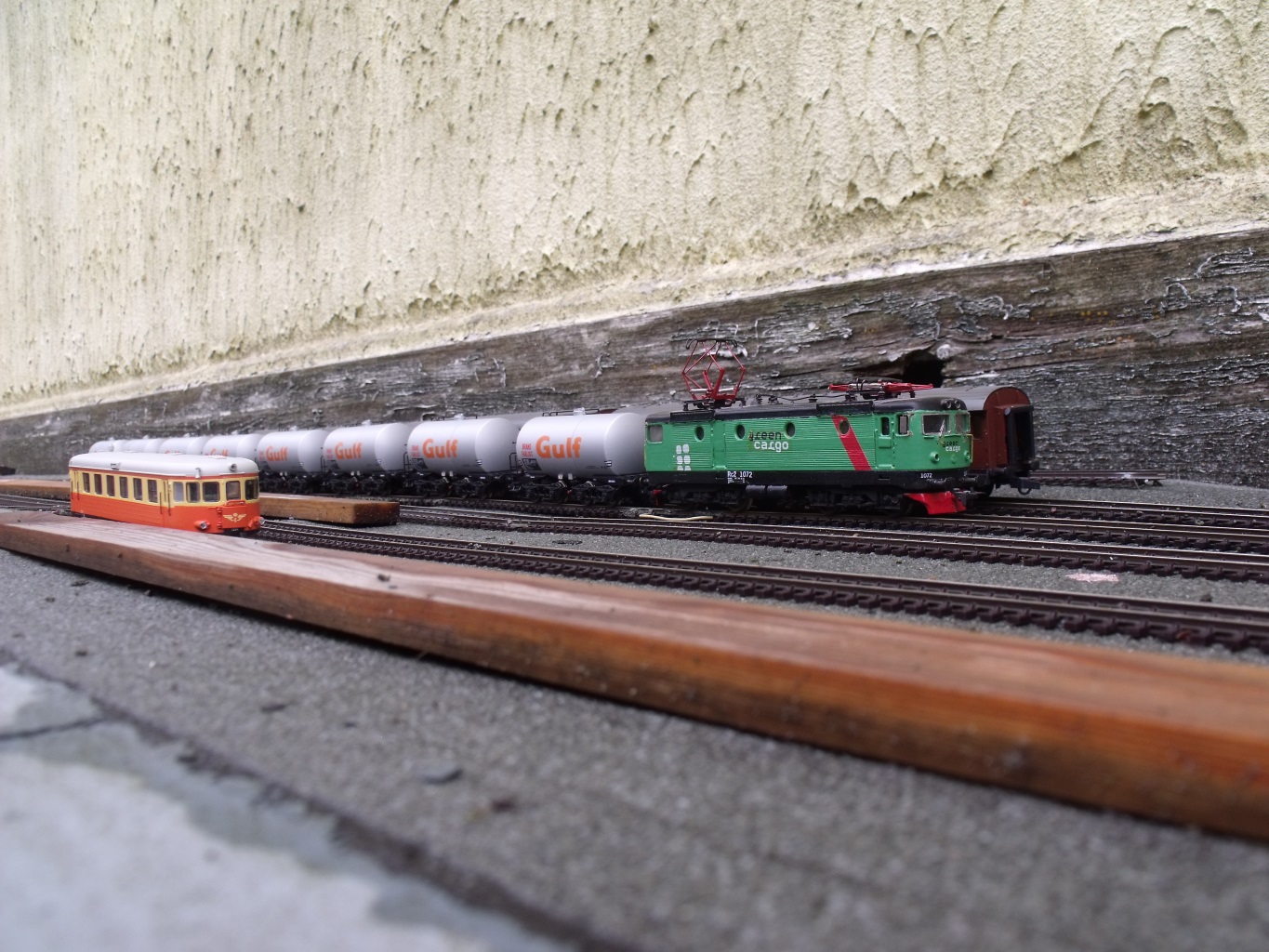
Left - Rc2 1100 with InterRegio train at Lövhöjden.
Right - Visiting Rc2 1072 with a Gulf oil train at Lövhöjden. This is a rebuilt Lima model.
[Photos: A. Allum.]


Top Left - Rc5 1323 and Rc6 1410 side by side; essentially the same loco, but different epochs!
Top Right - Jonshamn with an experimental layout of buildings - and containers.
Bottom - For staff use only, perhaps... a tiny halt alongside the locoshed at Lövhöjden.
[Photos: A. Allum.]
21.07.17 Mid-July, two Friends worked at Siljansnäs; repairing the damage there. Using a large off-cut, replacement boards were made for the areas that had rotted, and fitted in a day. The old boards were cut out whilst in situ, thus the Södra Stambanan was not affected by this work. Copious amounts of evo-stick were also used to seal the joins!
In other news; Hg2 787 failed at the beginning of July and an initial investigation suggests a disengagement of the gears in one of the bogies. All of the Hg/Hg2 locomotives will be investigated as a preventative measure.


Left - Two Roco B7 coaches are used to measure the smoothness of the curve - by watching the sideways movement between the adjoining gangways!
Right - Hg2 660 at the head of a goods train, after sister-loco Hg2 787 had been taken out of service with a faulty bogie.
[Photos: A. Allum.]
30.06.17 With lots of extra work taking place during June, here is an extra update!
PROJEKT CIDERBANAN!
Despite popular belief, the name Kopparberg was introduced to the FLMJ for a reason OTHER than being a brand name of a very popular cider! But that's another story. The fact is that the section of railway through the Kopparberg area was the one remaining part of the 'circuit' that still needed rebuilding on new baseboards (rebuilding at Gärde is another project for another time). On one day in June, the track was lifted, all scenery removed, and entire baseboard structure lifted off the legs. Then the new boards were made up, fitted into place and track relaid before it got dark. And there were only two Friends on site to do the work! Since that day, the scenery has been laid out (model buildings) and a layout has been agreed; very similar to before, and even features the church being moved back to the corner of the baseboard. Note: this section is not known as "Ciderbanan"; it's just a name we used for the project!

Kopparberg seen on the day of construction. Compare this picture with ones that we get later in the year as the scenery is refitted!
INDUSTRIOMRÅDET!
Having a small industrial area near Siljansnäs proved popular, but it had been poorly maintained. It was decided that a better track layout would be provided here and that it should be more interesting, and therefore not neglected. The plan that we have adopted was found in "Modelljärnvägsmagasinet" (with just one subtle modification) and work here was started in 2015. Most recently the missing end board has been made up and fitted into place and the track completed. However, the controls will take a little longer to do, and as with the locoshed (originally), the whole area is presently wired up as one sub-section. This may prove to be enough because it is unlikely that more than one loco will be required to be in this area at any one time.

Industriområdet now has complete baseboards and track, and is ready for scenery.
JONSHAMN!
With the rebuilding of the Railway, it was decided to fit in a second industrial area, or more to the point, a harbour. This work was started mid-June and has required some new construction techniques (to include the water-front - but not any ships)! Off-cuts were used here to make good use of the layout. The area needed space behind the board nearest Siljansnäs station because of the down-pipe from the home's guttering, and a little farther along, the cabling to a disconnection box. Then a full width board; and next to that another narrow board, but lined up at the back to allow room for the path and crossing area. Onto this last board, a lower level 'shelf' has been added to represent the (harbour) water. A small triangular piece is used at the station end to carry the curve to the station. Laying the track took a little longer because we needed to buy the points, but as with Industriområdet it will be one sub-section to start with.

Jonshamn has baseboards and some track, but we need to buy new points before track-work can continue.
Other News:
After a stock-check, we found that we have enough catenary masts to cover Lövhöjden station - but only if some of the tracks were moved slightly closer together. So this work was carried out in June, and it enabled us to correct a couple of other minor problems at the same time. Only one catenary mast will need to be purchased, but probably a few more posts! A very temporary switch panel has been made up for controlling the points at Månstorp. We have found that we can fit one Peco detector switch under the body of the hut that is available to disguise point motors, and this will enable us to have greater flexibility in controlling the railway. The same has been provided to the point where the Siljansbanan splits from the Norra Stambanan, but as the latter has not been relaid yet, it has not been connected up. Some of the newer roofing felt appears to be of extremely poor quality and it is simply disintegrating! Already this is having a bad (rotting) effect on the baseboards in the Siljansnäs area and patchwork repairs are evident until a better solution can be found. We are VERY reluctant to pull it all up again, but are resigned to the fact that we may have to!


Left - Lövhöjden has realigned tracks and is seen here with catenary masts laying across it (to get an idea of how it will all fit in).
Right - Patchwork repair at Siljansnäs...!
07.06.17 We held our non-SJ weekend at the beginning of June; a chance for our friends to run non-Swedish trains in the garden environment! By having this event once a year it saves the Railway being 'invaded' during our regular open events. Countries represented for this event included Britain (in both 00-scale and H0-scale), Japan, Netherlands and USA. A few Swedish trains did also run, but these were brief interludes to test new arrivals - and to demonstrate models for sale.


Left - Southern T9 116 with a typical train.
Right - BR(W) 'Warship'; despite being British, this is an H0-scale train!
[Photos: A. Allum.]
In other news: Very old Eckon levers have been recycled for the control panel at the locoshed at Lövhöjden. To start with these are simply isolating switches; but there will be a local controller for shunting purposes and one of the levers is reserved for the change-over function.


Left - Japanese steam loco borrowing some Swedish Ore wagons.
Right - The locoshed with the newly installed isolating levers at the front of the baseboard.
[Photos: A. Allum.]
Both Jeco Ma-locos have been playing up, running very slowly and making worrying noises! The exact cause has not been identified, but by taking the bogies apart and putting them back together, we seem to have resolved the issue, even if only temporarily. Ma 879 (our first one) has replacement wheel-sets (supplied by Jeco due to problems with the originals), which are very nicely detailed, and two of these wheel-sets have one wheel with traction tyre - both of which were recently replaced. Ma 831 has plain wheels and without traction tyres, but there was a knocking from one of the bogies, and the only cure has been to retrofit the 'spare' wheel-set which has one traction tyre - and finely detailed wheels! We hope to be able to keep them both in service, but we will be limiting their duties.


Left - Dutch invasion at a Swedish station!
Right - And from the USA, this electric loco.
[Photos: A. Allum.]
Our newest arrival is Jeco's model of the X2000 in original condition. This marks the transition from Epoch-IV to Epoch-V and the X2000 was also the last train to be developed in Sweden (before ASEA was merged with Brown Boveri to become ABB); so it has some historical reference. We are having running-in problems with this unit (not unlike the problems described with Ma 831 above) but in the absence of replacement wheel-sets, we're persevering in our own workshop. The Heljan equivalent of this train was sold very soon after this arrived!

The new X2000 unit at Lövhöjden. [Photo: A. Allum.]
The new X2000 passing the Railway's Head Office at speed.
17.05.17 The FLMJ was open for the first time in over two years to invited guests, and despite the weather, it was an enjoyable event. We had a theme to celebrate ten years of affordable good quality models from Jeco, and at the end of the Saturday, all of their locos and wagons that we have at the FLMJ were brought out for a photo-call. There were other trains in operation also, and some mixed epochs, not forgetting some interesting train formations! The Saturday was also the Director General's birthday, so a Swedish style birthday cake, home-made by a friend was a treat that partially survived into the Sunday! Sunday was a much quieter day with a more time-tabled operation of trains, but a few visiting models did make their way around.


Left - Jeco trains everywhere (and a few buses)!
Right - The Swedish birthday cake.
[Photos: A. Allum.]


Left - A visiting Dm-loco with a tanker train - many Dm that were not modified with the centre Dm3 were moved 'south' for other non-iron-ore duties.
Right - A Banverket Z65 with a coal train!
[Photos: A. Allum.]


Left - A 'Nynäs' tank wagon on static display behind the 'Nynäs' petrol station - this was because this was the first chance we had to run it, only to discover that it has 'ac' (conducting) wheel-sets!
Right - Guests enjoying the Railway. At last, we are able to share this creative enjoyable hobby in the way that we like.
[Photos: A. Allum.]


Left - Rälsbusståget - a nice railbus train on the embankment between Månstorp and Ålunden. Already this is a popular photography location!
Right - The two Ma-locos approaching Ålunden; sadly these both need some attention so that they can move faster than a scale 40kmh max!
[Photos: A. Allum.]
In preparation for the event we urgently needed a multi-way plug and socket, and a matching set was found at our local 'electronics' store, with pins that can be crimped or soldered. Unfortunately neither method had any reliable effect, and on both Saturday morning and Sunday morning we had to create bypasses around these connections. The plug and socket was intended to be temporary, but not to be replaced as quickly as has become necessary! Also, one of the track sections was 'dead' and this was traced to a faulty (recycled) switch. Fortunately, we use three-pole switches for the track sections when two should be enough, and we were able to use the spare! We had a list of models for sale, and by the end of the event, our old Heljan X2-2 had been provisionally found a new home.


Left - Modern-ish image also returned to the FLMJ; curiously this five coach train was reduced to four because of one being fitted with 'ac' wheel-sets!
Right - T43 212 with a container train passing Kopparberg.
[Photos: A. Allum.]


Left - Du 373 with a cement train arriving at Lövhöjden.
Right - Faringe station building is the new model for Gärde, which although out of use presently, we set up the buildings to give it some 'life'!
[Photos: A. Allum.]


Top Left - Z65 519 with a tanker train at the locoshed at Lövhöjden. [Photo: P. Rees.]
Top Right - For this special weekend, there were a few campers! [Photo: P. Rees.]
Bottom - Y6 764 between Månstorp and Ålunden. [Photo: P. Rees.]
02.05.17 A lot has happened since the April work-session! The Easter weekend saw a lot of electrical work being done, with the main looms connected in two of the Disconnection boxes before lunchtime on the Friday! The third (and largest) loom was completed during the afternoon, and this included a booster pair for the track alongside Kopparberg, which is fed 'strictly' from Disconnection box 1; but this means that the cabling is going 3/4 of the way around the home, so the booster pair takes the more direct route through Disconnection box 2. By late afternoon all tracks were live from the control panel, and we are now able to have two (or more) trains on the layout at any one time.
Easter Saturday was to have been a day for connecting up tracks at Ålunden, but much more preparation work was needed here, especially as much of the old electrical installation remains intact and it would be better to reuse that instead of starting over! An 'installation document' (a very useful thing we have at the FLMJ) was prepared as the surveying progressed, and apart from the need to buy some materials, the work was ready to start at the end of the day. Sunday, however, was a day off for other reasons, and Monday's weather was more 'usual'!
During the days after Easter (with the Director General on Leave from work), this work continued. Modifications were made to the bridging board at Ålunden, and it is now much easier to fit and remove. (Unfortunately, two of the four points needed to be changed because we had inadvertently fitted recycled 'electrofrog' instead of insulating ones!) Plug and socket assemblies were made up for the bridging board, and to go between the boards either side. Also, further changes were made to the fitting of the cameras at Månstorp due to the light colour of the home's exterior wall causing glare, and the automatic adjustment was virtually wiping out the image!


Left - The ribbon cable comes from the control panel, then the other cables (mostly) go to the tracks.
Right - Dm 836+837 takes an iron ore train up the gradient from Månstorp to Ålunden.
[Photos: A. Allum.]
As April drew to a close a new power supply was provided for Lövhöjden from a feed at Arjeplog (the non-Ålunden shed) and the controller feed within the Lövhöjden control panel was diverted to the local contacts instead of Fjällnäs, which had been a temporary measure. Female crimps have been used on the solder tags, so when the local controller is connected, this new temporary arrangement can be easily removed!
We are confident that we can have our first Open Weekend since 2014 and invitations have been sent to some of our previous guests. Any previous guest who has not received a notification is welcome to contact us - some emails couldn't be delivered; some email addresses seem to have got lost!


Left - We're using sliding rail joiners for the bridging board, and plug and socket assemblies to ensure good electrical contact.
Right - Z65 519 with a tanker train on the high level section near Ålunden.
[Photos: A. Allum.]
10.04.17 The two big jobs at the moment are the track-laying between Månstorp and Ålunden, and connecting-up all track sections to their isolation switches. Whilst some of this work was done during the April work session, as much spare time as possible was used to keep up the momentum. Thus, it was during the latter part of March that baseboard covering (the new high-level section) and track laying took place, and of course the soldering! The Director General took a week off work, mostly for other reasons, but making the most of the good weather (after-all, this was not a weekend), track was laid along the Södra Stambanan between Månstorp and Ålunden, joins bonded, and connected to the temporary controller. During the April work session, most of Saturday was spent soldering connections within the control panel at Lövhöjden. Adjustments were also made to the baseboards there, but we are still concerned that it is not very level, and trains are not staying coupled! More baseboard modifications were made on Sunday with better results. Platform 1 has been cut to length at Lövhöjden, and this includes a chamfer cut out alongside the crossover point to accommodate the overhang from long coaches - in true prototypical fashion! The underside of this wooden platform was painted, with the rest to be done once it has been fitted in place on site. To break up the monotony, a Y7 railbus provided a 2-hourly shuttle service, but on the Sunday a steam special arrived - nice to see a decent length train on the railway again. By the end of the weekend, we are ready to connect the main cable looms in their respective disconnection boxes, and then we can have more than one train on the layout at any one time. Also, the track connections at Ålunden are next to be done...!


Left - An Engineers' train on the new high-level Södra Stambanan between Ålunden and Månstorp.
Right - Inside the control panel! Ribbon cable looms go to the disconnection boxes, and are soldered down the middle of the tag-strips.
[Photos: A. Allum.]
In other news, the cameras and monitors were reinstated mid-March and are more secure than previously. The cameras are mounted on wooden plinths which are simply lifted out of a brace when not needed. The monitors are fitted over locating screws when in service (instead of free-standing as before), and are positioned nearer the controllers. A new (second-hand) X10 unit arrived in March. Our intention is to fit couplings to it but to leave it without a motor; we will then double the motors in our other set so that it can run more efficiently, with or without the new unit coupled up. An initial investigation suggests that actually quite a lot of work is needed! Ma 879 started to malfunction quite badly, and needed to be taken out of service. It was found that the traction tyres were glued to the wheels and that they were peeling away! During a maintenance evening mid-week, they were removed completely and spare Roco ones (as we had some in stock) were fitted in their place. B15F 3792 managed to lose one of the bogie pivot pins, but we were lucky in finding a spare. The shaft for it is broken, but we have been able to fit the replacement. We may need to fabricate a new shaft if we have further problems with it.


Top Left - The monitors at Lövhöjden are mounted on screws behind the control panel.
Top Right - The new platform at Lövhöjden, shewing the section cut out to make room for overhanging stock using the crossover.
Bottom Left - X10 3149 and newly delivered X10 3148 at Månstorp station.
Bottom Right - A steam special train at the end of the weekend, climbing the Södra Stambanan on route to Ålunden.
[Photos: A. Allum.]
15.03.17 Although there was a very low turnout of Friends to the March session at the Railway, a couple of friends of the Director General were on site to help with the work. Saturday's main job was the raising of the inclined section (baseboards) between Ålunden and Månstorp. As the work progressed, we were wondering if it was going to hold; but by the end of the day we had a sturdy and smart-looking infrastructure. The work was punctuated by the running of a basic local train service, which worked on a two hourly interval! For Sunday, we had our usual English weather (rain). There had been a plan to lay the track indoors at Ålunden if the weather turned against us, but in reality we needed to be able to open the access hatch and work from the points (turnouts) on the bridging piece, not the other way round. So, as a one-hour job, the four points were laid onto the bridging piece and fitted. The supply of serviceable point motors had dried up, so new ones will be bought to be fitted later! It dried up a little in the afternoon, but the Railway was too wet to be worked upon. But we were able to take some stock photos, mostly carriages; and in April we will be updating some of our photos in this website's 'Available Models' section!


Left - The Södra Stambanan will be carried on this high-level section, connecting Månstorp with Ålunden.
Right - The Bridging Piece with track laid, ready for point motors and cabling.
[Photos: A. Allum.]
In other news, some new carriages (all second-hand) arrived at the end of February. One is a Roco type B7 in the InterCity livery of brown with the words "InterCity" flanked by four chevrons either side. This will go into the InterCity 1980s set, releasing the 1960s B5F which will go to the 1960s InterCity set, releasing the B12 to become a reserve. Two of these B7s were bought in dubious condition to make one good one and to get rid of the other! A set of 1930s coaches also arrived; BCo11b + Co8b-L + Co8d-L, all by Heljan and in original condition. There is a long-term desire to modify the epoch of these coaches with later-style gangways and new definitions; AB4 + B8 + B8.
A slight modification has been made to the proposed signalling for the railway in that the Up starter signal (Utfartssignal) from Lövhöjden will now be in advance of the point between the main line to Gärde and Fjällnäs and the branch line to Siljansnäs and Månstorp, and will be alongside the former; so a new starter signal has been purchased for the branch line.

The BCo11b (later known as AB4) 3256 is seen at Lövhöjden station.
[Photos: A. Allum.]
18.02.17 As usual, the weather was not very friendly at the beginning of February, so the proposed work to solder the connections within the control panel and disconnection boxes did not get done. Nor were we able to fit the baseboard for the inclined route between Månstorp and Ålunden. Snow had been promised, so a number of buildings were put out overnight at Lövhöjden, but what little snow actually settled was at Gärde, so even there the weather wasn't very friendly!
Instead, Ra 988 (the new one) was rewired so that it will go in the correct direction (remember, in 12v dc analogue, the positive rail is the one on the right), and various other items of rolling stock were serviced also. This included our UGJ/Roco Dm-loco (which had taken ±20 years to build), and subtle improvements were made to its appearance. Gärde station is due for replacement later this year, but already it is out of use with the discovery of broken rail joints. There seems little point repairing it now because being isolated from the rest of the railway, we are not likely to want to use it until it has been rebuilt and reconnected.


Left - Ra 988 on test near Gärde following internal rewiring so that it goes the correct way!
Right - Track damage at Gärde, unlikely to be repaired before the whole station area is rebuilt.
[Photos: A. Allum.]
16.01.17 A small team gathered at the Railway in early January, which despite the inspiring weather forecast, was not as dry as we had hoped! Nevertheless, even though no soldering got done, the cabling between the Lövhöjden control panel and remaining Disconnection Boxes was run out and is ready to be connected. The Ålunden shed was given a tidy-up (somewhat compromised because we couldn't shunt things outside due to the rain), but we can at least see the floor now! Whilst this was going on, some tidying-up in the garden took place also; and even some gardening!
After some consideration, we have decided that the vulnerable nature of the location at Månstorp makes it unsuitable for a town-scene. Anything left here, so close to the front gate to the site, is at risk, and the low-relief buildings here are also easily damaged. Therefore, with the exception of a few "essential" buildings to justify the station's existence, the area is to be 'greened' over!


Top Left - Inside Ålunden; the second shelf down has a large pile of loose track, mostly recovered from remote storage and in good condition!
Top Right - A less cluttered garden makes the railway more enjoyable.
Bottom - One of the groups of buildings (from Månstorp) that will probably go to a new home.
[Photos: A. Allum.]
05.12.16 Unusually, the weather was not against us at the beginning of December (but the local trains did threaten to prevent some of the team arriving)! The new control panel was fitted into place, onto a board that will also have room for an auxiliary panel at a later date. This is, as before, hinged so that it can be put away out of the weather's way! Some tidying up took place at Ålunden as well as stock-taking all of the reels of cable that we have; and then we took some photos of the new shunting locos (FLMJ's and a member's) with some being run-in also.


Left - An evening picture with two Z65 and two Z70 on shed at Lövhöjden.
Right - The new control panel, finally in place at Lövhöjden!
[Photos: A. Allum.]
In other news: The trip to Hobbymässan at the beginning of November clearly wasn't enough and a return to Sweden was made for Hjulmarknaden at Solnahallen at the end of November! The only significant purchase was Jeco's Z70 721 in SJ Orange / Blue livery. But a 'Släpvagn' for an earlier period railbus (to go with the Y/Yd) was purchased; and two model cars were also acquired, the Saab 92 and Volvo PV444, both made by VV-model for SMJ and sold exclusively by them. 1940s coaches by Lokstallet (based on the old UGJ models) were looked at but were much more pricey than we had anticipated (their website's 2013 prices are about half the present) so none were purchased. For limited edition models, the price is not actually too bad, but for this event sufficient funds were not held. Their WL5 sleeper car is about £250 (2700:- Kr), but again, it is a home-produced model.


Left - The Släpvagn on a track in Sweden!
Right - The Saab 92 and Volvo PV444.
[Photos: A. Allum.]
Aside from the events in Sweden, another UGJ coach returned to service recently, this time B15F 3792; modifications had been necessary to the bogies to stop it leaning to one side. As with some other UGJ coaches, cracks are appearing in the main body material, especially around the windows, and the longevity of these models is questionable; but there are no suitable alternatives! The UGJ B8FR 3974 and BC1 4353 are currently on the workbench; the former also for a major overhaul, the latter still under construction, but close to completion now! Replacement transfers for the B8FR (and AB7) have been ordered from Lokstallet (because they were not available at Hjulmarknaden), and they have sportingly agreed to sort out some spare parts to replace those that are missing from the BC1.

B8FR 3974 nearer the camera and BC1 4353 on the workbench.
[Photos: A. Allum.]
14.11.16 Typically, the FLMJ's maintenance session in November was rained off. Nevertheless, a number of jobs were done indoors; including returning A5F 3958 to service, now NEM Compliant; fitting NEM couplings to the two new locos (the Z65 diesel shunter and the G steam loco - see below) and coaches (the B6/B6G - see below, again); and some general servicing to other models.
In other news, we have two new arrivals (loco-wise) in the shape of the Jeco Z65 shunter and a Trix G steam loco. We have had G/Ga locos here before, but the Trix model is more modern and more authentic. The future of our Triang Z65 locos is uncertain. Two kit-built models of the Y/Yd railbus have also arrived, in somewhat poor condition, second hand. One is in original livery, the other in HNJ livery, both hand-painted. They will both need rebuilding (including a new chassis for one) but various ideas are afloat regarding final liveries! From Hobbymässan in Älvsjö (Stockholm) recently, three B6/B6G coaches made by På Sporet have arrived (which will probably mean that our CM-Laser B6G coaches will be sold) as well as an original Lima F5 baggage car for conversion to NEM Compliance and other modifications. Another SJ bus has arrived, this time a Scania Bf76 with markings for school duties.


Top Left - G 1414 with a train of B6/B6G coaches at Lövhöjden during a dry spell on the Sunday.
Top Right - Z65 519 with A5F 3958 at Lövhöjden.
Bottom Left - CM-Laser B6G (left) and På Sporet B6 (right) at Lövhöjden.
Bottom Right - The school bus!
[Photos: A. Allum.]
2.10.16 The weather was against us at the beginning of October (but we'd have had the members present otherwise) so very little got done on the Railway, again. Instead we worked on locomotives. Rc2 1103 is now Rc3 1063, and we have a photo of the prototype (published in Nordens Järnvägar) in the orange livery with new cab windows but original roof profile and 'meat-stamp' logo. We will change the logo at a later date. Rc2 1054 (the Roco model) is now Rc1 1024, but all other details will remain. Green Cargo blue T44 269, is now SJ Orange T44 280. The work to repaint the chassis is ongoing, but this loco has a new body (which we had to change from GC 334 to SJ 280) - we now have the blue body (GC 269) for sale! Whilst we await the Jeco Z65, our Triang version has been given a number, 544 and already looks much nicer. At the same time, the freelance 'Z48' was given a logo and a number (711).


Top Left - The T44 chassis mid-way through repainting from suiting a blue body to an orange body.
Top Right - With T44 349 in the background (to compare with) the exchange bodies are seen in front.
Bottom Left - Rc1 1024; note that the Roco numbers and the replacement numbers are not exactly the same size!
Bottom Right - Rc3 1063.
[Photos: A. Allum.]
In other news, two of Jeco's Rc-locos have departed the Railway. They are Rc2 1097 in Green Cargo green livery and Rc3 1135 in Green Cargo blue livery. They were both deemed too modern for the FLMJ and have gone to a new home where an interest in the SJ blue epoch is augmented with an interest in Green Cargo (and to where our former Re-loco was sold).


Top Left - Z48 711 is a hushed-up freelance loco used for testing track as it is being laid!
Top Right - Z65 544 is not motorised and although it rolls - not very freely - it is used as a brake for loose rolling stock.
Bottom - Flashback to 2012 and a photo taken not long after delivery of the two locos now moved to a new home; Rc2 1097 and Rc3 1135.
[Photos: A. Allum.]
15.9.16 The new control panel is under construction. It has track switches for section AA (main line between Ålunden and Månstorp), sections MA-MC (sections within the Månstorp area and through Kopparberg), and sections LA-LP (all sections in the Lövhöjden area including the locoshed, Siljansbanan and line to Gärde). All of these switches are two-way centre-off, which when switched down will connect with the local (Lövhöjden) controller, and when switched up will connect with a remote controller via another switch to connect with the controller at Ålunden or at Fjällnäs. This selector switch is the same style, but moves left to right (with centre-off). Another identical switch enables the local controller to connect with tracks at these remote locations (Ålunden or Fjällnäs) if their switches are suitably engaged. The block section between Månstorp and Ålunden and the block section between Lövhöjden and Fjällnäs will both be connected via the usual block relays so that either end can take or relinquish control, and for this purpose these sections also have override buttons and panel indicators.
A separate panel will be built later to house the ammeter and voltmeters, as well as the high frequency track cleaner, and socket for the controller. The ammeter will relate to the local controller only. The three voltmeters will relate to Ålunden, local (Lövhöjden) and Fjällnäs and will be used for speed matching when switching control from one controller to another whilst a non-stop train is in motion. A changeover switch will disable the meters to engage the high frequency track cleaner, and its use is optional. Until this latter panel has been built, a standard table-top controller is in use.
A new timetable (the first for the rebuilt railway) has been written to take us up to the end of the year, but it only features the local (Y6/Y7) railbus on the Siljansbanan shuttle. During the club session on the Saturday at the beginning of September, this was used to break up the day's work (with Y6 764), which as well as the control panel construction described above, included trialling 10.5mm timber for platforms.
On the Sunday, six point motors were fitted (mechanically) to the track at Lövhöjden, enabling the two scotches to be moved to the two points at Månstorp. Five more need connecting, but these will be of the 'signal-hut' type because they cannot be hidden behind a back-scene. All of the catenary masts that we could find were brought out and sorted; and we will reuse as many as possible, but for some we might make a slight adjustment to the track. Where this is not appropriate we will either buy new or modify. Sunday's train service was provided by Y7 1201.


Top Left - Y6 764 at Lövhöjden alongside a makeshift platform under evaluation.
Top Right - Y7 1201 at Lövhöjden; this time with the station building flanked by the trial platforms.
Bottom Left - The control panel - so far! Our local Maplin was out of stock of PTB buttons, but we bought them later when passing another branch, to complete the front of this panel (see the pilot holes near the lamp indicators).
Bottom Right - Jeco catenary masts are seen laid out over the baseboard, and they have quite an assortment of pitches. The rusty ones are from the earlier layout here, but newer green ones and unpainted ones have been donated.
[Photos: A. Allum.]
In other news, Hg 202 in TGOJ green livery arrived at the FLMJ recently and this will work with the TGOJ passenger train which remains at the Railway, albeit privately owned. Another arrival is a replacement body for our blue T44 loco. We had seen some advertising for a rerun of this model, but Jeco is certainly not advertising it now. There are no more orange versions left, and the blue is now too modern for the FLMJ. Jeco has been advertising a few replacement bodies, and the only orange one is with Green Cargo markings as number 334; but we have purchased it along with new transfers for the SJ orange version as number 208. (We will soon have a blue GC body for sale...!)


Left - Hg 202 at Lövhöjden.
Right - The new body for our otherwise redundant T44 loco.
[Photos: A. Allum.]
15.8.16
Just as we were about to order a panel case for the control switches, a new problem was identified, and the order was put on hold. So, August's work party didn't involve wiring up the new switch panel. Instead, serviceable switches were removed from the old panel, and time was taken to draw a more detailed plan of the switch layout. Some scenic work was also necessary due to the road paint cracking up and needing repairs, but the locoshed area buildings were fitted into place also (at least the locating studs were fixed in place for the buildings to fit over, as usual). Sa 938 provided a few rides around the railway with a short train, also. With this train we were able to identify a few other problems; most notably a dip in the boards which we were able to correct, and drop in line voltage which again we were able to correct.


Top Left - Sa 938 with train at Lövhöjden - fuller-length platforms are for adding later!
Top Right - Sa 938 at speed; just in front of the loco, on the track are the blue and yellow power wires that were soldered on to bypass a voltage-drop issue!
Centre - The new layout for the buildings at the Locoshed.
Bottom Left - Notice how the bridge section has a down-grade - which it shouldn't have...
Bottom Right - ...and notice how it has been corrected.
[Photos: A. Allum.]
Ma 831 brings a sleeper train through Månstorp on route to Siljansnäs, the first train to run (other than the engineers' railbus) on the new infrastructure (July 24th).
Shortly after the FLMJ's first train on the new infrastructure, a goods train was tested - a nice long goods train on almost-level baseboards!
Lots of minor snagging is needed for the new infrastructure, and we're making reasonable progress. Sa 938 got a few turns around the circuit and turned out to be the best loco for finding areas with voltage drop; well area in singular, and fixed!
[Videos: A. Allum.]
On the following day, there was a little time available to do some track-work at Månstorp and to run a train. The train was T44 349 (a Jeco model) with 32 goods wagons! The couplings were not terribly happy about this, but we did manage a few trips round before knocking it down to 21 wagons (the FLMJ's usual maximum for this type of wagon is 14)!

T44 349 with the 32 wagons approaching Månstorp.
[Photo: A. Allum.]
T44 349 passing Kopparberg with 32 wagons in tow. [Video: A. Allum.]
5.8.16 - GRATTISTÅGET
A neighbour to the FLMJ celebrated her eighth birthday in July, and had said that she wanted to see the trains running on the FLMJ again. So, the weekend immediately following her birthday was a target date for us, so that she could enjoy the Railway. But we didn't quite make it.
It was late in the evening on the following Sunday that the first train moved under power; Y7 1136 was the test train and was unable to complete a full circuit until some missing links (cables for track bonds) were put in. Later Ma 831 came out with a passenger train, then Hg2 660 with a goods train. Where new baseboards meet old (the section through Kopparberg is still old materials) there are some incompatibilities and issues with short goods wagons becoming uncoupled, but this is being put right, now.
A week later, the Railway's eight year old neighbour got to see and drive Rc2 1054 with a short passenger train around the railway.
Using multi-core cable has made the job easier, it seems, and using disconnection boxes at strategic places around the Railway was also a good idea. We could make most of the connections to the track before the switch panel was in situ, and then it was just a case of connecting both ends of a ribbon-cable to terminal blocks. The new switch panel has been delayed due to difficulty finding a suitable product to use, but this has almost been resolved and we hope to get an order in, soon. For now, we have hot-wired all the sections together, meaning that only one train can be on the layout at any one time!

Ma 831 brings a sleeper train through Månstorp on July 24th.
[Photo: A. Allum.]
5.7.16 Despite the summer weather (rain) we were able to work on the access hatch to Ålunden at the beginning of July, and this time, instead of an off-cut of wood, we used a marine access hatch, larger than necessary, but enabling us to have a removable board with room to manoeuvre. We also made up a locking mechanism which works from the inside - simple but effective. The board that pokes through the hole was made from a damaged Ikea Ivar corner shelf so that it clips to the shelving inside; and we're using door-bolts on the outside. We will need to be very careful with laying the track to ensure that it aligns properly!


Left - The access hatch in the closed position.
Right - The access hatch open (we'll fit a magnetic catch later) with the new removable board poking through.
[Photos: A. Allum.]
In other news, the new petrol station has been added to the Gärde scenery, as well as the Faringe station building which replaces the Diö building. No precise placement will be determined until the boards have been replaced. Also, AB7 4359 has finally entered service. The number transfers for this model were lost ages ago, but a temporary home-made transfer has been made, and now our workshop has space for another model...


Top Left - The Konsum store is seen with the Nynäs petrol station alongside.
Top Right - The new station building being evaluated at Gärde.
Bottom - AB7 4359 in a train at Lövhöjden.
[Photos: A. Allum.]
16.6.16 The official session at the FLMJ in June was cancelled due to the Director General's poor health; but in between the showers on the following weekend, some work progressed along the Siljansbanan. All of the track joins have been bonded to improve electrical continuity, and this included a special arrangement over the bridge near Månstorp because of the need to keep the rails clear of cables - ready for when the road gets put onto it! T44 349 was used to test it all, and the result is pleasing. As the day ended, the motors for the two points on the running line at Siljansnäs were fitted.
In other news, more road painting has taken place, amid a last minute change in the layout at the station (Lövhöjden). The new layout gives great scope for subtle scenery so that we can make the scene look more Swedish. Various visited stations in Sweden provided the inspiration for this eventual layout.


Top Left - T44 349 pauses at the small temporary halt along the Siljansbanan; this loco had been running under its own power, albeit connected to a temporary controller; but at least we proved the effectiveness of the track bonding!
Top Right - The join nearer the camera has the standard type of bond; the one along the bridge has longer cables that run through the square section tube between the two ends.
Bottom Left - TThe two point motors at Siljansnäs. Despite the rusty appearance of the farther unit, it works OK!
Bottom Right - Bus-stops, taxi-rank and car-park all painted down at Lövhöjden.
[Photos: A. Allum.]
21.5.16 At an extra work session (theoretically cancelled due to proposed rain which didn't turn up until quite late) the last panel of track was laid between Månstorp and Kopparberg, allowing a complete circuit to be available again. Where the new boards join the old (at both ends of Kopparberg) there is some issue with gradients, but we have managed to make the transitions as slight as possible so that the stock does not uncouple when passing over.
Also on this day, roads were marked out along the front of the station at Lövhöjden, which included the bus-stops, taxi rank and car park, though we're not confident about the layout of the car park, and might change it! The 'Seglora' church was also added to the baseboard in place of the maisonettes, which will probably go to where the church came from.
In other news, the Månstorp end of Siljansnäs station was relaid recently to ease the curvature through the 90° turn, which had been quite tight. By bringing in the curve without losing space for the spur to Jonshamn, the curve looks much better and the stock rolls over it more smoothly. The short-radius 'Y' point was replaced with a standard medium-radius left point, and this contributed greatly to the improvement.


Top Left - Da 940 with a test train on the last piece of reinstated circuit! The track is not connected yet, but a 9v battery pressed onto the rails is adequate for testing!
Top Right - Road boundaries have been scored but the car-park (camera-side of the kiosk) is not certain - neither is the kiosk! Note also the new position for the Church.The old Lövhöjden is seen being dismantled.
Bottom Left - The relaid curves (and points) at Siljansnäs, with the old alignment still visible on the baseboards.
Bottom Right - An evening photo of Lövhöjden shewing the newly laid track. The black 'dot' on the main line is the Volvo Rälsbil!
[Photos: A. Allum.]
7.5.16 Only one member was present for the May session and building baseboards is really a two-person job. Nevertheless the one persevered - and messed it up! (The board, although solidly built, was too large due to a miscalculation with the measurements - or using the off-cut instead of the intended piece.) It would have been an even bigger job to change it, so it has been put into store to use when we rebuild Gärde. Despite all intentions, the spare 4'x2' was then fitted into place instead and track relaid. There is quite a severe gradient over this section, but hopefully we can still replace it next year with the intended boards and adjust the levels in the process. Whilst the track-work was going on, a trap-point from the locoshed was fitted.
With the nice weather, the scenery was given some consideration also, and the roads around the Lövhöjden town scene were marked out. Then the buildings' locating blocks were glued to the baseboards.
In other news: two new locomotives have arrived, both copies of existing models (albeit with different running numbers). One is Hg2 660, which means that we shall be able to operate a Humle + Dumle set (with the B6 coaches). The H+D reference was given to pairs of Hg2 locomotives when they topped and tailed these sets for quick turnaround, and comes from popular Swedish TV characters. The other loco is Ma 831, which means that we have better availability for heavier goods trains and relief for overnight sleeper trains. One of the locomotives was made possible as a payment for models that the FLMJ had for sale! At the same time, three new insulated vans arrived, type 'Icps' and made exclusively for Jeco by Hobby-Trade. We had reservations about buying them following previous experience with this brand, but we are pleased with them. The NEM couplings are correctly compliant and the attention to detail is pleasing. (Our only reservation concerns the enormous boxes that they come in!) Recently, all remaining TGOJ wagons have been withdrawn from sale (we're keeping them), and have been retrofitted with close-couplings so that they can run with other stock.


Top Left - With the roads marked out, the buildings were placed - now to make it look good...!
Top Right - Hg2 660 with a train of 'Icps' wagons, with Ma 831 in the background - all new models.
Bottom - T21 64 with TGOJ wagons, all now close-coupled.
[Photos: A. Allum.]
13.4.16 An extra work session occurred at the FLMJ in April, with the intention to complete the baseboards at Lövhöjden; but the weather was not conducive to this! Instead, a lot of track-laying was done, including the locoshed area, realignment of the adjacent junction, the tracks through the tunnel, and the up end of Lövhöjden station (the down end will have to wait until the baseboards have been completed). The station layout now includes a crossover between tracks 1 & 2, and this will add greater flexibility with the way that the train service operates.
All of the Lövhöjden buildings were put out (except for the locoshed area) to see how we could best use the extra space, and in conclusion the car-hire office has been taken away (for now) and one of the new Jeco houses added; but all of the other buildings have been moved about, especially the Heljan Maisonettes which are now on the other side of the tunnel.


Top - Track progression at Lövhöjden, shewing the new crossover between tracks 1 & 2, and the extra space at the front of the layout boards. The loose curved section in the foreground is the entire down-end junction, awaiting boards to be laid on, and tracks 4 & 5 are only half-laid for the same reason.
Middle - The station building will now be halfway along the platform in front of the crossover. The vehicles give a clue to the new proposed road layout. The lorries are passing where the main road will be and the buses are at the bus-stops. There will be a small taxi-rank in front of the station building, but the car-park is in the right foreground.
Bottom - The apartment blocks (right) with one of the proposed layouts for vehicular parking; then the shops and flats (centre) which will be on the other side of a short road (with residential parking behind). This backs onto the loading area for the post office (extreme left).
[Photos: A. Allum.]
2.4.16 A good team of Friends worked on the FLMJ at the beginning of April, and with the (mostly) good weather we rebuilt the Lövhöjden area. This involved removing about 6m (18') of old baseboard and building new slightly wider boards; not quite to the full length required, but the gap will be bridged later with a left-over new section from a previous session. The new station area boards are wider for scenic purposes; the track layout will remain as it was (plus a new crossover between two tracks) but it won't be quite so cramped.


Top Left - Before we started, we went out to buy materials, and made the most of that to witness "Tornado" steaming through Farnborough (about half a mile down from the Main station).
Top Right - The old Lövhöjden is seen being dismantled.
Bottom Left - The new wider boards are seen being fitted (not quite yet level in this view). Note also the removal of the overflow pipe - this is being redirected so that it emerges below baseboard level.
Bottom Right - A small wooden fill-in piece was also fitted to rejoin Månstorp to the Kopparberg section, and will remain so until the Kopparberg section is replaced as part of the whole project.
[Photos: A. Allum.]
14.3.16 Three Friends worked at the FLMJ mid-March (with favourable weather) and the final baseboard for Månstorp was built and fitted. Some remedial work was also required on the adjacent board where one set of legs had sunk into the ground (poor foundations) and needed lifting, but once done all looks well.
A breather is necessary before the next main part. A serious plan needs to be made for Lövhöjden which is more damaged than we had realised when we started this job 15 months ago! But weather permitting, the April session should be a busy one with whatever decision we make.
In other news, a selection of Jeco buildings arrived recently, some of which have locations to be fitted into, others will be fitted in wherever they seem suitable. But they are very Swedish, and worth finding locations for!


Top Left - The final old board for Månstorp has been removed - and the tunnel lifted to make the work easier!
Top Right - A one-piece frame supports this dual-width board - wide for the station area; narrow through the tunnel.
Bottom Left - Some track was laid on the Sunday. Notice the 'dog-leg' in the Siljansbanan track; this is deliberate to remind us that this is a truncated station! The short panel of track to the train's left is also part of the reminder of the original layout (a copy of an authentic plan), but also makes it easier to fit the passenger crossing. Note that the main line to Ålunden will have concrete sleepers. We had reservations about the plastic used by Peco, but recent testing has influenced our new decision about using this track.
Bottom Right - The Jeco model of a signalbox is likely to be located near the locoshed.
[Photos: A. Allum.]
6.3.16 For the third consecutive month, the FLMJ's maintenance session has been rained off; and the next job is weather-dependant! The most was made of the day to repair the front fence (so one person still got wet) but an extra date has been proposed. There is some other news, however.
Dm 946+947 has now been declared ready for service! The final job was the fitting of the handrails. Most recent work has included water-sliding the number transfers, and these included an extra '947' where the missing number plate would have been fitted. A whole day was needed to fit the roof details; bending the roof-wire to fit the insulators was a very slow but thorough job! Subtle modifications were needed so that we could securely fit the pantographs, and we did not have the bolts that they are threaded to take - fortunately we had some that fit! The following day, the mirrors and windscreen wipers - freshly painted - were fitted, along with the number plates. The steps were not needed because the Roco chassis has them attached. Unfortunately, whilst there is no functioning railway for it to run on, the celebration of this 20 year project has been watered down a bit, but we will be able to shunt - with some wagons - in the Gärde area at least. With this big project out of the way, a lot of the leftover scrap parts (the UGJ chassis for example,) will be used as dead weights for other projects, and we hope to have a very productive year this year. We're certainly off to a good start.
The Lima Ra-loco is another story of bad to good. Whilst it was a very nice model when produced nearly 30 years ago (it rather overshadowed their Rc-effort), it had the usual 'pancake' motor and the 'basic' couplings were fitted to the bogies. We desired the fitting of NEM couplings (an almost impossible retrofit with this model) and better performance. We missed the opportunity many years ago to buy a Jeco retrofit chassis for this model (which became obsolete when Jeco produced their own Ra-loco), and reaching the conclusion that it was beyond economical overhaul and would soon be obsolete due to the couplings issue, we were thinking of selling it. This will soon be the case, but with a clearer conscience due to the arrival, out of the blue, of a second-hand identical loco with the Jeco chassis and Roco bogies which became available from our regular Stockholm supplier!


Left - The UGJ model of Dm 946+947 is seen at Lövhöjden - some body mounting issues remain, but are not so urgent.
Right - Two Ra 988 models side by side; the one with the Roco close couplings (therefore in NEM pockets) is the new one.
[Photos: A. Allum.]
Another interesting development - or arrival - is that of a Russian sleeper coach of the type 'WLABm'. NMJ has produced two of these in conjunction with Tillig, one with destination boards for Moscow - Oslo and the other for Moscow - Stockholm. The latter does not appear to be available with our usual supplier, but the former - which would have run through Sweden anyway - can find its way into our NSB sleeper train, or our SJ sleeper train, or even run on its own behind a loco! It's a nice but pricey model. Because the 'Oslo' reference appears only on the destination board, and with a reluctance to glue this on, we're not too bothered about the unavailability of the 'Stockholm' version.
Some new workshop tools were purchased at a recent Model Railway Exhibition and these should help with getting more of the outstanding jobs done. A few modelling materials were also purchased, including a metal strip with which we hope to strengthen the bogies under the B6 coaches, moving them closer to entering service.

The SZD (Russian) WLABm sleeper coach (directly behind the loco (the new version of Ra 988) and next to the NSB (Norwegian) WLAB sleeper coach).
[Photos: A. Allum.]
7.2.16 The work-party on the railway that was planned for the beginning of February (to build more baseboards for Månstorp) had to be postponed due to the weather; heavy rain and strong winds! Nevertheless, some work was done indoors, especially on the Dm-loco, the UGJ body on Roco chassis. The UGJ windows were trimmed so that they could be refitted without preventing the body from being lowered onto the Roco chassis. They were glued in with Micro-Clear, so that the glue isn't visible (when dry). The next job is all the roof fittings. One of the oval number-plates is missing, but the other three are present, as are the transfers for the body-ends.
In other news, the Hobby-Trade 'Hbis' wagons are in the workshop for modifications to their NEM couplings at one end; the couplings protrude by just over 3mm too much, so we are in the process of cutting them back. Conversely, their 'Ibcos' wagons have the NEM couplings too far in, and these will be dealt with later in the year.


Left - Dm 946+947 is seen on the worktable with all windows glazed, using the original UGJ glazing - somewhat modified.
Right - The white plastic sleeves will support an inner sleeve which will be exactly 3mm long. Then 3mm will be cut off the ends of the NEM coupling boxes, so that the wagons can be the right distance apart from any that they are coupled to.
[Photos: A. Allum.]
2.1.16 The first maintenance session at the FLMJ in 2016 was on a very rainy day, so we were unable to do the work required outside. Instead, we worked on the UGJ Dm-loco, and made inspiring progress. Parts of the Roco chassis needed filing or cutting away, and all of the engine-room windows on the UGJ body needed removing, but after a day's trial and error, we got the body to sit well on the chassis. (We've had this body kit for nearly 20 years and this is our third attempt at putting a chassis underneath it; this is a Roco Dm-Dm3-Dm chassis bought second-hand with the damaged centre unit discarded!) Now, we need to "Micro-Clear" glaze the windows, fit all the roof details and mirrors, and apply the number. One of the oval number plates has gone missing (only one in twenty years is not too bad) so we're thinking about alternative arrangements - we don't want to change the loco numbers (946+947) now!
In other news, the number of Iron Ore wagons was increased over the Yuletide break; we now have 16 'Uad' wagons and 12 'Mas' wagons. (We had wanted to bring the 'Mas' total to 16 also, but the particular set that we were after was out of stock with the supplier.) All of the Iron Ore stock is Kadee-fitted and although we intend to run them as two trains, they can be coupled together. The Roco Dm-loco is in original condition, so would be the preferred loco for the 'Mas' wagons; the UGJ Dm-loco is in rebuilt condition, so would be the preferred loco for the 'Uad' wagons; but we're not going to be too choosy about that.


Top Left - Lövhöjden completely flooded in a concentrated area - this shews how badly the existing boards have not stood the test of time, and their replacement cannot come too soon!
Top Right - The Roco Dm is on the left, the UGJ on the right.
Bottom Left - And here they are side-by-side; many detail differences exist, but also manufacturers' quality of detail differs; though the UGJ model is still missing many parts.
Bottom Right - Dm 836+837 with all 28 Iron Ore wagons; 16 'Uad' of two types and 12 'Mas' of two types.
[Photos: A. Allum.]
Keep checking this website for the latest news on the rebuilding of the FLMJ
Sponsor the FLMJ?
The FLMJ needs rebuilding, but funds are very limited, and the new plans do take this into account. The FLMJ is looking toward a brighter future with open events that are hassle-free (though the weather will always be a nuisance). Certain parts of the project have been the subject of pledges - the trackwork, the signalling and other electrical work. However, the base is the biggest cause for anxiety, and the FLMJ is still looking for assistance with this - either by sponsorship or by an interest-free loan.As the FLMJ is not a public railway, (and it is located on a private residential estate,) we are not looking at putting up big posters for the sponsors. However, we are looking at free advertising in our journals for an agreed duration, and posters for display during open events only. (Also, when the new layout is featured in the "Continental Modeller" magazine, all of our sponsors (where in agreement) will be mentioned.) E-mail AJK for more information.